
 E-Paper



Infra push & welfarism remain key focus as U.P. presents a please-all Budget
Like previous Budgets, the second Budget of the Yogi Adityanath 2.0 government also sticks to its voter-approved formula of infrastructural push and social welfarism -- the two defining pillars of the last six of the Uttar Pradesh government


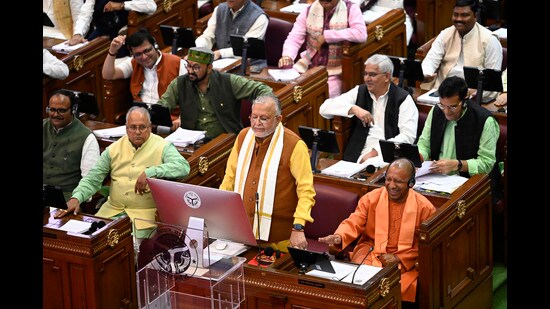
LUCKNOW: Amidst chants of Jai Shree Ram, finance minister Suresh Khanna began his Budget speech on an emphatic note projecting the gross state domestic product (GSDP) to grow by 19% in 2023-2024 as compared to a 16.8% growth in 2021-2022. In nominal terms, the GSDP for FY 2023-2024 is estimated to be ₹24.39 lakh crore.
This time, the size of U.P. Budget expanded to ₹6.9 lakh crore ( ₹6,90,242.43 crore), up from ₹6.15 lakh crore in the last fiscal. Following the tabling of the Budget, chief minister Yogi Adityanath said that the state government, as per Budget announcements, will spend ₹64,000 crore to fulfill 110 of the 130 poll promises made by the BJP.
Like previous Budgets, the second Budget of the Yogi Adityanath 2.0 government also sticks to its voter-approved formula of infrastructural push and social welfarism -- the two defining pillars of the last six of the Uttar Pradesh government. Of the total ₹6.9 lakh crore, ₹32,721 crore has been reserved for new schemes focusing on infrastructure, youths, women, and farmers.
Delivering on the party’s poll promise, Khanna announced a 100% discount on power for farmers using private tubewells. The announcement is in line with BJP’s Lok Kalyan Sankalp Patra. “In 2022-23, private tubewell consumers were given a 50% discount. The same has been increased to 100% in 2023-24. A sum of ₹1,500 crore has been earmarked for the purpose,” he added.
In a relief to state residents, no new taxes were proposed in the Budget. Also, allocations were increased for state-run schemes. A sum of ₹3,000 crore has been earmarked for CM’s Urban Expansion Scheme. A sum of ₹2,500 has been allocated for Maha Kumbh Mela 2025, Prayagraj, while ₹100 has been provisioned for Kanha Gaushala Scheme for stray animals.
Funds have also been earmarked for startups, the distribution of tablets and smartphones, and setting up of digital libraries, and the expansion of e-governance in villages. An allocation of ₹300 crore was made to set up digital libraries and ₹4 crore was announced for the expansion of e-governance in villages. A sum of ₹3,600 crore will be kept aside for the distribution of tablets/smartphones to students. Another ₹100 crore will be given as seed funding to boost incubators.
Khanna also highlighted that the process to set up industrial clusters is underway along the Poorvanchal and Bundelkhand expressway projects. In this context, ₹235 crore has been allocated for the new Jhansi Link Expressway and Chitrakoot Link Expressway even as work on the 594-km Ganga Expressway from Meerut to Prayagraj is under progress with a proposed investment of ₹36,230 crore.
Similarly, ₹550 crore was allocated for the Bundelkhand Expressway and the Defence Corridor project. A provision of ₹200 crore has been earmarked to set up industrial clusters along the Gorakhpur Link Expressway. “The Yamuna Expressway Industrial Development Authority (YEIDA) is setting up International Film City on a 1,000-acre land with an investment of ₹10,000 crore,” said Khanna.
In his Budget speech, Khanna also cited the recently-held Global Investors’ Summit in Lucknow. The minister said, “As many as 19,000 intents of investment worth ₹33.50 lakh crore were inked during the summit. About 16% of this investment came for the renewable energy sector, 12% for electronics, 11% for industrial parks, 9% for the education sector, and 9% for the logistics sector as well.”
The finance minister also pointed out that 11 meetings of the G20 summit will be held in U.P. districts -- including Lucknow, Agra, Varanasi, and Greater Noida. These meetings, he said, would provide the state an opportunity to showcase infrastructure, cultural heritage, and U.P’s potential of development to the world.
Referring to the construction of the Ram temple in Ayodhya, Khanna told the House that the broadening of three approach roads and setting up of six parking places will be completed in two years. He also shared the allocations of metro projects -- Kanpur Metro ( ₹585 crore), Agra Metro ( ₹465 crore), Varanasi, Gorakhpur and other cities ( ₹100 crore), and Delhi-Ghaziabad-Meerut Regional Rapid Transit System ( ₹1,306 crore).
The finance minister also announced the establishment of five new universities -- Maa Vindhyavasini State University in the Vindhyachal Dham division, Maa Pateshwari Devi State University in the Devipatan division, another state university in the Moradabad division, Mahatma Buddha Agricultural and Technological University in Kushinagar, and National Law University in Prayagraj.
Despite a massive push to infrastructure, Khanna also promised that the state’s green cover would be increased from the current 9.23% to 15% by 2030. All along his speech, chief minister Yogi Adityanath, deputy CMs Keshav Prasad Maurya and Brajesh Pathak, and other ministers of the ruling party kept thumping their desks to praise every fiscal allocation.
Even as Khanna peppered the speech with poetic couplets, Opposition leaders were seen keenly jolting down all salient features of the Budget. On the day, leader of Opposition and Samajwadi Party chief Akhilesh Yadav and other MLAs of his party donned a black sherwani to protest police action against senior SP leader Azam Khan.
.


