
 E-Paper



Love, legends and Ayodhya’s Jagmag dharamshala
Amidst the whispers of Amaniganj, the Jagmag ‘dharmshala’ emerges as a living testament to a love story that transcends the shackles of pre-independence times.

 Prefer HTon Google


In the heart of Ayodhya, a town currently under the global spotlight ahead of the consecration ceremony for Ram Lalla on January 22, every corner echoes with fascinating tales.
Amidst the whispers of Amaniganj, the Jagmag ‘dharmshala’ for instance emerges as a living testament to a love story that transcends the shackles of pre-independence times.
While the Rampath witnesses a seamless flow of traffic, only a few pause to acknowledge the silent narratives embedded within the ‘dharamshala’ and the adjacent gurudwara. The dharamshala, having lost its plaque during the makeover, finds itself in the background, unlike the gurudwara at Amaniganj, formerly part of Faizabad and renamed Ayodhya in 2018.
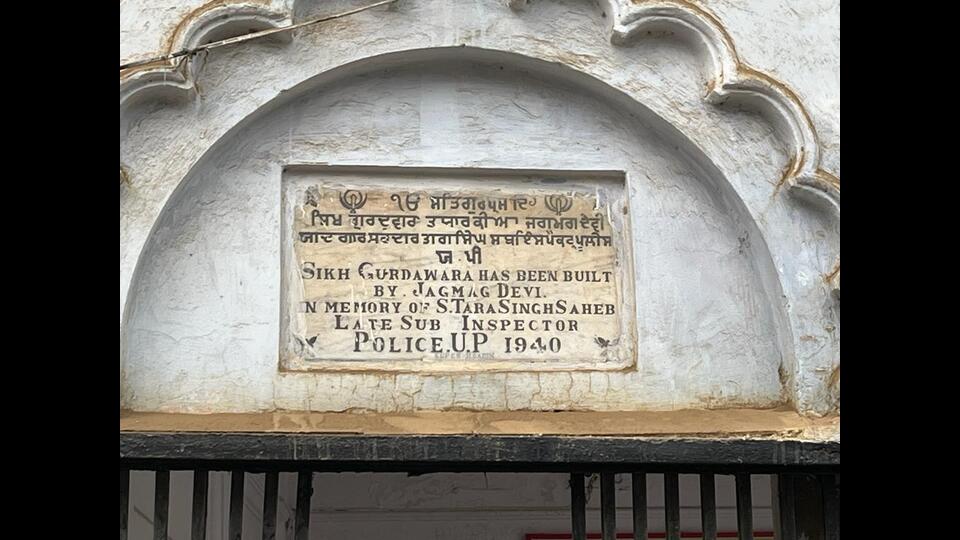
A plaque at the gurudwara captures attention, bearing the inscription, “Sikh Gurudawara has been built by Jagmag Devi in memory of S Tara Singh Saheb, late sub-inspector police, UP. 1940.” A natural inquiry arises: Who was Jagmag Devi?
According to Harendra Singh Kharbanda, an octogenarian retired Chemistry teacher and the treasurer of the Amaniganj gurudwara, “She was a courtesan of Faizabad who shared a profound connection with the then police inspector, Sardar Tara Singh Saheb. In his memory, she later undertook the construction of the Gurudwara, generously contributing the land behind it.” Kharbanda further reveals, “Jagmag not only facilitated the creation of the gurudwara but also generously donated the adjoining land.”
In contrast, the ‘dharamshala,’ partially dismantled by earthmovers, remains nearly empty and in legal disputes. A plaque stating its construction in 1933 succumbed to the renovation efforts on the Rampath, one of Ayodhya’s main corridors amidst its ongoing transformation. Arvind Kumar Arora, a 70-year-old retired bank employee residing opposite the dharamshala, shares the intimate details of the love story, that unfolded during pre-independence times and withstood the test of time and earthmovers. “This century-old tale of timeless love may be unfamiliar to many today, but a story that has endured for over a century carries a weight of authenticity,” Arora reminisces.
He continues, “Sardar Tara Singh ji commissioned the construction of the dharamshala for Jagmag, reciprocated by her building the gurudwara in his memory. We were privy to the lore of Sardar Tara Singh ji’s meticulous efforts to ensure the finest bricks were employed in constructing the dharamshala. Sadly, the unique bond between the cop and the courtesan has faded from public consciousness. Perhaps, we are the last of our generation to hold knowledge of this century-old affair.” As the town evolves, the tale stands as an enduring testament, telling us that Ayodhya’s essence resides not just in its grandeur today but in timeless stories etched deep within its soul.


