
 E-Paper



Nutritional tech to augment livestock production in focus at GADVASU in Ludhiana
The conference held at GADVASU, Ludhiana, was based on the theme ‘nutritional technologies to augment livestock, poultry, canine and fish production for global competitiveness’


Laying stress on ‘clean milk’ concept to prevent the transmission of zoonotic diseases, including tuberculosis (TB) and brucellosis, to humans, experts at Guru Angad Dev Veterinary and Animal Sciences University (GADVASU) discussed the issue of presence of mycotoxins in milk during the 19th International Biennial Conference of Animal Nutrition Society of India (ANSICON-2022) on Thursday.
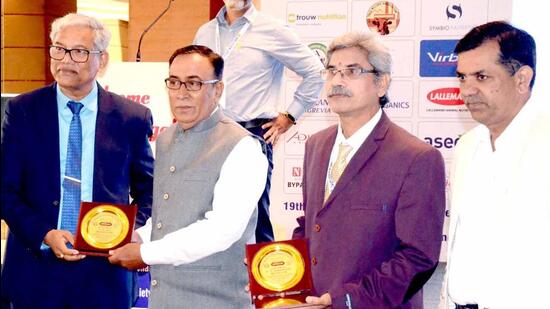
The conference was based on the theme ‘nutritional technologies to augment livestock, poultry, canine and fish production for global competitiveness’.
Stating that unpasteurized milk could prove to be a carrier of various zoonotic diseases, director extension, GADVASU, Parkash Singh Brar emphasised the importance of cleaning milk.
“Mycotoxin remains present in milk even after boiling and higher risk of mycotoxins, contaminating maize silage, could directly affect herd efficiency,” said Brar.
He recommended farmers to consult their nutritionist if they are concerned about mycotoxins in their silage and test their forage to assess the risk posed to livestock. He also suggested using proven bacterial inoculants to minimise the development of mycotoxins.
Experts discussed the right kind of livestock feed which not only enhances productivity but also mitigates the risk of bacterial transmission.
Vice-chancellor Dr Inderjeet Singh advised that progressive farmers with innovations in livestock feeding must be recognised. He emphasised that varieties of crops must be selected for feeding animals with new experiments related to quality of crops.
Udeybir Singh, president ANSI, said this society comprising 1,500 members is continuously working for professional development. He further highlighted that the department of animal nutrition at GADVASU is the first in the country to develop dog food.
Secretary, Animal Nutrition Society of India, APS Sethi, said a total of six technical sessions were conducted on the second day of the international conference in which a large number of scientists and students deliberated on various aspects of animal nutrition. He revealed that the outcomes of these technical sessions will prove to be handy in drafting future road maps in the sectoral domain of animal nutrition.
Organizing secretary of the international conference Parminder Singh informed that the general body meeting of the Animal Nutrition Society of India was also conducted on the second day of the conference which was attended by the office bearers and members of the society to address the concerns and decide the forthcoming policy and planning of the society.


