
 E-Paper



Pak delegation on Indus treaty leaves; says meeting a success
Pakistan had raised objections to the designs of Pakal Dul and Lower Kalnai hydropower projects in Jammu and Kashmir; India had said that the projects were fully compliant with the treaty. Arun Pal, Punjab Police’s protocol officer at the Attari border, said the delegation returned to Pakistan about 1.30pm


Amritsar A seven-member delegation of Pakistan’s Commission on Indus Waters Treaty (IWT), which had arrived in India on March 23 (Tuesday), for two-day talks returned to their country via the Attari-Wagah border on Thursday. The delegation held talks with the Indian team led by Indus Water Commissioner Pardeep Kumar Saxena in New Delhi, after two-and-a-half years, with the last meeting held at Lahore in August 2018.
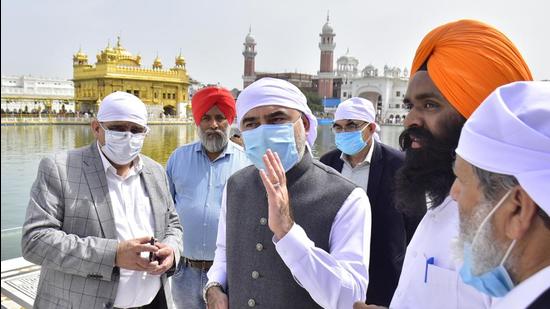
On Thursday, Pakistan’s Indus Water Commissioner Syed Mohammad Mehr Ali Shah paid obeisance at the Golden Temple in Amritsar before going back. Terming the two-day meeting of the Permanent Indus Commission, held in New Delhi on Tuesday and Wednesday, as a success, Shah said options for such bilateral meetings should always remain open.
Pakistan had raised objections to the designs of Pakal Dul and Lower Kalnai hydropower projects in Jammu and Kashmir; India had said that the projects were fully compliant with the treaty.
“Our meeting is proof of the implementation of the Indus Water treaty. The treaty is being implemented and our ways of communication are open,” Shah told reporters at the Golden Temple
He added, “We are trying to resolve issues and objections related to the treaty via bilateral talks. We hope that the dialogue related to the treaty will continue, and our potential problems will be solved.”
Arun Pal, Punjab Police’s protocol officer at the Attari border, said the delegation returned to Pakistan about 1.30pm.
The IWT, signed in 1960, mandates the two commissioners to meet at least once a year, alternately in India and Pakistan. Last year’s meeting to be held in New Delhi in March was cancelled, a first, in view of the coronavirus pandemic, and the impact of India’s decision to scrap Jammu and Kashmir’s special status in August 2019.
The IWT also stipulates that the water of the eastern rivers—Sutlej, Beas and Ravi—is allocated to India for unrestricted use. The waters of western rivers—Indus, Jhelum and Chenab—has been assigned largely to Pakistan.
As per the treaty, India has been given the right to generate hydroelectricity through run-of-the-river projects on western rivers, subject to specific criteria for design and operation. The treaty also gives rights to Pakistan to raise objections on the design of Indian hydroelectric projects on western rivers.


