
 E-Paper



Vishnu Deo Sai takes oath as Chhattisgarh CM; PM Modi, other BJP leaders attend
Sai is the first tribal chief minister of Chhattisgarh. Of the 29 reserved seats for scheduled tribes, the BJP won 17, up from the three it won in 2018

 Prefer HTon Google


Bharatiya Janata Party (BJP) leader Vishnu Deo Sai took the oath of office and secrecy as the chief minister of Chattisgarh on Wednesday in Raipur in the presence of Prime Minister Narendra Modi, Union home minister Amit Shah, other BJP leaders and chief ministers of BJP-ruled states.
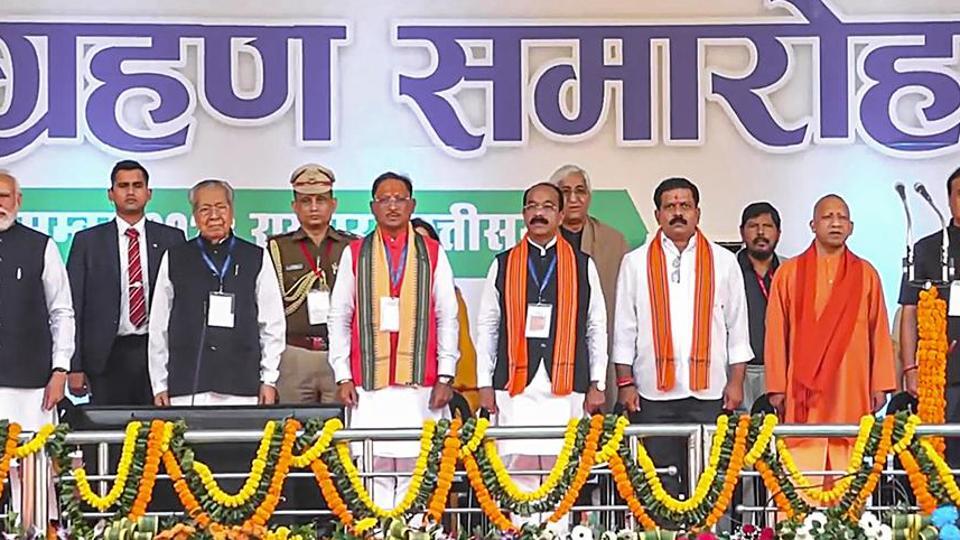
Along with Sai, Vijay Sharma and Arun Sao also took the oath of office as the deputy chief ministers of Chhattisgarh.
Sai (59) is a four-time Lok Sabha MP and three-time state BJP chief. Sai, who is a lawyer by profession, fought the assembly elections from the Lormi constituency.
He was elected as the BJP’s legislature party leader at a meeting of 54 newly-elected MLAs held at the party’s state headquarters here on Sunday.
During the election campaign, the BJP had promised to pay the pending paddy bonus worth Rs.4,200 crores to farmers by December 25 and to sanction 1.8 million units under the PM Housing Scheme.
In his first comments after his appointment, Sai said, “As chief minister, I will try to fulfil Modi’s guarantees (BJP’s pre-poll promises) through my government. Sanctioning 18 lakh (1.8 million) houses to beneficiaries of the housing scheme will be the first thing to be done.”
Sai is the first tribal chief minister of Chhattisgarh. Of the 29 reserved seats for scheduled tribes, the BJP won 17, up from the three it won in 2018. Tribals account for more than 30% of the state’s population, and Sai is from the Kanwar tribe, the second largest grouping after the Gonds.
Said had previously served as minister of state for steel, mines, labour and employment in the Modi-led cabinet during the 16th Lok Sabha between 2014 and 2019. After the Congress won Chhattisgarh in 2018, he led the party’s revival in the state and was appointed state president between 2018 and 2022.
Sharma, the first-time MLA from Kawardha, holds the post of general secretary in the state BJP. Sharma was also the state president of the party’s youth wing, Bharatiya Janta Yuva Morcha.
Known for his strong pro-Hindu image and oratory skills, Sharma defeated senior Congress leader Mohammad Akbar, who was also a cabinet minister in the Bhupesh cabinet.
After taking the oath, Sai is likely to hold a meeting with senior officials in the evening.
Earlier in the day, Sai performed customary rituals at the Jagannath temple and prayed for peace, progress and prosperity in Chhattisgarh, according to a statement issued by the state public relations department.
He also paid tributes to freedom fighter Shaheed Veer Narayan Singh and former Prime Minister Atal Bihari Vajpayee by garlanding their statues at different places in the state capital.
In the recently concluded assembly elections, while the BJP won 54 of the 90 seats, the Congress, which had won 68 seats in 2018, was reduced to 35 seats. The Gondwana Gantantra Party (GGP) managed to win one seat.
-kW0H-U20214218012MgB-250x250%40HT-Web.jpg)


