
 E-Paper



Visibility-cutting haze in Lko to continue for couple of days
Experts call phenomenon normal; moisture in air condenses into tiny droplets which settle on dust particles, creating haze

 Prefer HTon Google


A thick layer of haze (shallow fog) descended over many cities of Uttar Pradesh including Lucknow, Kanpur, Prayagraj, Pratapgarh, Varanasi, Mirzapur, Meerut and Agra on Tuesday morning that all but cut out the sun.
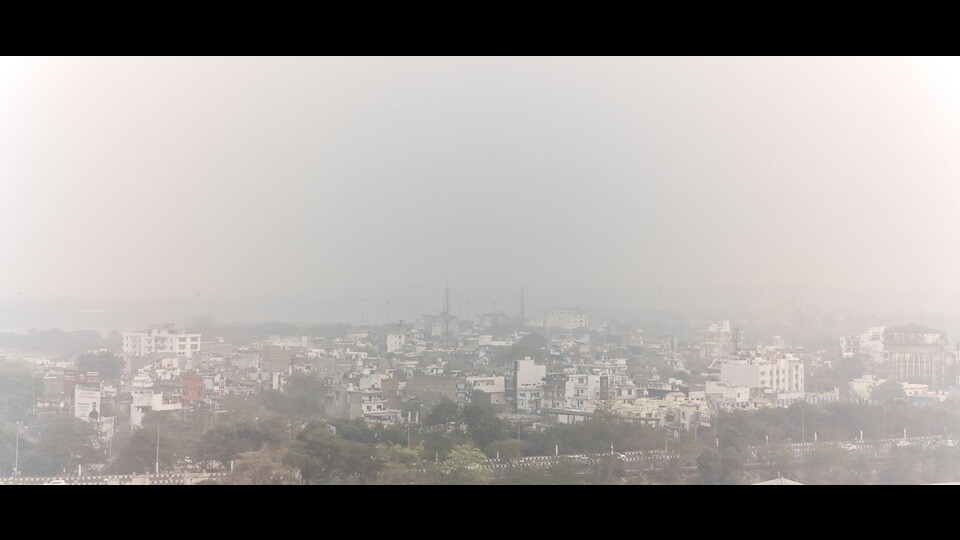
Due to the haze, visibility dropped significantly at many places. In Prayagraj, it dropped to 30 m, Meerut 100 m, Varanasi airport 500 m, the weatherman said.
A similar condition occurred in 2008 too.
“Due to the abundance of moisture carried by humid Easterly Winds, conditions of haze and mist gripped the state during the day,” said Manish R Ranlakar, director, Lucknow Met office here, on Tuesday.
He said that the haze will continue for the next two days.
“Temperatures are expected to remain largely unchanged over the next 4 to 5 days; consequently, the weather will remain extremely hot, though light rainfall is anticipated starting March 15,” the weatherman said.
Influenced by atmospheric stability over western and adjoining central India, temperatures across the region are running significantly above normal.
In Kanpur
Parts of Kanpur have continued to witness episodes of morning smog, a phenomenon meteorologists link to a combination of weather conditions.
According to Sunil Pandey, a weather scientist with CS Azad University of Agriculture and Technology, the sharp contrast between intense daytime heat and cooler nights creates conditions for radiation fog, where moisture in the air condenses into tiny droplets near the ground overnight. Calm winds allow the haze to linger, while dust and pollution particles in the air act as surfaces for moisture to settle on, making the fog appear thicker and smog-like in the early morning hours.
In Prayagraj and Pratapgarh
The haze was experienced by all, as is evidenced by social media posts and real-time images capturing barren trees vanishing into gray haze, sparking discussions on whether this is an intensified smog in an unseasonal month or a spell of flash fog.
In Meerut
Former head of the geography department at Meerut College and a meteorologist Dr Kanchan Singh, said the haze is a normal weather phenomenon often observed during the seasonal transition from winter to summer.
During this period, temperatures at the surface start rising while the upper atmosphere remains comparatively cooler. When humidity increases slightly, water vapour begins to accumulate around these particles, forming tiny suspended droplets. This process scatters sunlight and creates a hazy appearance in the sky.
In Agra
Although such a phenomenon of haze has not been widely reported in the city of Agra, those living along the Yamuna have witnessed this pattern for the past few days when visibility fell.
In Varanasi
Hazy conditions prevailed on the outskirts of Varanasi, Sonbhadra, Mirzapur and Ghazipur too. Since Tuesday morning, the weather has been hot and sultry. BHU geophysics and meteorologist Prof. Manoj Kumar Srivastava said, “Westerly Winds and moisture in the air in Eastern Uttar Pradesh and parts of Bihar sharing boundaries with the UP together created the hazy conditions in almost the entire eastern Uttar Pradesh, and its districts including Pilibhit, Lakhimpur-Khiri and Behraich in the Terai region.”
Bundelkhand region
Parts of Bundelkhand including Hamirpur, Orai, Banda and Mahoba witnessed hazy conditions on Tuesday morning which prevailed almost till 9.00 am.
Visibility was very low in these areas in the morning, ranging to a few meters. Scientists and environmentalists attribute the situation to rampant climatic change conditions.
Prof Amit Pal of department of environmental science, Bundelkhand University, says that over exploitation of human resources and excessive anthropogenic activities have resulted in variation of rainfall pattern which can be the cause of this unusual foggy weather.
“Moreover, this region has an excessive water evaporation rate and these evaporated particles may have stagnated on the tropospheric layer causing the fog”.
Aditya Singh, scientist, Agro Meteorology, also attributes the sudden occurrence of fog to the variation of temperature due to climate change. He further warned that due to predicted Western Disturbances, chances of thunderstorm and lightning, along with medium to high-speed wind velocity can occur by the third week of March and may stretch on till the first week of April. Though this can bring down the temperature giving respite to the people but may harm the standing crops.


