
 E-Paper



Wildbuzz | Owls! Phantoms of eerie hours
One should know their owls, if not by the scowls of the day then by their drawls in the dark; they are wondrous creatures whose real lives are not at all governed by the presumptions of superstition


As a child budding in a verdant Sector-7 bungalow in Chandigarh, I would awake to a haunting bird call in the eerie hours when the human spirit is at its lowest ebb. The call went as a single, mellow, interrogative note, ‘wuat?’, jerked out unhurriedly and monotonously every three seconds or so. The call’s acoustics startled the bungalow’s brooding atmosphere. I was versed enough with Nature’s ways to discern it was an owl’s vocalisation.
I searched for the owl in the trees the next day and my eyes picked a silent spotted owlet in just the second one I scanned, a fig tree. I presumed it was the phantom of the opera well past last midnight.
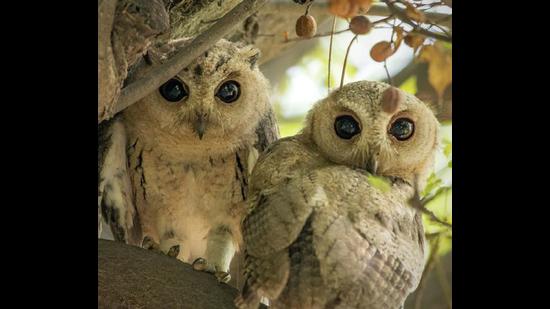
As luck would have it, the legendary birdman of India, Dr Salim Ali, was on a tour during summer 1982 and was staying with us. I went up to him and grandly announced I had heard an owl call, ‘wuat?’, had searched for “many exhausting hours” the next day in “every single tree” and pinpointed the spooky songster as the Spotted Owlet. Dr Ali was very patient and encouraging with children. Ever so gently he pricked my ballooning birding ego. He identified the species from my description of the call as the Punjab Collared Scops Owl, which is currently known as the Indian Scops Owl (ISO).
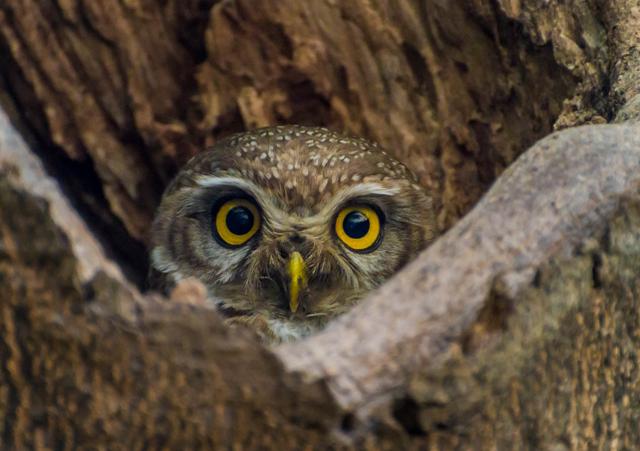
In Dr Ali’s words, the Spotted Owlet’s calls were very different: “A harsh, screechy ‘chirrur-chirurr-chirurr’ etc followed by or alternated with ‘cheewak, cheewak, cheewak’ and a variety of equally discordant screeches and chuckles.” As a child, I had heard the ‘chirrur’ calls umpteen times but since they were not spooky enough for a young mind mired in detective fiction and ghost thrillers, I had not stretched a limb to pinpoint the caller.
He went on to explain that there was every chance of both species perched close by but a keen and uninitiated eye noticing only the more conspicuous of the two, the head-bobbing Spotted Owlet. The ISO was a master in camouflage, remained frozen as a statue during the day and could hide in some obscure, dark nook of the foliage by taking the shape of a tree snag such as a decaying leaf.
Dr Ali prodded me to redouble my efforts and locate the perch of the ISO, the true ‘wuat?’ caller. Following his gentle rebuke, I was desperate to deliver an atonement to the globally-renowned birdman and then PM Indira Gandhi’s favourite conservationist. Much to my consternation, I was never able to find the wily ‘wuat?’ phantom. Despite the many honest hours I invested in neck craning and feverishly scanning leafy boughs as if they held out the promise of a furtive glimpse of misting limbs and appendages of a perching Bo Derek or Zeenat Aman.
I recalled the anecdote with a wry grin just a few days back on August 4, celebrated as International Owl Awareness Day. Nocturnal species such as owls and nightjars prove arduous to spot during the day due to their cryptic habits, plumages and enigmatic silences. At night, one may trod upon an irate serpent if one chooses to randomly poke the eye up the dark chambers of foliage looking for an owl. The saving grace is that owl lingo is more distinctive than the faces that subtly set them apart. The owl species is identified by keeping the ears peeled from dusk to dawn while knowing precisely which owl makes which particular call. The night listening enables us to assess the owl’s rough location and makes it easier to locate the perch the next day. In other words, an owl’s call is virtually its nightly face.
So, know your owls, if not by the scowls of the day then by their drawls in the dark. You will find they are wondrous creatures whose real lives are not at all governed by the presumptions of superstition. The ‘spooky’ call may well be just a doting ditty of courtship and love, in just the way owls are.
vjswild1@gmail.com


