
 E-Paper



Nitish Kumar’s era leaves a legacy that will be hard to match
For many in Bihar, Nitish Kumar was the CM who worked towards ensuring basic infrastructure like roads, bridges and electricity

 Prefer HTon Google


Nitish Kumar resigned as Bihar chief minister on Tuesday ahead of his beginning as a Rajya Sabha member, ticking one more box in a long political journey that he started as a student leader in 1974.
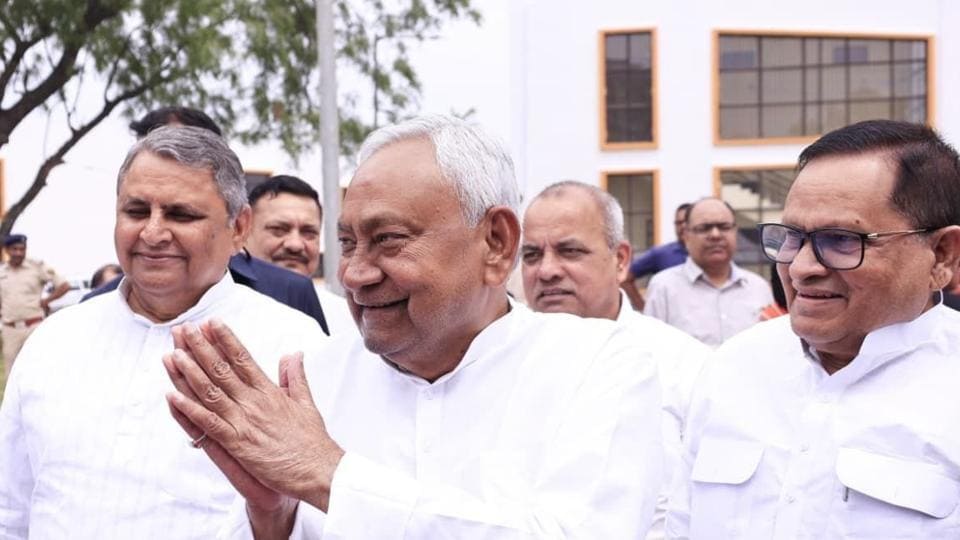
Over the years, Kumar exhibited sharp political acumen to emerge as the longest-serving Bihar CM, having taken oath a record 10 times. Kumar was the CM choice irrespective of who he chose to align with - a pattern set since 2013 when he first broke alliance with the BJP over announcement of Narendra Modi’s name as the prime ministerial candidate; by then, he had positioned himself as the primary choice to lead the Bihar government
“He was a true socialist from his student days and talked mostly of leaders like Ram Manohar Lohiya, Madhu Limaye and Jai Prakash Narayan. He was quite interested in politics,” said Nitish Kumar’s batchmate, Radhakant Prasad, former principal, Patna Science College.
Anjani Kumar Singh, director general of Bihar Museum, who was the chief secretary of Bihar till 2018 and later served as CM’s advisor, said that Nitish Kumar would be remembered as the man who understood the importance of women-led development and worked for it.
Nitish Kumar’s legacy
For many in Bihar, Kumar was the CM who worked towards ensuring basic infrastructure like roads, bridges and electricity.
“Soon after taking charge in 2005, he came up with a cycle scheme, which added wings to girls and today the result is gender parity at the secondary level in a state where they hardly moved out earlier. He backed it up with reservation to women in jobs to change the mindset and sow the seeds for women-led development right from the grassroots level. His vision and passion have been matchless,” said his long-time cabinet colleague Vijay Kumar Choudhary.
Role in politics
Indispensable to Bihar’s predominantly triangular electoral politics for any combination to form the government, Kumar is credited for the innovative 7-Resolves programme to make sure that Bihar’s priorities did not suffer due to political compulsions.
“His long-term vision can be understood by the fact that when he realised the growing pulls and pressures of politics, he came up with 7-Resolves in 2015, which remained a constant governance model till date irrespective of who aligned with him and when. That maintained a governance continuity,” said former director of AN Sinha Institute of Social Studies DM Diwakar.
Leaving on a high
As Kumar leaves state politics, his party, the JD-U, is on an electoral high. After the 2020 loss when his party was relegated to the lowest-ever tally of 43 seats in the Assembly election, he bounced back five years later in 2025 with JD-U winning 84 seats to help NDA achieve a landslide victory like in 2010.
The big mandate also raised a question: What next after Nitish Kumar?
“The way Nitish defied his age to slog constituency after constituency to reach where he wanted is an indication that he, perhaps, wanted to sign off on a high. And he did that when he wanted, as those who know him can understand that nobody can dictate any decision to him,” said a senior party leader.
Also Read: Bihar: Samrat Choudhary takes oath as CM, becomes first BJP leader at the helm
Despite talks about his failing health, Nitish Kumar remained pivotal to Bihar’s complex electoral arithmetic even in recent years. JD-U won 12 of the 16 seats it contested to equal the BJP in 2024, which fought one more, to emerge as a crucial ally for the NDA government at the Centre and ensure parity in seat distribution in the Assembly election 2025
Welfare & development politics
But then, it is not just his political acumen that kept him afloat despite the feeble presence of his caste (less than 3%) against the formidable combination of Muslim-Yadav for Lalu Prasad’s RJD. “Nitish worked with a plan and purpose - both politically as well as administratively. If women emerged as a big constituency favouring him despite the caste divide, it was a result of his government’s consistent plans and policies since 2005, which built trust in a leader who delivered. He gave women the belief to Move out of the four walls and be economically self-reliant,” said social analyst NK Choudhary.
7-day wonder to political constant
In his first stint as the CM, Nitish lasted just for seven days as he could not manage the seven votes required to pass the trust vote on the floor of the assembly. It was the second failed attempt after 2000, when RJD Lalu Prasad thwarted his CM’s ambitions, though Nitish’s then party, Samata Party, enjoyed the Vajpayee government’s support. Prasad ensured his wife Rabri Devi would occupy 1 Anne Marg, the Bihar CM’s official residence.
The first stint of the Nitish-led NDA government from 2005-10 came in the backdrop of Bihar’s pitiable state marked by decrepit roads, long power cuts in Patna, erratic power supply in much of the state, lawlessness, absence of basic infrastructure and a meagre annual budget of just ₹21000-crore.
In the first term he worked on the basics and the result was the biggest ever landslide for the NDA in 2010, and it continued till 2013, when he left the NDA for the first time. After that he kept changing sides until January 2024, when he returned to the NDA fold, vowing never to ‘flip flop’ again.


Stay updated Bihar Lok Sabha Result and with all the Breaking News and Latest News from Bengaluru. Click here for comprehensive coverage of top cities including Delhi, Mumbai, Hyderabad, and more across India . Stay informed on the latest happenings in World News.


