
 E-Paper



API-AFMS Chapter launched at AFMC by minister Jitendra Singh
A memorandum of understanding (MOU) was also signed on Tuesday between the Department of Biotechnology, Ministry of Science and Technology, and Armed Forces Medical Services (AFMS)

 Prefer HTon Google


As part of the year-long platinum jubilee celebrations of the Armed Forces Medical College (AFMC), Jitendra Singh, minister of state (independent charge) for the Ministry of Science and Technology and minister of state for the Prime Minister’s Office (PMO) launched the Association of Physicians of India (API) chapter of AFMC, Pune, and also inaugurated the first annual conference of API-AFMS Continuing Medical Education (CME) on “emerging trends in the practice of medicine”.
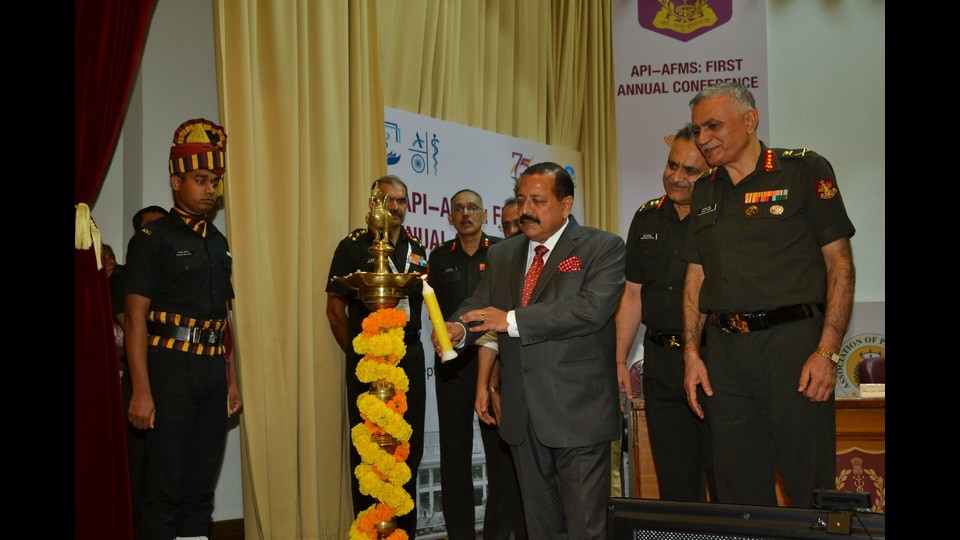
A memorandum of understanding (MOU) was also signed on Tuesday between the Department of Biotechnology, Ministry of Science and Technology, and Armed Forces Medical Services (AFMS) to build research collaborations and promote scientific cooperation.
Describing AFMC, Pune, as the first Central institute of medical education established much before AIIMS, Delhi, came into being, Singh said the idea of a separate AFMC came from Dr. BC Roy, credited with nurturing the API.
“As a common legacy, the coming together of API and AFMC also has a historical value and marks a befitting tribute to the first-generation physician, Dr. BC Roy,” he said.
Singh said the age of working in silos is over and the Narendra Modi government worked to integrate different organs of the government, including ministries and departments with various associations, institutes of higher and specialized learning and the industry, particularly in the healthcare sector.
“Preventive healthcare and widespread mass screening will help India attain the status of a developed economy. The whole world recognized India’s leadership role during COVID-19, as it achieved the rare feat of delivering over 220 crore vaccinations through a fully digital platform (COWIN), and the process continues.
Singh said there has been a transition over the entire disease spectrum as well as the evolution of therapeutic and preventive modalities available to us over the last half a century or so.
“After the 80s, there was globalization or the so-called ‘democratization’ of diseases, so we also started having the lifestyle diseases, coronary diseases, etc. and coupled with that also the change in life expectancy,” he said, pointing out that the life expectancy has gone up close to 70 years of age.
Singh further said the MoU will help in pioneering new research in areas like genomics, which have a bearing on lifestyle Diseases and emerging diseases.
“Biotechnology will be the key to Amritkaal economy and also for making India a frontline nation in the world. The biotechnology sector has seen rapid growth in the last 9 years and India is now being rated among the top 12 biotechnology destinations in the world.”


