
 E-Paper



BORI expo leaves Punekars proud of Indian heritage
Among the major attractions at the exposition were a Sharada script copy of the Rigveda, critical editions of the Mahabharata, manuscripts of the Atharvaveda and Bhagavata Purana, and several ancient printed works.

 Prefer HTon Google


PUNE: The three-day exhibition at the Bhandarkar Oriental Research Institute (BORI) concluded on February 23 with an overwhelming response, as students, scholars, families, and history enthusiasts thronged the campus to see rare manuscripts and archival treasures preserved for over a century. The exhibition left visitors with a renewed sense of pride in India’s civilisational depth, and the enduring efforts of institutions like BORI to study and protect the country’s vast knowledge tradition.
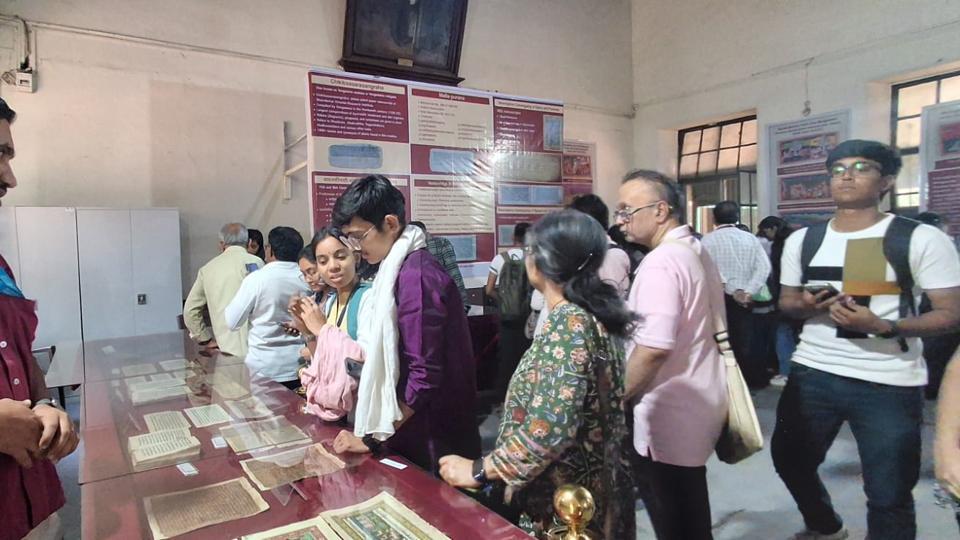
Among the major attractions at the exposition were a Sharada script copy of the Rigveda, critical editions of the Mahabharata, manuscripts of the Atharvaveda and Bhagavata Purana, and several ancient printed works.
Among the distinguished manuscripts on display were the Vāstuvidyā-Tīkā (53rd adhyaya) from the celebrated Bṛhatsaṃhitā, carefully preserved in the Devanagari script; Vīrabāhura Vadha written in the Bengali script with folios bearing visible traces of orpiment application – a traditional preservation technique using mineral pigment; Chikitsā Saṅgraha, regarded as the oldest surviving paper manuscript in Maharashtra within the institute’s collection; and Citrakāvyabandhodaya, an Odiya-language manuscript inscribed on palm leaves.
Also on display were Līlāvatī and Viṭṭhala Sahasranāma Stotra; a rare Prakrit manuscript of the Paryuṣaṇa Kalpasūtra dated 1515 Vikrama Samvat (1458 CE); a manuscript of the Bhagavadgītā Pancharatna, received from D V Dakshindas; the Ayodhya Mahatmya, notably referenced in submissions before the Supreme Court of India; and a Persian translation of the Bhāgavata Purāṇa, illustrating the intellectual exchange that flourished between Sanskrit and Persian traditions in medieval India.
Fourteen thematic stalls showcased the institute’s extensive research initiatives, including its globally renowned critical edition of the Mahabharata, long-running lexicographical projects, and its growing portfolio of digital archives and online academic courses.
Curator and registrar of BORI, Shreenand Bapat, explained that the first gallery was dedicated to the manuscript tradition, displaying rare texts such as the Rigveda, Panchatantra, Bhagavad Gita, and Dhvanyāloka that have entered UNESCO’s ‘Memory of the World’ register. Visitors also viewed a manuscript of the Nāṭyaśāstra, illustrated folios, historical maps, and scholarly charts.
A live demonstration area allowed visitors to observe the winding and unwinding of manuscripts, while a conservation section showcased preservation techniques, some of which visitors could experience hands on.
A notable artifact, the 1955 typewriter used by Vishnu Mahadev Atre, drew crowds eager to witness a tool that once served eminent literary and academic pursuits. Among the displays illustrating recreation in ancient times was Tabulphala, a traditional dice-based board game from Goa dating back to the 19th-20th centuries CE.
Dedicated stalls highlighted ancient Indian mathematics, ongoing research under the academic development programme supported by the Infosys Foundation, and major projects including the Bhagavata Purana research project, Atharvaveda research project, and study of inscriptions of the Kadamba dynasty. A separate exhibit detailed the digital restoration of the Ellora sculptures.
Elaborating on the scale and vision behind the exhibition, Bapat said, “The Bhandarkar Institute has been working since 1917. It has completed 108 years and today houses around 28,000 manuscripts and nearly 160,000 books including the critical edition of the Mahabharata and history of Dharmashastra. Through the Infosys Foundation grant, we have undertaken several major research projects and published more than 40 books in the past three years alone. This exhibition is a comprehensive presentation of all our activities.”
Bhupal Patwardhan, chairman of the executive board of BORI, emphasised that the primary purpose of the exhibition was to answer a long-standing public question as to what exactly does BORI do?
“For 108 years, Bhandarkar has been working in the cultural and scholarly domain. But many people, even those living nearby, did not fully know what work happens here. Our basic aim was to bring our activities before the general public. We received an extraordinary response,” said Patwardhan.
With more than 20,000 visitors attending across three days of the exhibition, Patwardhan said that what is particularly heartening is that the younger generation is more interested in this. “They are deeply curious, asking numerous questions to our scholars. They want to understand their culture and identity. That is the true success of this exhibition,” he said.
As the exhibition drew to a close Monday evening, it became evident that it was not merely a display of manuscripts, but a reaffirmation of Pune’s enduring connection to classical scholarship. By opening its archives to the public, BORI successfully bridged the gap between rigorous academic research and popular cultural consciousness marking a significant milestone in its 108-year journey.


