
 E-Paper



BRTS found contributing to traffic congestion in many parts of city
In July this year, traffic police identified 32 roads across the city that are facing severe traffic congestion after which they held discussions with the PMC to design a strategic traffic decongestion plan


Traffic police have found that the Bus Rapid Transit System (BRTS) is contributing to traffic congestion in many parts of the city, and have suggested that the Pune Municipal Corporation (PMC) should either make the BRTS fully functional on wider roads or remove the mixed-lane BRTS which is complicating the overall traffic management system.
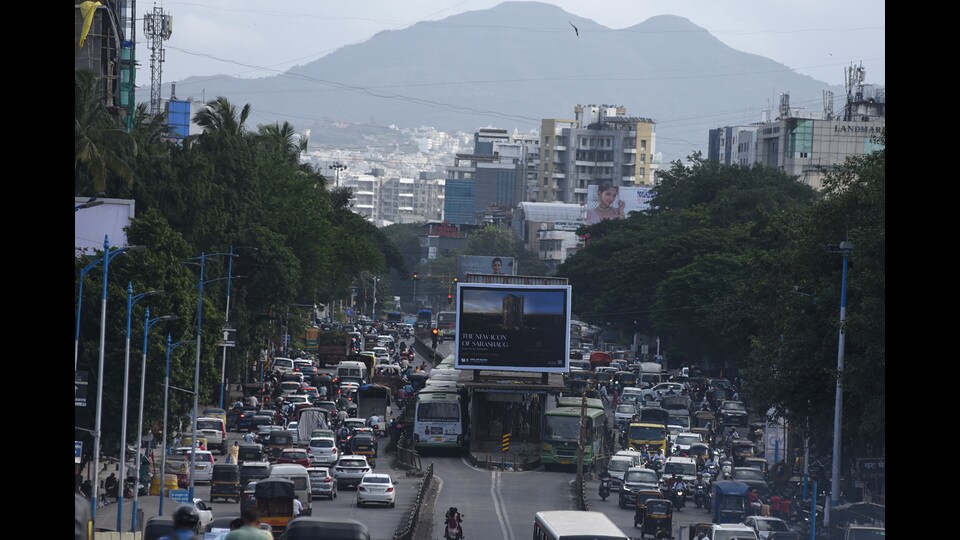
In July this year, traffic police identified 32 roads across the city that are facing severe traffic congestion after which they held discussions with the PMC to design a strategic traffic decongestion plan. A key aspect of this plan was reevaluating the future of the BRTS system in Pune. The removal of certain stretches of BRTS such as the 400-metre stretch near Kirloskar Bridge and parts of the BRTS on Viman Nagar Road has already shown positive results. Decisions about whether or not to retain the BRTS system beyond Viman Nagar Chowk on Nagar Road are still pending.
Additional police commissioner Manoj Patil offered further insights into traffic improvement initiatives. He said that work is currently underway at Nagar Road, Solapur Road, and in the Koregaon Park area to reduce traffic bottlenecks and ensure smooth travel. At Golibar Maidan and Fatima Nagar, traffic signals have been closed to reduce unnecessary stopping. Additionally, the remnants of BRTS infrastructure at Kirloskar Bridge and Ravi Darshan have been removed to eliminate traffic bottlenecks. The PMC has also begun work on Kalubai Chowk and Ramtekdi Chowk to further improve traffic flow, and these changes have already resulted in faster travel on Solapur Road.
For other important roads like Viman Nagar and Shastri Nagar Bridge, work is set to begin soon which will improve traffic movement in these areas as well. At Viman Nagar Chowk, the BRTS infrastructure has been removed and introduction of a rotary traffic system is on the cards to ease congestion.
On North Main Road, the corner bridge at lane 7 has been widened to accommodate more traffic and the PMC is working on widening the road from ABC Farm to Tadi Gutta. The widening is expected to be completed in about a month-and-a-half after which traffic flow should improve, Patil said.
Patil emphasised that while the BRTS system can be beneficial for public transport, it works best when implemented as a continuous corridor on roads that are wide enough— ideally around 35 to 40 metre wide. This ensures that there is enough space for both the BRTS lanes and other vehicle lanes. When BRTS is implemented on short, disconnected stretches, it can add to the traffic congestion rather than reducing it as traffic flow is interrupted by narrow lanes and mixed traffic.
The PMC has also identified 30 junctions across the city that need improvement, and design work has already been initiated for nine major corridors. While some of these junction upgrades have already been completed, many others are still in progress and will take additional time to finalise.
Aniruddha Pawaskar, chief superintendent engineer at PMC, confirmed that the traffic police have recommended removing certain stretches of the BRTS to improve traffic flow. Following their advice, BRTS has already been removed from Nagar Road and Solapur Road, and these areas are now seeing smoother traffic movement. However, Pawaskar clarified that removing BRTS across the entire city is not feasible.


