
 E-Paper



Civic Sanskriti: Pune municipal polls must reflect civic reality
Pune municipal region may need 3,600 public buses in the next 10 years. Currently, only 1,400 are operational and urban civic areas already need 2,500 buses


With elections coming up, the public should express what they want the future government to do. Hopefully, we will be over the worst of the health crisis of Covid-19 by the end of 2021 and can look forward to resuming work and education.
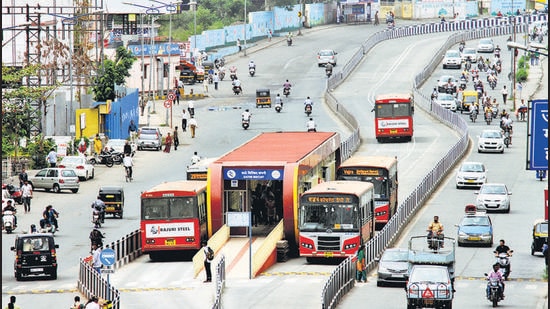
Safe transport is a crucial service we would want the city government to focus on. A basic expectation is that going anywhere in the city should be easy, safe, and affordable. Since the transport sector is a major pollution source in Pune, it is equally essential to reduce the number of private vehicles on road. Strengthening bus-based public transport is among the most critical needs in Pune currently, for providing mobility for all and reducing vehicular pollution.
People living in the Pune municipal area used to make roughly six million trips daily going to school, college, or workplaces, for domestic chores, or for leisure or social needs, prior to the pandemic situation. Only about 17% of these trips used public transport.
The share of public transport must rise to at least 40% in the next four to five years and facilities for walking and cycling improved alongside.
Though many Punekars and perhaps politicians feel that the Metro will meet public transport demand, in fact, in most big cities which have a substantial metro network, such as London, New York and Singapore - the bus system often carries as many, if not more people. This is because buses are easier to access and convenient for medium-length trips, which is the bulk of the trips in Pune.
Pune’s Comprehensive Mobility Plan has projected that unless public transport is improved, congestion will rise dramatically. Peak-hour travel times would increase, and traffic would move at about 10km per hour along the major arterial roads. Air pollution would become much worse.
So how will the shift from private-transport to public-transport happen?
It can only happen with excellent public transport. We are fortunate to have PMPML as a publicly-owned city bus service. Now, PMPML must step up, and also receive PMC and PCMC support, to provide high-quality, easily accessible to all, affordable, high frequency bus services.
Good network, but strengthen the fleet
As per an ITDP study “People near Transit, Transit near People”, about 25% of the population will have access to rapid transit within 500 metres, considering that both metro and Rainbow BRT networks will be operational.
All the rest of us, who don’t live near the metro or Rainbow BRT would use the regular city bus services by PMPML. This is eminently possible since 96% of Pune and Pimpri-Chinchwad live within 500 metres of the extensive PMPML network. Bus connectivity is already pretty good.
However, according to Pranjali Deshpande, who authored the study, the frequency of the bus service needs to be greatly improved, as only 66% of people have a bus available every five minutes at a walking distance of 500 metres.
PMPML must increase the number of buses substantially, and strengthen routes and operations for more people to ride the bus.
PMPML’s new business plan suggests that fleet size would be 3,600 buses in the next 10 years. Considering the service area and population, the Pune urban region already needs 2,500 buses in service. Currently, only 1,400 are operational.
In fact, PMPML should aim for at least 5,000 buses over the next few years just for Pune and Pimpri-Chinchwad. The benchmark by the Ministry of Housing and Urban Affairs is 40-60 buses per 0.1 million people.
Bus Rapid Transit
When Rainbow Bus Rapid Transit was launched in 2015, it received a huge positive response from commuters with its high-quality services, dedicated bus lanes, covered bus shelters, bus arrival information, safe access to the bus, clear branding, and customer relations.
However, the city has so far operationalised only two corridors in Pune–Sangamwadi-Vishrantwadi and Yerwada-Wagholi – though funding was accessed for 60km of BRT.
Sujit Patwardhan, founder of Parisar, advises that PMPML and PMC need to renew the commitment to the Rainbow BRT and implement the network and maintain it well, and this should have been included in the business plan.
Finance
Both the Pune and Pimpri-Chinchwad municipal corporations should continue to support PMPML by providing it annual core funds, regularly and in time. They should also help raise additional revenue and create the necessary facilities of good bus shelters and for pedestrians and cyclists to access public transit services.
Though experts’ views differ on the exact strategies for strengthening the organisation and its operations, and the fleet size essential, PMPML’s new business plan is a step forward.
Will election manifestos support excellent bus-based public transport? They must if politicians care for the well-being of people and aim to improve air quality and climate action.
Sanskriti Menon is senior programme director, Centre for Environment Education. She writes on urban sustainability and participatory governance. Views are personal. She can be reached at civic.sanskriti@gmail.com


