
 E-Paper



Curtain Call: Storyteller Nipun Dharmadhikari tells us how one actor played two characters simultaneously in a show
We were experimenting with time-travel in the play and wanted to create something that people had not seen on stage before. For that to happen, we were getting in touch with various people – magicians, engineers, technicians – and were thrashing out details and logistics, he says


When one actor played two characters simultaneously!
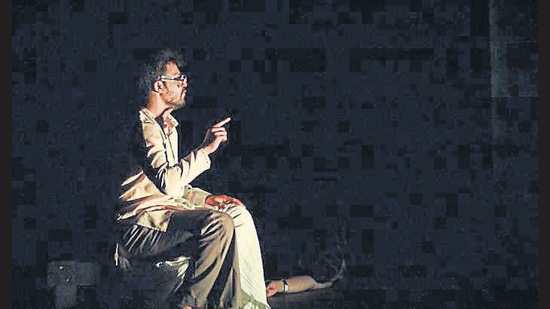
The date was set for the opening show of “Amar Photo Studio”. But I still had not resolved two issues within the play – there was one scene where two characters were supposed to be on stage but they were played by the same actor! And the second was that I needed to show a change in the era.
We were experimenting with time-travel in the play and wanted to create something that people had not seen on stage before. For that to happen, we were getting in touch with various people – magicians, engineers, technicians – and were thrashing out details and logistics.
So, to deal with the first problem about the two characters, we thought of multiple solutions. One thing that stuck with me was to project a pre-recorded video of one of the characters and the actor would interact with that video. I was sure that the give and take would have created an interesting scene. After discussing this with our set designer and a technical director, I became more and more convinced that this was the way forward. It was extremely complicated, but exciting nonetheless!
While we were prepping for it, I was reminded of the two plays in which I had used a projector earlier. One was a children’s play, which was also a fantasy. And the other was a sangeet natak in which we had used 3D renders to showcase grandeur of palaces, war scenes and the like. While it had worked mostly and was appreciated, I had experienced technical difficulties more than a few times.
I realised that I was heavily inspired by the visuals of plays I had seen abroad and desperately wanted to create something like that here. But I was yet to realise that the technical expertise and accuracy required for the results were possible there as plays run for months in a single theatre. In fact, they are also designed as per the theatre space. In India, we travel with our plays. Not to mention, we have to assemble the set, adjust lights, perform and then vacate the space in a matter of nearly four hours. Using such technology becomes very difficult. And the one time things go wrong, they tend to go very wrong!
I had used the projector in my earlier plays to create set elements. So, when something did go wrong, it disturbed the visual but did not hamper the performance of actors. What I was thinking of in this case was an interactive piece and I realized the kind of risk I was taking. One small glitch and it could hamper one of the most important scenes in the play. So, I decided to go back to basics and use the power of a performance instead.
The costume designer, Kalyani, came up with a half and half costume design. The actor, Suvrat, was wearing the costumes of one character on the left side and that of the other on the right. He played both characters at the same time. The light designer assigned two different coloured lights for each character. He switched the lights as per the character. Suvrat underlined the mannerisms and spoken quality of both characters beautifully, so that they could be differentiated by the audience, even though they would be seeing only one actor on stage.
We were worried if the audience would understand this. But I have learnt not to underestimate the intelligence of the audience. And such risks have to be taken! How else will we realise if these experiments will work or not? So, we decided to go ahead with this idea.
This scene became the highlight of the play, and rightly so! It was one of those pieces where all departments came together beautifully and celebrated the simplicity of storytelling in theatre!
But there was still one more huge problem left to be tackled – that of changing the era while a scene was being performed. It would have looked extremely shabby if the backstage artists came on stage while the scene was going on and changed the set. I still had nearly two weeks to come up with a solution. With this recent experience in hand, I changed my way of thinking and went back to my roots and tried to find simple solutions instead.
I will speak more elaborately about it next week...
Nipun Dharmadhikari is a storyteller and looks forward to telling them on stage, in front of the camera or in person.


