
 E-Paper



Excavation, concrete work weaken roots, triggering tree falls during heavy rains: Experts
Excavation for roads and utility lines often damages root systems, leaving trees structurally unstable even if they appear healthy for years.

 Prefer HTon Google


Pune: Experts blame excavation and concretisation from urban projects for weakening city trees following the tragic death of a flower vendor during recent rains. On April 2, Ranjana Navnath Giri died near the Navshya Maruti temple on Sinhagad Road after a tree in the vicinity got uprooted by strong winds and heavy rain. Two other persons suffered injuries and were rushed to a nearby hospital.
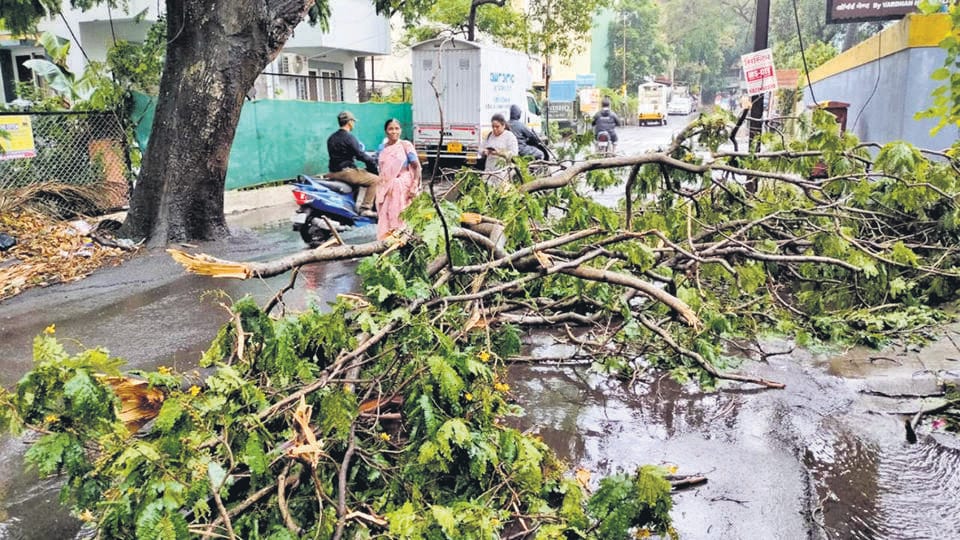
Excavation for roads and utility lines often damages root systems, leaving trees structurally unstable even if they appear healthy for years. Additionally, excessive concretisation around tree bases has worsened the problem. In many areas, asphalt and concrete are laid right up to the trunk, restricting root growth and reducing stability, they say.
Sachin Punekar, conservation biologist and founder-president of Biosphere, has raised serious concerns over the civic body’s ongoing infrastructure practices, stating that rampant cement concretisation of internal roads and open spaces has severely hampered natural water percolation. “Unscientific pruning of trees by both the administration and private entities has further weakened their structural balance, making them more vulnerable to collapse during heavy rains and strong winds,” he said.
He also highlighted that in several instances, trees were planted after road tarring and installation of paver blocks, which disrupts the natural soil cover around roots. This, he said, weakens the root system and makes trees susceptible to bacterial and fungal infections. To prevent tree falls, Punekar emphasised the importance of adequate soil exposure and the preservation of the root zone (rhizosphere) around trees.
“The majority of fallen trees belong to fast-growing exotic species, which are commonly planted by the Pune Municipal Corporation (PMC) and private developers to quickly boost green cover. However, these species are not suited to the local ecosystem, making them more prone to uprooting during adverse weather conditions,” he said.
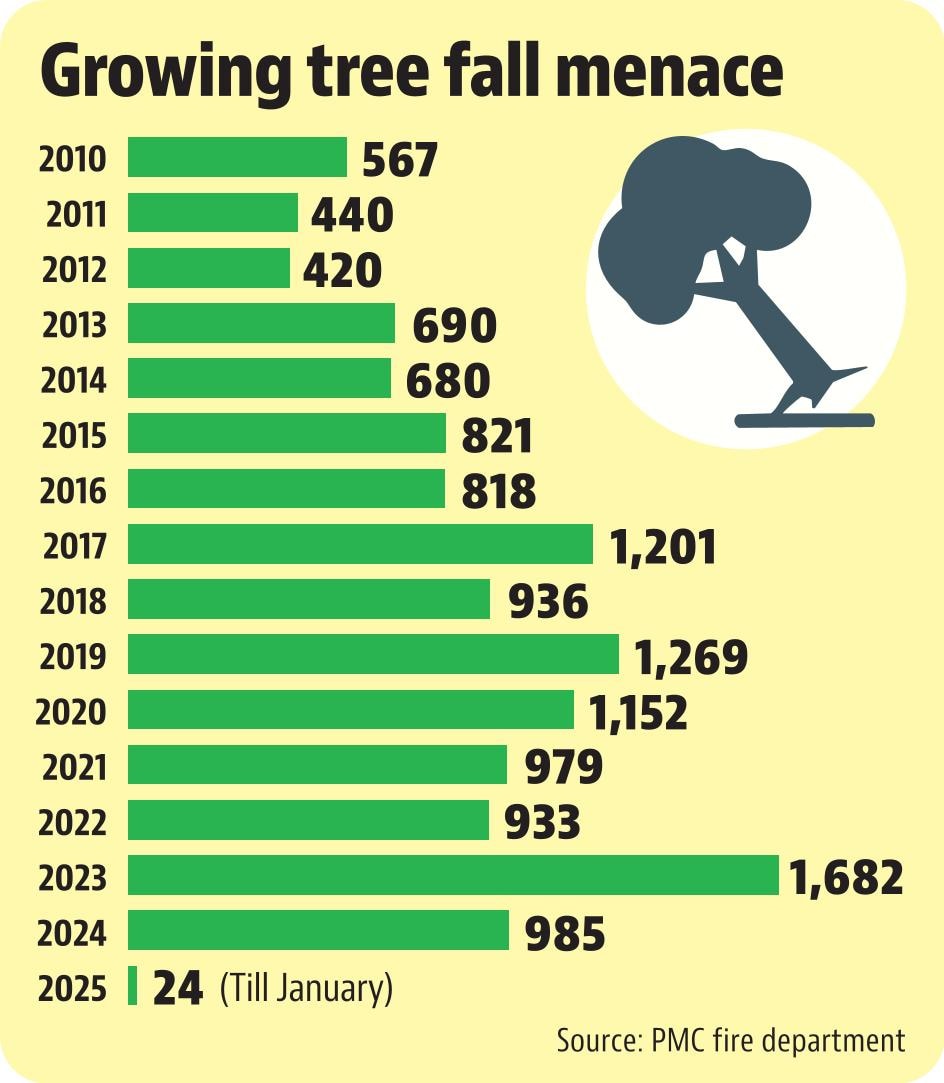
The data from the PMC fire department highlights the scale of the problem. Pune recorded 2,151 tree fall incidents between 2014 and 2025, with as many as 1,682 cases reported in 2024 alone. In the past week, heavy rains triggered nearly 190 tree-fall incidents across the city, including the fatal accident on Sinhagad Road.
PMC undertakes drive to prune trees
The Pune Municipal Corporation (PMC) has initiated a citywide survey and pruning drive to identify and tackle hazardous trees, officials said.
Civic officials admitted that despite earlier warnings and reports flagging the risk posed by weak and damaged trees, timely action had not been taken. Following the fatality, the administration has now mobilised teams to assess and mitigate the threat posed by unstable trees across the city.
Madhavrao Jagtap, deputy commissioner, PMC, said, “A comprehensive survey of hazardous trees has been launched. Dead and extremely dangerous trees are being removed, while those that are leaning or have excessive canopy are being pruned. Trees inclined towards roads are being secured with protective nets to reduce risk.”
Teams comprising garden department staff, including agricultural assistants and senior officials, along with ward-level officers, have been deployed for the exercise. Trees that are decayed, tilted or located close to power lines are being prioritised.
The civic body has also directed housing societies, as well as government and private establishments, to prune hazardous trees within their premises after obtaining necessary permissions. Ward offices have been authorised to grant approvals, and officials warned of action in case of non-compliance. Citizens have been urged to report dangerous trees to the garden department.
Officials said the drive is aimed at preventing loss of life and property during the ongoing spell of unseasonal rains and the upcoming monsoon season, when incidents of tree falls typically increase due to strong winds.


