
 E-Paper



Global Village Idiot: Secret Option Number 6, our answer to climate change
The past three years, Pune has mainly been grey and intermittently wet from June to January, unlike the previous 20-odd years. When I looked at the IPCC’s charts on possible future scenarios, it made immediate sense that India has a much wetter future in store in all of the scenarios.


So, what can we do about climate change? The answer is Secret Option Number 6.
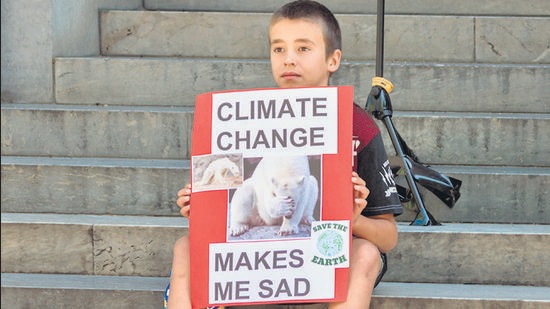
Let me explain.
A few weeks ago our youngest, Rex (7-years-old) designed his first Powerpoint presentation by himself. He had been assigned as the Space Reporter for his Grade’s assembly and given that space exploration is one of his interests, he researched his stuff, made points, create a 3-minute script and then decided to make a presentation - like a real news report on a YouTube channel. He was super pleased with himself. Till he found out that he had to print the pictures on paper and show them while he spoke online.
He took it in his stride, but one afternoon a few days later, he looked at me and said: “Paper is made from trees. And we cut lots of trees to make a few pages of paper. A computer presentation is better because it will save trees and that’s something we can do to help the environment. Should I ask her if I can just present instead of printing paper?”
This wasn’t the first time he had brought up using computer software instead of paper. Throughout the last couple of years he and his brothers have been vocal about typing instead of writing their homework, digital instead of printed.
Initially, I thought it was because they did not want to write by hand, since their handwriting is all over. Over a period of time, I realised they do write when they have to, but it’s not their preference because most of their work is digital.
That’s not why Rex brought up the paper versus digital thing. It’s because he remembered what he’s been learning in school, what teachers are saying in class about energy, renewable sources, how we as individuals can help, switching off electricity, saving energy and so on. And he remembered his mother telling him how paper was made from trees and how using less paper would help the environment.
Children follow adult behaviour. They don’t follow adult sermons (what we say), but our actions (what we do). Educators and parents and adults in general should realise this, understand this, know this, and remember this. Children also think much more and in a much wider random pattern than adults. They make many more connections than we do. Educators and parents should remember this as well. As I am learning to remember. I realised he was expecting an answer and that my answer would go into his repository of decision-making info.
“Why don’t you talk to the teacher and explain your viewpoint?”
He thought about it and said, “I will write an email to her.” That was last week. He’s still in dialogue with his teacher and we will see how it goes.
Meanwhile, he keeps track of what I am watching and reading and asks questions whenever it’s something to do with his interest. The past few weeks it’s been mostly weather and climate and the recent report from the Intergovernmental Panel on Climate Change (IPCC). I am pretty much seasonal, having no convictions of my own on matters I don’t understand, but I read and read, and think and think. The report is voluminous and interesting and I guess also alarming, since governments and media and writers are in focus. Am hoping the focus won’t fade in a few months, because I don’t need an IPCC report to tell me the weather is changing.
The past three years, Pune has mainly been grey and intermittently wet from June to January, unlike the previous 20-odd years. When I looked at the IPCC’s charts on possible future scenarios, it made immediate sense that India has a much wetter future in store in all of the scenarios.
Obviously, there’s a lot that urban individuals and societies can do as their bit. Change lifestyle, change consumption patterns, reduce emissions, ask for accountable actions from government bodies, ask for responsible green products from industry and so on. But my observation is that urban educated city-societies are opting for Secret Option Number 6: educate our children to change their ways so that they can reverse the damage that we and our previous generations have done to the climate with our insatiable greed and actions on account of that greed.
Which is why every school and its teachers, and climate activists and government bodies, are now droning on about climate and climate change and asking little clueless Grade 1, 2, 3, students to learn about consequences of their actions.
It would help if all such evangelists also state what they are doing individually to change their habits. I am not a Bill Gates fan, but it’s more compelling to move to action on his evangelism since he clearly states how much he is adding to carbon emissions (individual and family), and how he’s changing and contributing to a healthier environment (his companies’ contribution is different).
Meanwhile society (adult) is innovating and buying and selling and producing and cutting forests and dumping waste and setting up new industries and tagging everything “green” without the due diligence to know if it is actually green and sustainable. And pledging millions and billions of dollars to zero carbon, carbon neutral, go green till they are blue in the face. And then, printing paper and asking children to hand-write on reams of notebooks and print their homework on paper…


