
 E-Paper



How political heat is reshaping Maharashtra’s response to wildlife conflict
Increasing demands from elected representatives facing growing public anger have led authorities to take quick decisions to handle human-animal conflicts


Pune: A string of recent leopard attacks across Pune, Nashik and Ahilyanagar has prompted the Maharashtra forest department to give permission to sharpshooters to kill two big cats and place a third under a shoot-at-sight order besides holding urgent meetings and taking multiple steps.

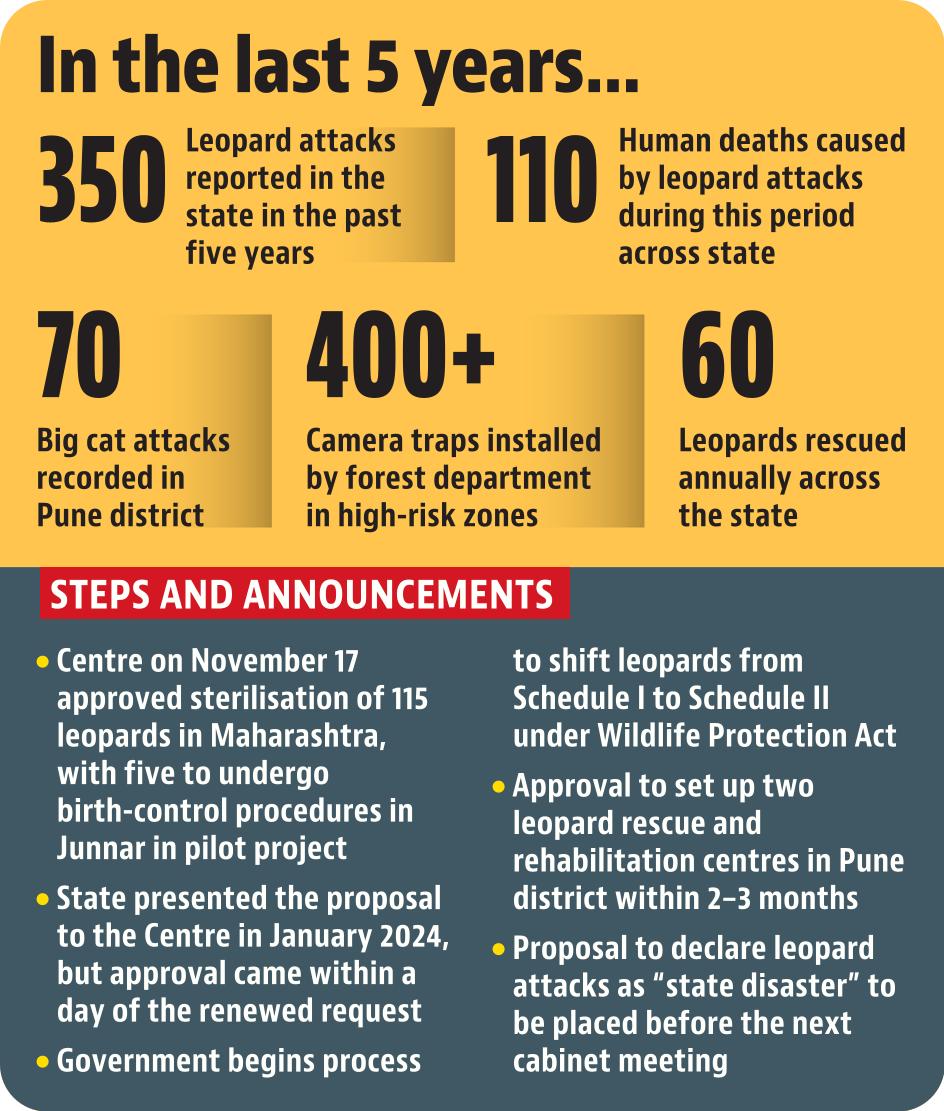
The Centre too responded faster than expected, granting approval on Monday for the sterilisation of 115 leopards, beginning with a pilot to administer birth control to five animals in the Junnar division. While the state had approached the central government with the request in January 2024, the okay came only when pressure over human-animal conflict peaked ahead of local body polls.
Dubbed as mini assembly elections, municipal councils, zilla parishad and municipal corporations will go to polls in December and January.
With less than a fortnight to go for the first round of polls, chief minister Devendra Fadnavis at a special meeting in Mumbai on Tuesday instructed that a proposal to declare leopard attacks on humans as a “state disaster” be placed before the next cabinet meeting. He directed officials to submit a proposal to remove leopards from Schedule I of the Wildlife Protection Act and include them under Schedule II that attracts a lower degree of protection with reduced legal consequences.
Shirur MP Amol Kolhe, who was not invited for the Tuesday meeting, posted on X later in the day, “Since I have not been invited for this crucial meeting, I am placing here my demands to address the problem.”
Political pressure
The pace of these decisions, many of which would usually take months, reflects increasing demands from elected representatives who are fielding growing public anger. MLAs, ministers and local political leaders are insisting on quick, visible action, and the department appears to be moving accordingly.
Forest minister Ganesh Naik recently acknowledged the pressure in a public address, saying that leaders are demanding “strict and immediate action” after each attack. He directed authorities to kill leopards showing “aggressive behaviour”, marking a significant shift in the tone of official instructions. Conservationists and several former forest officers said the pressure is changing the response of frontline staff to conflict situations with political urgency overtaking slower, science-based decision-making.
The shift is rooted in the political fallout of recent elections. During the April 2024 Lok Sabha and November assembly polls, the ruling alliance faced serious backlash in the Shirur Lok Sabha seat and Junnar assembly constituency over the rise in leopard attacks. Shivajirao Adhalrao of NCP lost to Amol Kolhe from NCP (SP) in a high-pitched Lok Sabha battle where leopard attacks was a prominent campaign plank.
A senior forest department officer requesting anonymity said, “When such a conflict situation arises, forest officials face political pressure and have to handle the situation with utmost care.”
Aditya Paranjpe, honorary wildlife warden, Pune forest department, said, “The honorary wildlife warden plays a crucial role in managing wildlife conflict situations. As per protocol, the warden must be informed before any action is taken on the ground. While I contacted the chief conservator of forests and offered any assistance needed, I was neither included in the communication loop nor involved in the actual operation.”
Junnar and nearby tehsils are among the state’s most sensitive areas for conflict with the officials estimating the leopard population to be around 1,300. In the last five years, leopards have caused 21 human deaths and 52 injuries in the region, and villagers have reported losses of nearly 18,000 livestock. More than 236 villages are classified as leopard hotspots.
The numbers have created a major political challenge. Fear among rural communities is rising, farmers are demanding quick relief, and local leaders want immediate measures before the civic polls.
Green cover
The ecological factors behind the rise in conflict are long-standing. Maharashtra spans about 308,000 square kilometres and supports rich biodiversity, including around 85 mammal species and 460 bird species. Forest cover has increased over the years, rising from 16.5% in 2019 to 20.1% in 2023, according to the Indian State of Forest Report (ISFR). But much of the forest is spread in patches surrounded by expanding agriculture, highways, industrial zones and rapidly growing towns. These fragmented landscapes push leopards, elephants, wild boars and other species into human settlements more often.
For farmers, the economic toll is severe. A study by the Centre for Sustainable Development at Gokhale Institute Of Politics And Economics (GIPE) estimated annual losses from wildlife conflict in the state at ₹10,000 crore to ₹40,000 crore. Wild boars cause the highest crop losses, affecting more than 80% of impacted farmers. In the Konkan region, macaques and langurs dominate complaints. Nilgai and sambar cause major damage in Marathwada and Vidarbha. Leopards, gaur and smaller species create intense, localised losses that add to an already strained situation.
Political leaders across parties have taken public positions as the conflict has intensified. During a public address in Shirur on November 12, Minister Naik said leopard numbers in Junnar and Shirur tehsils had risen sharply and warned that, if trends continue, leopards could be seen “roaming the streets like stray dogs”. He said complaints had come from senior leaders, including Ahilyanagar guardian minister Radhakrishna Vikhe-Patil, whose grandchildren recently escaped a leopard attack. Naik said the matter was discussed in the state cabinet, where deputy chief ministers Eknath Shinde and Ajit Pawar urged him to intervene directly.
The heightened political interest has encouraged more leaders to raise their demands publicly. Amol Kolhe, MP from Shirur, has been one of the strongest voices on the issue. He joined villagers in a protest earlier this month, seeking immediate conflict mitigation and long-term solutions. As he was not invited to a high-level meeting held by Fadnavis to review the leopard situation, Kolhe issued a detailed statement arguing that the safety concerns of local residents cannot be ignored. He called for permission to tranquillise leopards near settlements, strengthen rescue equipment, and increase manpower on the basis of a study of leopard population and habitat.
The conflict is also affecting prominent individuals outside rural zones. On November 9, CCTV footage showed a leopard entering the Junnar home of NCP (SP) leader Satyashil Shirsat, despite a 9,000-watt electric fence around the property. Sugar factories in the region have also reported a rise in leopard sightings around their premises. In Nashik, guardian minister Girish Mahajan had a narrow escape on November 14 when a leopard attacked a forest guard standing close to him during a rescue operation in Vanvihar Colony. Such incidents have increased pressure on the administration for stronger, quicker responses.
The forest department’s pattern of decisions over the past two weeks shows how this pressure is playing out. It issued three elimination orders for leopards in 15 days — something that senior conservationists say is extremely rare. Sindhudurg officials submitted a proposal for the relocation of wild elephants, while Pune authorities have revived an older plan to shift about 50 leopards from Junnar. Officials say these moves are necessary to ensure public safety. Critics argue that these steps appear rushed, influenced by political urgency and may only shift the conflict to other regions.
Divided take
Experts, however, are divided. Some say a firm approach is needed in areas where animals are entering settlements frequently and where attacks have created fear. Others believe that the current situation reflects years of gaps in preparedness, including staff shortage, delays in compensation, limited rescue equipment and weak coordination across departments. Former conservators say these weaknesses allowed tensions to build until the issue reached its current point.
Madhav Gadgil, a veteran ecologist, said, “In Scandinavia, wildlife is considered a renewable commodity and they have implemented a wildlife management plan that includes a killing option. A similar approach should be implemented in India.”
Anuj Khare, member, State Wildlife Board, said, “Several measures should have been taken earlier to prevent the situation from escalating to this level. The department must adopt a scientific approach going forward to ensure sustainable management.”
Public anger has been visible throughout the state, with protests in several districts. Farmers and villagers are demanding quick compensation, secure livestock enclosures, and reliable rescue support. In districts where leopards and tigers cause repeated fatalities, these demands have become central during pre-election campaigning. As civic polls approach, wildlife conflict — once treated as a marginal issue — has become a major part of the political conversation, with leaders under pressure to show immediate results.
The coming weeks will show how the state balances public demand for safety with long-term conservation needs. The forest department now finds itself navigating decisions that must address immediate risks while also preventing the conflict from shifting or escalating. The steps followed after the recent approvals, relocations and elimination orders will determine how Maharashtra manages the issue in the run-up to elections and beyond.


