
 E-Paper



India’s pledge to sequester 2.5 to 3 GT CO2 in 15 years not a realistic target: Lele
ATREE fellow Sharachchandra Lele said India’s Intended Nationally Determined Contributions to sequester 2.5 to 3 Gigaton CO2 in fifteen years is not a realistic target


PUNE Through calculations related to the amount of net carbon dioxide (CO2) sequestered by native or fast-growing trees over the land available for afforestation, it can be concluded India’s Intended Nationally Determined Contributions (INDCs) to sequester 2.5 to 3 Gigaton CO2 in fifteen years is not a realistic target, said Sharachchandra Lele (aka Sharad Lele), a fellow in environmental policy and governance, Ashoka Trust for Research in Ecology (ATREE).
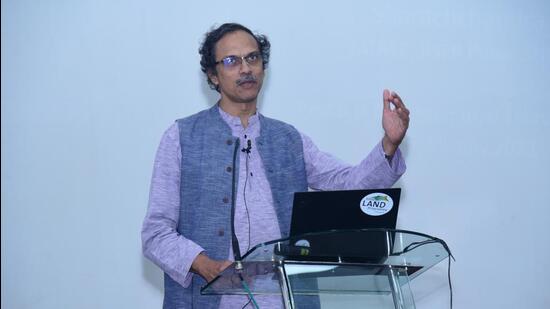
He was speaking during the 10th BD Tilak Memorial lecture titled ‘Forests and climate action in India: Science, social science and ethics’ at CSIR-NCL on Tuesday.
Carbon sequestration is the process of capturing and storing atmospheric carbon dioxide. It is one method of reducing the amount of carbon dioxide in the atmosphere to reduce global climate change.
Lele examined the role of Indian forests in sequestering carbon dioxide to reduce global warming, from the perspectives of natural sciences, social sciences and ethics.
“Through calculations related to the amount of net CO2 sequestered by native or fast-growing trees over the land available for afforestation, it is seen that meeting India’s Intended Nationally Determined Contributions (INDCs) to sequester 2.5 to 3 Gigaton CO2 in fifteen years is not a realistic target. Further, dedicating forests for the sequestration role involves trade-offs between diverse stakeholders in the context of the multiple roles that forests perform in a densely populated and historically forest-dependent society such as India,” said Lele.
He added that forests have an ecological role in biodiversity and watershed services; a social role in supporting local communities through non-timber products, fodder, and fuel wood; an economic role through timber; and now a climate action role through CO2 sequestration.
“Now the international community is seeking to find ‘nature-based carbon solutions’ through forest sequestration, which could again restrict the communities in and near the forests from entering, thus marginalizing their rights to forest services. A solution would be an ethical approach that enables the local communities to arrive at appropriate trade-offs through a process of democratic governance,” said Lele.


