
 E-Paper



More than 60% of landslides occurred at contact between bedrocks: Study
The study was carried out by ACWADAM with the support of the Maharashtra office of UNICEF and the state government’s disaster management authority


PUNE: More than 60% of the landslides in western Maharashtra occurred at the contact between two different units of Basalt lavas, revealed a study conducted by the Advanced Centre for Water Resources Development and Management (ACWADAM). According to the study, bedrocks are made up of alternating vesicular-amygdaloidal basalts (VAB) and compact basalts (CB) and removal or instability of the underlying VAB following intense rains caused failure of the overlying CB in most landslide cases.
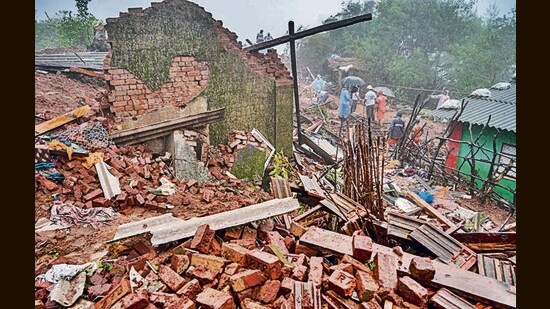
The study was carried out by ACWADAM with the support of the Maharashtra office of UNICEF and the state government’s disaster management authority. The assessment was carried out in six talukas across the Pune, Satara and Raigad districts of western Maharashtra and Konkan. At least 84 landslides from the Bhor and Velhe talukas of Pune district, Mahabaleshwar and Patan talukas of Satara district, and Mahad and Poladpur talukas of Raigad district were inventoried and studied in detail over a period of three months. Additionally, the ACWADAM also studied landslides in the Chiplun area of Ratnagiri district, which was also included in the report.
Most of these landslides were within an elevation range of 300 to 1,400 metre above mean sea level while a few - especially in the Mahad taluka, which is close to the coast - were at lower elevations. Several factors affecting the landslides such as rainfall, slopes, aspects, drainage, geology, hydrogeology, ecology, and engineering along with social aspects (especially during fieldwork on landslides which had affected habitations) were considered for the study.
The study revealed that the contribution of excessive rainfall (of July 2021) and consequent hydrostatic pressures that built up in the soil and weathered zone profiles of the landscape, even as overland flow continually acted as a means of surface drainage, were key factors in the inventoried landslides. The failure of slopes occurred dominantly at the contact between VAB and CB, with a secondary dominance of fractured rock failure.
According to the study, careful monitoring of parameters such as rainfall, subsurface water, springs and movement of the surface itself should be carried out as part of an early warning system. It is important to quickly set up infrastructure for an early warning system preferably in all habitations of each of the six talukas of the three districts, beginning with sample locations that can be identified based on clusters of habitations, with the possibility of collaborative efforts between GSI and ACWADAM. Sensitising local communities is also part of the precautionary measures.
Himanshu Kulkarni, Scientist Emeritus, ACWADAM, said, “The organisation mainly works on studying groundwater. However, when the demand came from villagers and NGOs working for landslide-affected areas, we undertook this study. The study is a helpful inventory to understand the complex scenario of landslides. We are hoping that the government will take strong steps in the coming days to set up the early warning system in the western Ghats.”


