
 E-Paper



Monday Musings: Looking back at 2022; Pune survived during Covid but stuck in traffic jam
It is customary to feel joyous at new beginnings, but that was not the case when 2022 began


It is customary to feel joyous at new beginnings, but that was not the case when 2022 began. The Covid pandemic had not ended. The daily caseload outdid previous waves even as infections were milder and fatalities negligible as the Omicron variant did not turn out to be as lethal as Delta. By the end of the first quarter, the wave subsided and the city returned to normal.
This was when people got the news that the city was waiting for over a decade. The Metro service finally commenced, albeit on a limited stretch in Pune and Pimpri-Chinchwad, promising to change how residents would commute. People now await Metro operations on extended stretches that should resolve Pune’s traffic mess, at least partially.
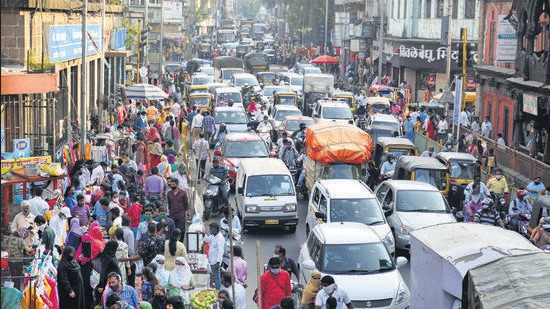
After all, traffic has been an issue which impacted people most in the past year. As life had come to normal after two years of Covid-19 induced curbs, people began stepping out for work, and recreation. Since the economy had returned to normal, many preferred to buy vehicles which further added to the chaos the city is grappling with for the past few months.
As per the latest data available, Pune Regional Transport Office (RTO) has registered 43.40 lakh vehicles under 17 different categories till September this year. The number of vehicles is now almost equal to the population of the city which as per the 2011 Census was 35 lakhs, with another 10 lakhs being added by the merger of 23 villages with the Pune Municipal Corporation (PMC).
With a large number of vehicles being added on streets that are not expanding in width, the result has been visible. To add to the problem, PMC has not been able to create any new roads mostly due to opposition to land acquisition or environmental concerns raised by activists and locals. Amid all this, people have complained their commuting time has doubled, or in some cases, tripled. The traffic has been a great equaliser though. It did not spare anyone --rich or poor, those residing on eastern parts of the western front, those in a position of power or being governed.
The traffic impacted chief minister Eknath Shinde as much as it did to Mercedes-Benz India’s CEO Martin Schwenk as they were stuck in traffic during Pune visit. It stayed largely throughout the year.
The easiest solution decision-makers have found to deal with this problem is building flyovers. As the column has previously argued, most flyovers operational in the city – barring a few - have often been a source of relief from traffic woes. However, the benefit is temporary for people, particularly those residing in suburbs. If bottlenecks at intersections have often led to traffic jams, flyovers constructed to decongest the city have merely shifted congestion from one point to another. The city with the neighbouring industrial town of Pimpri-Chinchwad currently has over 50 flyovers. They will have an addition of at least ten which are either under construction or proposed.
With 2023 less than a week away, among the things top of people’s minds in Pune include relief from perennial traffic jams. And for this, a quick yet long-term solution can be to strengthen the public transport body Pune Mahanagar Parivahan Mahamandal Limited. More buses on road with better frequency will reduce the number of private buses.
At the same time, allowing bike taxi aggregators can improve the situation. Even though the regional transport office recently rejected an application by one of the bike taxi aggregators, services such as this often help in providing last-mile connectivity at a cheaper price, which saves fuel too. The state transport department needs to design rules that will help bike taxis to operate which can end the monopoly of auto-rickshaw drivers, and encourage residents to board Metro rail or PMPML buses for longer distances.
The PMC has proposed a cycle track on both sides of the 20-kilometre canal between Khadakwasla and Hadapsar. If the civic body can complete the project – there is opposition from the water resource department, which controls the canal – it can turn out to be a game changer. People riding bicycles come to work if they are assured of reduced travel time and uninterrupted cycle track connectivity. Pune has already seen corporates encouraging employees to come to work on bicycles.
There is surely a way to reduce congestion beyond deploying cops on street to man the traffic. What is needed is ‘will’. The year 2023 may offer it to our decision-makers.


