
 E-Paper



Pune records ‘poor’ air quality, Shivajinagar ‘very poor’
The city air on Thursday plunged to ‘very poor’ as cyclonic winds loomed over it


The city air on Thursday plunged to ‘very poor’ as cyclonic winds loomed over it. Four monitoring stations recorded ‘poor’ air quality while Shivajinagar’s air quality deteriorated to ‘very poor’. Air quality index (AQI) levels in the range of 200 to 300 are considered ‘poor’ whereas those above 300 are considered ‘very poor’.
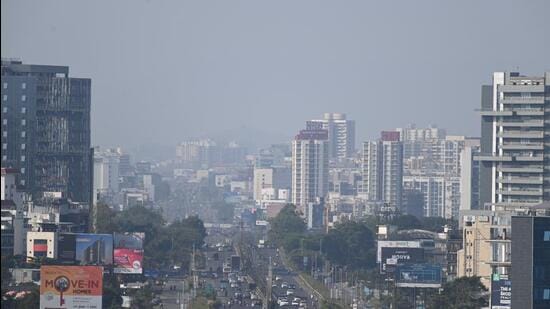
According to the System of Air Quality and Weather Forecasting And Research (SAFAR), the AQI in Pune was 204 micrograms per cubic metre of PM2.5 particles in the evening. Shivajinagar saw a higher concentration of particles at 322 micrograms per cubic metre of PM2.5; followed by Bhosari at 245 micrograms per cubic metre; Nigadi at 244 micrograms per cubic metre; Bhumkar chowk at 224 micrograms per cubic metre; and Kothrud at 218 micrograms per cubic metre.
B S Murthy, director, SAFAR, said, “Shivajinagar is a traffic junction, hence, a hotspot of pollutants inducing a ‘very poor’ AQI. Pune is in a poor condition due to the cyclonic circulation in the Bay of Bengal. The flow of wind is from the Bay of Bengal to Maharashtra, causing a heavy cloud cover over the cities here. With radiation cut off and low temperatures, the efficiency of pollutant dispersion from low ground areas to high ground areas decreases with pollutants accumulating. The impact can only be expected to reduce once the cyclone subsides.”
Whereas the overall PM10 levels remained moderate at 127 micrograms; with Shivajinagar at 181 micrograms, Bhosari at 146 micrograms, Nigadi at 145 micrograms, Bhumkar chowk at 143 micrograms, and Kothrud at 122 micrograms. The forecast for Friday’s AQI has only seen an increase in these numbers as the winds remain stagnant. The overall AQI of the city, too, remained ‘poor’ at a worrying 204 micrograms per cubic metre of PM2.5 and 127 micrograms of PM10 (moderate).
Dr Sundeep Salvi, director, Pulmocare Research and Education Foundation, said, “The difference between ‘poor’ and ‘very poor’ AQI is not great. It is better to avoid walking during cold weather conditions and in high-traffic areas. The colder the air, the more polluted it is. Humans are at risk, hence, wearing a mask would be better while moving outdoors. Hydrated bodies are healthier as dehydrated lungs draw more pollutants into the body.”
“People with underlying lung diseases, children with vulnerable respiratory tracts and likewise senior citizens, are more prone to catch lower respiratory tract infections, asthma and COPD with the immune system compromised. In case of older people, the brain and heart can also be affected severely,” Dr Salvi said.
High levels of air pollution are made worse by the cold weather and the air becomes heavy with pollutants as burning of toxic substances magnify the depth of the problem. Even a single particle emitting carbon into the atmosphere would raise the AQI levels significantly.
Alongside geographical factors, emissions from human activities have aggravated the pollution levels in the city. Excessive construction work and increasing traffic are major contributors to these emissions. The surrounding blanket of air is a combination of retained moisture from the cyclone and particulate matter, officials said. The temperature decrease during winter traps air which is expected to encapsulate pollutants, further worsening the quality of air along with inducing complications in citizens’ health.
“We are expecting better conditions in two to three days as the winds eventually cross the coast of Tamil Nadu and the sky becomes clearer,” Murthy said.


