
 E-Paper



SimLionics brings Artificial Intelligence to real-world batteries
Observing a clear gap between advanced battery science and the tools available for everyday engineering and operational decisions, Dr Rutooj Deshpande founded SimLionics in 2025 to bridge that gap.

 Prefer HTon Google


Pune: As electric vehicles and energy-storage systems become mainstream, understanding what is happening inside a battery has become critical. An inaccurate estimate of remaining charge can leave an EV driver stranded, while incorrect assessments of battery health can lead to warranty costs, lost revenue, and safety concerns for fleet and energy-storage operators.
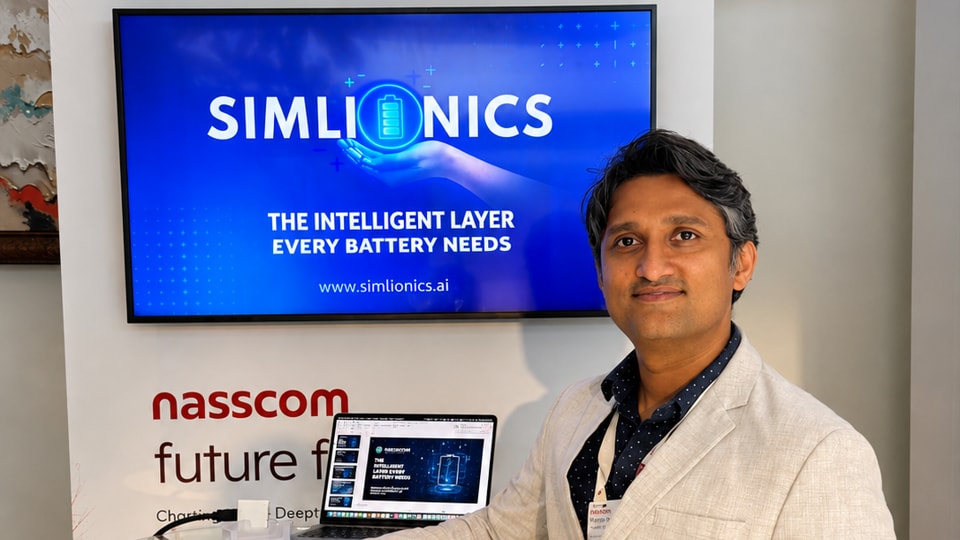
SimLionics, founded by battery scientist and engineer Dr Rutooj Deshpande, 39, in January, 2025, addresses this challenge by combining battery physics and chemistry with artificial intelligence. The bootstrapped startup, incubated at Venture Centre Pune, became profitable in its first year and today works with customers across multiple continents.
18 years in the making
SimLionics grew out of Deshpande’s 18-year journey in battery research and engineering, beginning with his doctoral research in 2008 and later as a postdoctoral scholar at Lawrence Berkeley National Laboratory.
“My early work focused on understanding the physical and chemical mechanisms responsible for battery degradation,” said Deshpande.
He subsequently worked with companies like Ford, General Motors, Rivian, and Sterling and Wilson on EV and battery-energy-storage programmes. His work spanned cell design, battery integration, pack design, control algorithms and warranty estimation, resulting in approximately 20 patents and trade secrets.
“A consistent theme throughout my career has been connecting fundamental battery physics and chemistry with real-world engineering,” he said.
Along the way, Deshpande repeatedly encountered battery problems that caused reliability concerns and substantial financial losses. That experience became the starting point for SimLionics.
Bridging intelligence gap
A battery’s internal condition cannot be understood through voltage and temperature measurements alone. Fleet operators need to know how long batteries will last, while energy-storage businesses must understand how rapidly they are degrading and whether safety risks are emerging.
“We saw a clear gap between advanced battery science and the tools available for everyday engineering and operational decisions. SimLionics was founded to bridge that gap,” says Deshpande.
SimLionics raised projected vehicle warranties to twice their earlier level and developed battery state-of-charge imbalance estimation for fleets involving more than 200,000 vehicles. It also helped reduce fast-charging time from 37 minutes to 25 minutes and enabled approximately 10% savings in the initial cost of an energy-storage system through improved life estimation and design optimisation.
Physics meets AI
SimLionics’ solution is based on physics-informed AI, combining data-driven intelligence with an understanding of the electrochemical, physical and thermal processes governing battery behaviour.
Its Battery Intelligence Stack operates across three layers. Edge Intelligence provides real-time estimation of state of charge and health, detects battery imbalance and identifies risks such as lithium plating. Cloud Intelligence enables fleet-level learning, predictive maintenance and warranty analytics, while Design Intelligence helps accelerate battery development and optimise fast charging, controls and system design.
“We are building the intelligence layer for electric-vehicle batteries, battery-energy-storage systems, and next-generation battery technologies,” said Deshpande.
The multidisciplinary team covers battery physics, electrochemistry, mathematical modelling, AI, controls and software development, bringing together more than 40 years of experience, over 20 patents and more than 30 scientific publications.
Bootstrapped and profitable
SimLionics’ first customers came largely through the team’s reputation and industry relationships. Within 18 months of its launch, the startup developed a client base across multiple continents and now works with multiple US Fortune 500 companies, electric-aircraft companies, an energy-storage operator, battery manufacturers, and electrode-material manufacturers.
Deshpande invested ₹16 lakh in SimLionics, which remained bootstrapped and revenue-driven, achieving profitability in its first year. The company now plans to raise ₹45 crore for expansion, supported by a pipeline of 40 intellectual-property assets across battery-design and edge-intelligence technologies.
The road ahead
SimLionics’ long-term ambition covers the entire battery lifecycle. “Our ambition is to make SimLionics a global hub for advanced battery intelligence,” Deshpande said. “Our vision is to use physics-informed AI to unlock the potential of every battery — from its initial design and operation to its second life, reuse or recycling — and help accelerate the global transition to a cleaner future.”


