
 E-Paper



Startup Mantra: Building batteries for a greener future
A Venture Center Pune incubatee, Tharam-Thiran Green Energy Flow, is making long-lasting, sustainable battery energy storage systems to fuel the renewable energy sector

 Prefer HTon Google


As we veer more towards renewable energy, the issue of batteries becomes even more critical. Generating energy is one part, but storing and utilizing that energy is equally important. Umesh Vasu, 37, founder of Tharam-Thiran Green Energy Flow, who has a doctorate in mechanical engineering from IIT Madras, says, “As our country accelerates towards net zero goals and rapidly increases its share of renewable energy, the demand for robust battery energy storage systems (BESS) has become more urgent than ever. We observed that a one-size-fits-all battery solution cannot address the unique challenges of a renewable-dominated grid. In particular, long-duration energy storage spanning 10 hours and beyond remains costly and technologically underdeveloped in India, even as shifting demand patterns and surging renewable integration make such solutions a near-term necessity.” There indeed was a problem that needed a solution.
Problem area
According to Umesh, “The mainstream storage technologies, like lithium-ion batteries, are well-suited for short to medium durations but face economic and safety hurdles when deployed for multiple-hour, large-scale grid balancing. Meanwhile, the mismatch between variable renewable generation and consumer demand grows, amplifying risks of energy curtailment and grid instability. These barriers are likely to constrain India’s progress unless we find new, affordable, and scalable long-duration storage options and commercialize them.”
To explore a possible solution to battery energy storage systems, Umesh returned to his alma mater, IIITDM in Kanchipuram, in 2020, where he focused on various aspects of flow battery technology development, refining both the science and engineering. Says Umesh, “As the project gained momentum and scale, I had the privilege of bringing Kaleeshkumar and Vaiskah on board as team members, uniting our complementary expertise and shared passion to advance this energy storage solution.”
Finding a solution
According to Umesh, “Lithium iron batteries are widely used even for grid-scale energy and have a cost advantage. However, it has a problem with lower capacity. A lithium–iron battery can discharge energy for a maximum of about two to four hours. If one needs more hours of energy, then you have to install more batteries.
“Then we have vanadium batteries. Vanadium salts are used in these batteries and are kept in a separate container. The greater the energy storage and discharge, the more the chemical is needed. Vanadium is a costly salt and is mired with several geopolitical issues right now, so it’s expensive. We thought, why not use a chemical that is cheaper and easily available? Why not make a battery that is cost-effective and sustainable?”
Says Umesh, “The cost of the electrolyte constitutes a major portion of long-duration energy storage systems. Our studies highlighted that vanadium, while proven, faces significant supply chain and cost issues. So, we shifted our focus to iron-based chemistries, which offer high safety and compelling economics for large-scale energy storage.” After rigorous evaluation, they chose to work on sulfur-iron redox flow batteries. “The technology leverages widely available raw materials and promises significant reductions in electrolyte cost.”
Affordable batteries
Umesh explains the mechanics of battery energy storage and dissipation. “In a battery, energy is stored inside the battery’s solid components—the chemicals inside the cell. So, if a battery can power a device for 1 hour, to make it last 10 hours, you would need to add more chemicals inside that same battery body, which affects performance.
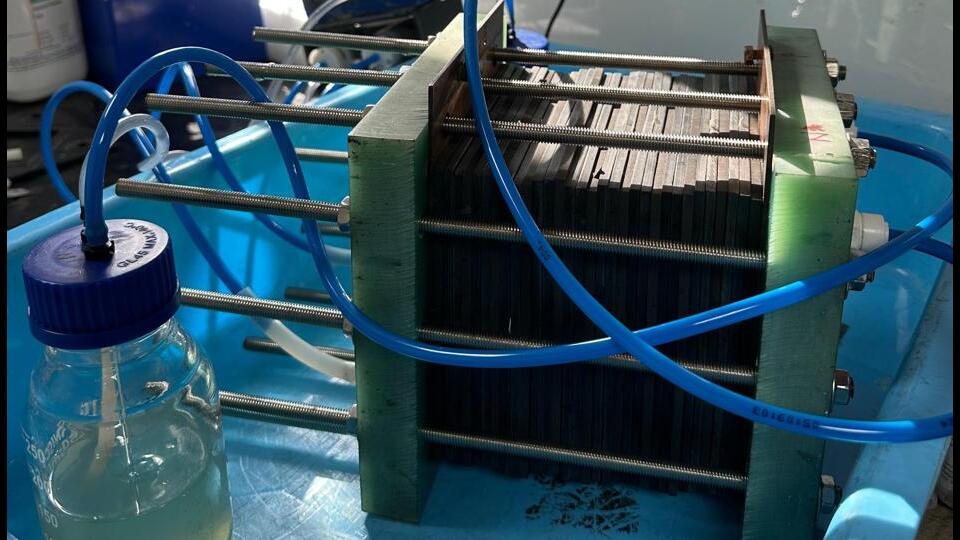
“In contrast, a flow battery separates the chemicals from the cell itself. The energy is stored in liquid solutions called electrolytes, which are kept in external tanks. These liquid electrolytes are pumped through the battery cell, where the chemical reactions take place to charge or discharge energy. So, if you want to store more energy or make the battery last longer, you simply increase the volume of the liquid chemicals in the tanks, without changing the cell hardware. The design allows for much easier scaling of energy capacity and is ideal for long-duration energy storage needs.
“In our sulfur-iron flow battery, these electrolytes contain sulfur and iron salts that are dissolved in water-based solutions. They flow through the battery cell where electrons are exchanged, generating electricity during discharge and storing energy during charging. This technology offers safe, cost-effective, and highly scalable energy storage.”
Initially, when they began experiments with sulphur-iron, they got a current density of 10-40 mA/sq-cm. However, to be commercially acceptable, they need to get to 80-100 mA/sq-cm. Says Umesh, “We have tried different interventions – using metal oxide coating on the electrodes. We tried different metal oxides; we are still in the process of trying out different materials. To get to commercial scale, we need to reach 80-100 mA/sq-cm.” While they have reached 80 mA/sq-cm, their R&D is ongoing.
Tharam-Thiran Green Energy Flow was registered in 2020, by Vasu along with other members Kaleesh Kumar M, electrochemist and Vaisakh V, product development.
Hurdles
For them, scale is the issue. Says Umesh, “Our lab scale battery can give 100W. To make a 100KW battery, we need to give tech demonstrations to different customer segments. Solar power companies that produce 100KW will be interested in trying out even a small 5KW battery to see if the technology can work. Once it proves itself at 5kW, then we can scale it up to even 100kW.” Luckily for them, there is a deep interest in power producers to test out new technologies, as the demand for more efficient batteries will only grow.
After they do their pilot project with their 100W battery, they plan to scale that up to 5kW in the next year and a half. “After the pilot testing of the 5kW battery, we will build our 100kW battery.”
Cost
Over the five years that they have been working on this, they have raised over ₹1.5 crore (~$180,000 USD) to fund extensive research, prototyping, and iterative testing. The investment has been primarily directed toward materials procurement, laboratory infrastructure, stack manufacturing, and validation studies. The development journey has required not just capital, but also technical perseverance and strong partnerships, critical to translating lab-scale innovations into market-ready solutions.
“Currently, our core team comprises four dedicated members who bring together expertise in electrochemistry, mechanical engineering, and product development. Recognising the scale of the challenge ahead, we plan to expand our team to more than 20 professionals within the next two years to accelerate technology maturation and commercial deployment.
“We anticipate raising ₹2.5 crore over the next two years to successfully launch our Minimum Viable Product (MVP). This will be used towards finalizing prototype development, securing intellectual property, completing certification processes, and setting up pilot deployments for real-world validation.”
“Following the MVP launch, we project the need for an additional ₹10 crore over the subsequent two-year period to scale commercial deployments. This capital will be used for manufacturing scale-up, expanding our team, enhancing supply chain capabilities, marketing efforts, and establishing strategic partnerships with utility and industrial customers.
Competition
Currently, ZH Energy and Lucas Energy are the key global players in this specific space, which gives us and them an important first-mover advantage. “Our strength lies in the targeted focus on long-duration storage solutions (10 to 20 hours and beyond) for installations above 50 kW. While each technology has its niche, our solution delivers a unique combination of low-cost, scalable, safe, and locally adaptable systems that suit the needs of India’s renewable energy ecosystem,” says Umesh.
Future plans
“With the lab prototype ready, we are now ready to move into pilot production. Over the next two years, our goal is to develop a 5 kW system to be released as our Minimum Viable Product (MVP), alongside installing up to five pilot projects with key stakeholders to validate real-world performance,” says Umesh.
“Our subsequent two-year plan focuses on scaling up to 100 kW battery systems and concentrating on commercial deployment. This phased approach allows us to progressively build confidence in the technology, refine manufacturing processes, and establish market presence before targeting larger-scale industrial and grid applications,” he said.


