
 E-Paper



Sutradhara’s Tales: The rustic divinity of Pune’s deities of the hills
These hill deities epitomise the living connections of Punekars even today, as they guard the urban greens, critical for a quality urban life

 Prefer HTon Google


The modern Pune of the 21st century still harbours a cosmic world of magical spirits, goblins and folk deities of primitive origins in its folds.
Before we explore the blast of development which took place during the 18th century and track the process of Pune’s urbanisation, let us take stock of lesser-known folk cults residing in and around the prominent hills of Pune.
Habitation and human connection with the hills of Pune has not been a new phenomenon, starting from micro-lithic tools of Mesolithic man to historical cave excavation activities in early medieval period.
For lack of evidence, we cannot find a point in history when the folk deities come into existence. Establishment of a folk deity is, often, part of larger cultural processes of assimilation, mobilisation, elevation, demobilisation, replication, and adaption within social movements and religious discourses. It may, at times, be a manifestation of an un-manifested power perceived by a group or a community, or interpretation of a natural phenomenon. The cycles of evolution and regression repeat in cultural processes based on the local perception of the masses.
Divine marriages, acquisition of a family or entourage, and successive incarnations are theological manifestations of social fusion. The continuity of certain cult-spots does not mean that descendants of the original prehistoric tribesmen continued to worship the same god at the same place with, at most, a change of name. Ceaseless nomadic movements, famines, migrations, feudal warfare and epidemics can confuse any regular sequence. Nevertheless, some continuity of tradition often remains and restoration of cults in modified forms can be observed.
The relevance of the folk deity is upheld through divine interactions with the deity through means of rituals such as a “angat yene” (possession by the divine spirit), Shamanic functions via devrushi, offering of prasada, pledging and fulfilling the vows, kaul (demanding solution to problems through series of questions and answers), various demonstrations through performances and plays, and hosting a yatra (pilgrimage) or jatra (fairs). The tradition of bagad held at the Nava Kalbhairav Temple is one such example.
The nomadic and semi-nomadic pastoralists such as Dhangars have been frequenting Pune environs for centuries as they set off on annual migrations to western parts of Maharashtra and Konkan. The lush grass pastures on hills have served as annual pit stops on the way. The centuries of connection to the place along annual migration has resulted in veneration of spirits by enshrining of the spots.
This is very well observed at the top of the Vetal hill complex, right in the centre of Pune city. The place marks the boundary of four villages, namely, Pashan, Kothrud, Erandwane and Bhamburda, all of which are firmly a part of the Pune metropolis, today.
Till a few decades back, there existed a stone circle erected by the Dhangars painted in white which represents the king of goblins, Vetal, along with his hordes. The king of goblins was later assimilated in the Shaiva pantheon, but here it exists as an independent deity. The younger brother of elder Vetal is located at foothill near the Mendhi farm area. The malevolent spirit of Vetal is known to be fierce as seen through adjective such as “agya” (fiery) and is offered non- vegetarian prasada. The annual jatra takes place on Gudhi Padwa when locals of Ramoshi wadi carry out a procession in the middle of night to enact Vetalbaba’s midnight march consisting of pishacchas, bhutas and goblins. Wrestlers from all around Pune are known to offer their prayers and pledge vows asking for strength and virility before wrestling matches.
The shrine is considered an embodiment of the hill environs itself. The deity and its pantheon, thus, prefer to stay in the open, sky clad. One witnesses vermilion- clad erect undressed stones all around the shrine representing blood-thirsty spirits attending Vetalbaba. Women are not preferred around the shrine. However, these restrictions have been relaxed now days.
Though the nature of rites has grown less primitive and fierce today, the fear-filled respect for the deity of Vetal is still realised.
Curiously, there existed a ward of Pune known as Vetal peth, named after Vetal baba who hailed from Saswad region.
The other famous Goddess of a Pune hill is goddess Chaturshrungi at the Ganeshkhind end of the Vetal hill complex. The original hill of Vetal complex has four shringas (horns/peaks) thus forming the name for the once cave-dwelling Goddess. The “swayambhu” (self-emanating) mother Goddess of Chaturshrungi residing in a womb-like cave from “little tradition” was later revived and connected to “great tradition” via a mythical story. A distinguished money lender during the Peshwa period, Durlabhshet Mahajan was an ardent devotee of goddess Saptashrungi (one of the Shakti peetha) near Vani, Nasik. As he found it difficult to visit Saptashrungi due to old age, the goddess willingly offered to appear at a rock-cut cave near Pune. On exploration, Durlabhshet found a rounded stone as a manifestation of the goddess. The temple was built in 1786, the goddess was revived and subsequently brahminised, too. It is pertinent to note that presence of a folk mother goddess may have existed before this revival. It can be seen through presence of many aniconic stones covered in vermilion in precincts of temples dating to pre-Peshwa times. The yatra of goddess Chaturshrungi is held with great pomp and show during the Navratri and Dusserah festivals.
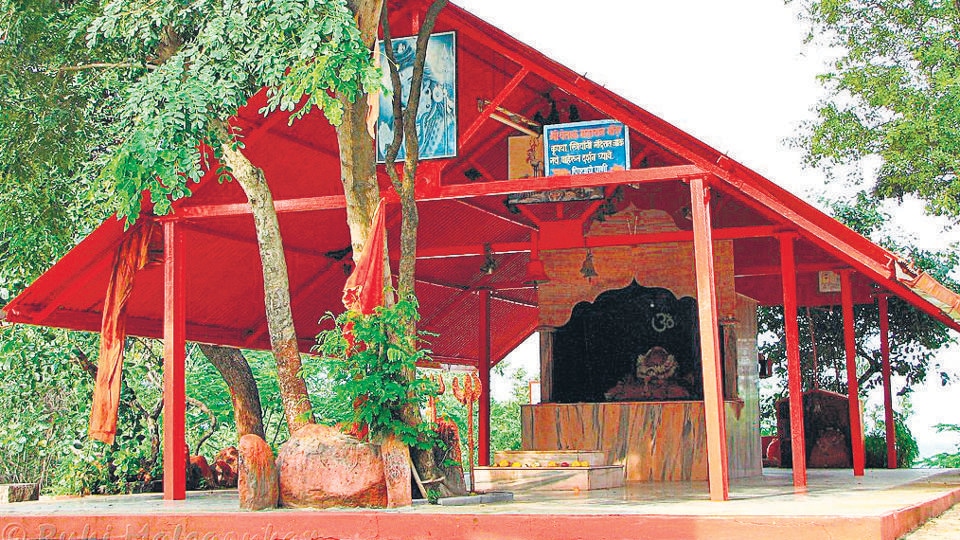
Mhatoba (also Mhaskoba or mhasoba) is a buffalo- headed folk God venerated by animal herding pastoral communities of the Deccan peninsula. It was later adapted by agrarian communities and is commonly seen serving the function of a Kshetrapal (guardian deity) on the boundaries of human settlements. One can find a shrine of Mhasoba at the foot hills of Parvati hill and it also serves as a “gram daivat” of the Dattawadi settlement along river banks. But, a much older Mhatoba is located on western ends of the Vetal hill complex. It originally came from Mawal area in the west and serves as satellite site of Mhatoba of vilalges of Wakad and Hinjewadi. According to distinguished archaeologist Damodar D Kosambi, the Mhatoba of Pune hill was brought in by herdsman from Wakad where it existed before 1678 CE. Mhatoba at Pune hill exists in the form of red-daubed boulder along with his wife Jogubai or Jogeshwari. Mhatoba of the Mhatoba hill end is meant pay respect to goddess Tukai near the Sutaardara area of Vetal hill complex. Kosambi has reported various microliths near the original shrine which has regrettably been modernised beyond recognition.
As the Vetal hill complex has been frequented by Punekars exercising, a modern Maruti (signifying power and bravery) is established as “Hanuman” and “Apla Maruti” is enshrined at the Law college end on a path towards the Vetal hill top.
The scrubby thorny wilderness of dry deciduous nature on the hills was perceived as forests by the erstwhile Punekars, and wilderness was recognised in the form of folk Gods guarding these sacred spaces. This has manifested in the form of sacred grove-like protected wilderness of a natural place. Goddesses Taljai and Waghjai and even the local goddess Parvati of pre-Peshwa eras are best examples of such mother guardian spirits.
These hill deities epitomise the living connections of Punekars even today, as they guard the urban greens, critical for a quality urban life.


