
 E-Paper



Taste of Life: Staying connected to cultural roots through food
Food reinforces ties between people and the homes they have left behind while linking them to a wider world. It is an identity marker that links people overseas to their homes and helps recreate an identity in the diaspora


Food has a remarkable ability to bring people together and create a sense of connection. It is often the primary point of contact in experiencing and learning about a different culture and helps broaden our understanding of the world around us.
On January 1, 1928, an article written by Mohan Keshav Shaligram was published in the Marathi newspaper “Dnyanaprakash”. Born and brought up in Pune, Shaligram studied physics at the University College London and later taught at a college in Edinburgh.
The long article described the New Year festivities in Scotland. He delved into the history of Christmas and New Year celebrations in European countries including England and Scotland. He wrote in detail how the festivals kept evolving through centuries and how they were affected by geography, climate, religiosity, wars, famines, and rulers. He then wrote passionately about the Hogmanay he had witnessed in Edinburgh.
Hogmanay, the Scottish celebration of the turning of the New Year, was the biggest celebration in the Scottish calendar. The modern Christmas ritual had spread slowly through regions and social classes of Britain, reaching Scotland in its full form last of all. For the Scots, Christmas was essentially an English festival they resisted, partly for their own nationalistic and economic reasons, and partly because of a fundamental difference in religious beliefs. The ruling class in the seventeenth century Britain believed that the Christmas celebration was a decadent indulgence unbefitting the Puritans. The Presbyterian Church had positioned itself against Christmas because they considered it pagan with no authority in the New Testament. While the expatriates took Christmas to India and made it the nationally accepted form of the winter festival, the Scots stayed loyal to Hogmanay. They worked over Christmas and celebrated their winter solstice holiday at New Year when family and friends would gather to party and exchange gifts.
Food reinforces ties between people and the homes they have left behind while linking them to a wider world. It is an identity marker that links people overseas to their homes and helps recreate an identity in the diaspora.
In Poona, Scottish officers went to celebrate Hogmanay with gusto. The Officers’ Messes of various regiments prepared a huge silver punch bowl of Atholl Brose, combined with strange other ingredients to make it really explosive. Atholl Brose was a Scottish drink obtained generally by mixing oatmeal brose, honey, whiskey, and on festive occasions, cream.
At 11.30 pm, headed by a piper, all the officers set forth with this lethal draught to the Sergeants’ Mess, and then the party started. Similar scenes took place in the barrack blocks and canteens. Toasts were drunk, songs were sung, everlasting friendships were sworn, and if by 4 am one had reached one’s bed and undressed, they were fortunate indeed.
But the officers and soldiers were roused out at about 6 am, dressed in all their glory, and marched to the Maidan, an enormous cleared parade ground and exercise area, where British and Indian soldiers were put through a military ballet of vast proportions on the New Year’s Day.
In 1903-04, the 93rd Sutherland Highlanders Regiment was in Wanowrie where it celebrated Hogmanay and New Year’s Day in “traditional style”. In the evening, they sat down to eat Scotch broth, roast beef, potatoes, parsnips, Brussels sprouts, plum pudding and custard, oranges, and figs. They drank Scotch whiskey, beer, and coffee and afterwards, a piano was arranged from the Scottish Church and a concert was held. The Royal Scots too, during their stay in Poona, celebrated Hogmanay.
Scottish soldiers in India eagerly waited for their parcels of Hogmanay bannocks to arrive from their home country. The Hogmanay bannock was a flat cake made with ground oatmeal flavoured with caraway seeds. It was round, and flat, with a hole in the middle and nipped around the edge.
The Church of Scotland Ladies’ Association in Poona baked Hogmanay cakes for the Scottish population in Poona. In 1875, Mrs Ross, the wife of the chaplain of the Scotch Church, began to visit a few “zenanas” in Poona, and about the same time, the Church of Scotland Girl’s Orphanage was shifted from Bombay to Poona. The Church of Scotland Ladies’ Association was formed a few years later. It started seven schools where 700 girls and 150 boys studied in 1890. The association also ran a training school for teachers that enabled the missionaries to train their teachers, a cottage hospital with eight beds, and a medical dispensary that primarily served the native population.
The association held a dinner every year a day before Hogmanay for which donations were sought and students, teachers, soldiers, officers, churchgoers, helpers, patients, donors, patrons, and other Scottish members were invited. In 1896, mince and tatties, clear chicken soup, thin bread and butter, roasted parsnips, creamed fish, potato soufflé, broiled sweet breads, French peas, cranberry marmalade, devilled chestnuts, whipped cream, fruit cake, fruits, nuts, and bonbons were on the menu. The Scotch bun was exclusively served to the students.
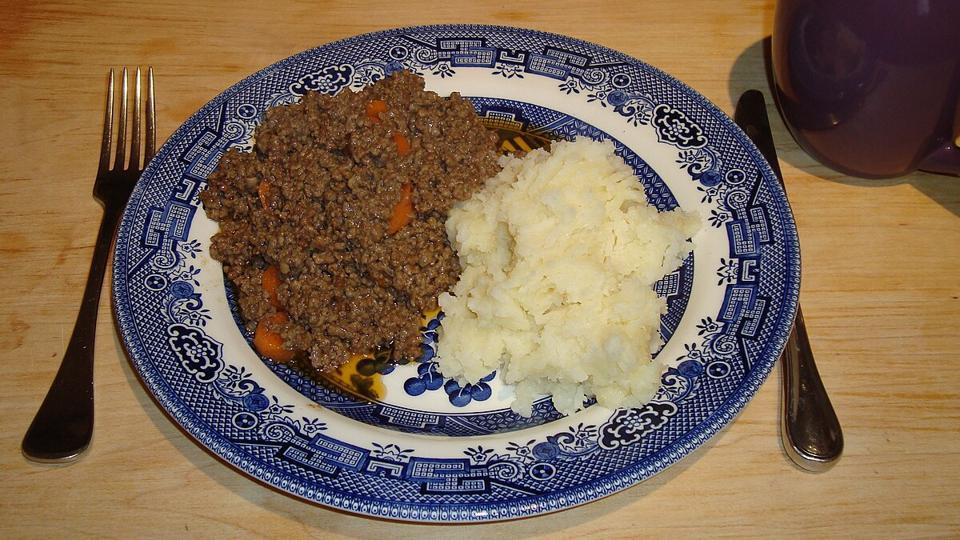
Mince and tatties was a Scottish dish consisting of minced beef and mashed potato. Onions and other root vegetables were also added with seasoning and stock. The Scotch bun, also known as black bun, was a fruit cake containing raisins, almonds, citrus peel, ginger, cinnamon, and black pepper.
According to the reports published by The Church of Scotland in the Home and Foreign Mission Record, several Parsee, Muslim, and Anglo-Indian families were invited for the dinner. Celebrating the New Year on January 1 was alien to common Indians then. But the growth of an educated middle class and the growing proximity of the upper-class Indians with the colonizers resulted in the steadily growing possibility of intercourse between the Indian and European customs and traditions in the early twentieth century.
The growth of an educated middle class and the growing proximity of the upper-class Indians with the colonizers resulted in the steadily growing possibility of intercourse between the Indian and European customs and traditions in the early twentieth century. This made a section of society insecure and unhappy. Shaligram’s empathetic article in “Dnyanaprakash” tried to create a sense of familiarity for Hogmanay among his readers to allay the phobia of the “Western culture”. He compared the Scottish traditions to celebrate the New Year with those followed by Hindus in Maharashtra during their “New Year”. He explained what “ringing out the Old Year” and “ringing in the New Year” meant and indirectly compared them with ringing bells in Hindu temples.
According to Shaligram, in Scottish villages and cities, young children dressed in long coats with deep pockets and went door to door asking for cakes. He used the Marathi word “aahaaroli”, used for wheat bread baked on embers in Maharashtra, for the Scottish fruit cakes and drew parallels with a similar tradition followed in several villages in Western Maharashtra where young children visited the neighbourhood on the “Chaitra Pratipada”, or the so-called “Hindu New Year”, asking for sweets.
He seemed cautious while writing about the consumption of alcoholic drinks on Hogmanay, but ardently elaborated how the celebrations were full of love and respect. The Scotts wished each other prosperity and health; they gifted their friends and families clothes and food, and sent cards to their loved ones; the elders showered love upon the youngsters. Aren’t the emotions enveloped in the customs demonstrating love and kindness universal, he asked.
The food vocabulary of a culture reflects its values and ideologies. The notion that communities are monoliths could be destroyed by the diversity of food and eating practices that exist. The rich tapestry of cultural traditions defines and enriches our daily lives. Looking at different customs and traditions with respect shapes our culture which is far from homogenous.


