
 E-Paper



Taste of Life: Goods shed turned into refreshment room to feed sky watchers
The district officials decided to convert the goods shed into a great refreshment room for the visitors who had turned up at Jeur, some 150 km from Poona, to watch the total solar eclipse on January 22, 1898


Pune: On January 22, 1898, a total solar eclipse occurred that was visible across Central Africa, and India and Asia. The British Astronomical Association organised an expedition to observe the celestial event. Among the many convenient sites for observation of the eclipse which lay along the central line of the belt of totality, Jeur, a station on the Great Indian Peninsular Railway, some 150 km from Poona, presented many points of advantage.
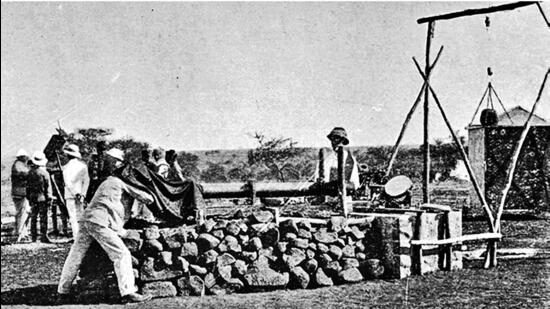
Professor William Wallace Campbell from the Lick Observatory, Professor Kavasji Dadabhai Naegamvala from the College of Science, Poona, and a Japanese party from Tokyo University led by Professor Hisashi Terao were the first to reach the village near Solapur with their pieces of equipment. Professor Charles Burckhalter from the Chabot University, California was also there with his telescope.
The central line of the eclipse was shown on some maps as passing through Targaon, on the Southern Mahratta Railway, and Jeur; but the American parties were not satisfied with this alignment, and pitched camp farther eastward. Campbell’s camp was within two miles northwest of this line. Adjoining his camp, but farther from the line, was Naegamvala’s, while the Japanese were a hundred yards farther on again.
While serious work was going on at the eclipse camps, Jeur station and its surroundings were rapidly putting on a holiday appearance. A month or so previously someone had suggested that the railway company should run a special from Bombay to Poona, which, after some hesitation, they advertised to start if a sufficient number applied for seats beforehand. The response was huge, for, not one, but eight long specials steamed into Jeur on the eclipse morning from Bombay, Poona, Ahmadnagar, Hyderabad, Baroda, and Madras, and emptied hundreds of European and native visitors, some keen on observing the eclipse and the astronomers, others out more for a picnic and the fun of the thing.
Jeur was a tiny village with no amenities to feed and entertain visitors from all over the world. Scores of white tents crowded around the station and peeped out from the surrounding trees. It was somewhat easier to accommodate the visitors in tents, but there were not enough utensils to cook food for them. The district officials decided to convert the goods shed into a great refreshment room. It was decorated with flags, bunting, evergreens, and Chinese lanterns. Covers were set in first-class style for three hundred. Some of the visitors had brought their tiffin baskets.
The responsibility of managing the refreshment room was given to the messman of the refreshment room at the Poona railway station. Unfortunately, I have not been able to find much information about this refreshment room except that it was known for its delicious European food all over India.
Mr Nowrojee Maneckjee owned a refreshment room at Neral station in the 1890s. A report published in the “Poona Advocate” in March 1894 suggests that he was trying to start a refreshment room at the Poona railway station to cater for European and wealthy Indian passengers. However, I have not come across more information in this regard.
Poona was a junction of the Southern Mahratta Railway with the Great Indian Peninsula (GIP) Railway, where passengers changed trains owing to the break of gauge. Several tourist guides published after 1910 mention that the station had refreshments rooms. Since the trains stopped for a longer time at the station, passengers had the option to leave the train and dine at the Connaught Hotel or the Napier Hotel, both not very far from the station. Horse carriages would be waiting outside the station to ferry the passengers to and fro from the hotels. A “Hindu” hotel opened right in front of the station in the 1920s, thus benefiting native Hindu passengers.
In the early 1900s, notwithstanding the extent of Indian Railways and the long distances traversed, there were hardly any refreshment cars running in the country. There were a few trains like the Poona – Bangalore Daily Express with dining cars. The Bombay – Calcutta route had a train with a dining car, and so did the Rajputana – Malwa Express. Oudh and Rohilkhand State Railway had dining cars attached to their trains. On the famous Bombay – Poona express, a passenger could obtain a dinner at a moderate price hardly to be equalled in the best hotel in India.
It was considered a waste of money to provide dining cars on railways where the European passenger traffic was light and variable. But on certain routes like Calcutta – Bombay, Calcutta – Lahore, Bombay – Lahore, Bombay – Madras dining cars were always provided since the trains on these routes never lacked European passengers.
On expresses which did not include restaurant cars, halts were made at stations with refreshment rooms, where meals could be purchased. All the refreshment rooms had adequate and proper arrangements for passengers to sit and dine.
Refreshments were divided into light refreshments and regular sit-down meals. The former, as also drinking water which was sometimes supplied free, were retailed to passengers without requiring them to leave their compartments and were chiefly suitable for native passengers. The latter were in the European style entirely and were served in refreshment rooms at regular hours.
For natives, because of caste difficulties, it had not been the practice to provide refreshment rooms initially, where regular sit-down meals could be obtained; but, in response to a strong desire expressed by the Muslim and Hindu community, native refreshment rooms were opened in the late nineteenth century at a few stations as an experiment. Poona Railway Station, in 1925, had three refreshment rooms – one for European passengers, and two for Muslim and Hindu native passengers.
But the time spent in refreshment rooms in serving the numerous meals usual in India tended seriously to pull down the average speed of trains. When passengers were dependent on refreshment rooms, it was sometimes suggested they be provided with a luncheon basket. This usually included cold chicken, biscuits, potted meats, milk, Brand’s essence, liquors, and tea outfit. The GIP Railway provided such a basket to passengers travelling in the Poona – Bangalore service for a while.
When these luncheon baskets ceased to be provided in the train by the GIP Railways, Cursettjee & Sons began selling those at their shop in the Sadar Bazaar area of the Poona Cantonment. These baskets were a hit among the passengers since some tourist guides advised them to avoid tea and especially milk at “less important refreshment rooms”. Orders for these baskets would be placed by post or telegraph.
A passenger could also place an order for breakfast, lunch or dinner at the refreshment rooms via post or telegraph. Most of the important railway stations had a telegraph office.
A special government telegraph office was set up in the vicinity of the temporary refreshment room at the Jeur railway station. The British Astronomical Association, which had organised the expedition to Jeur, was beyond pleased at the arrangements made by the messman from Poona. I wish I knew what he served to the astronomers on the day of the total solar eclipse.
Chinmay Damle is a research scientist and food enthusiast. He writes here on Pune’s food culture. He can be contacted at chinmay.damle@gmail.com


