
 E-Paper



Village in Beed runs shops, services, farms under gram panchayat
Vanjarwadi village in Beed district promotes self-reliance, running essential services to ensure fair prices and reinvesting profits into community development.

 Prefer HTon Google


While most villages depend on private shops and middlemen for daily needs, Vanjarwadi in Beed district has turned towards a model of self-reliance. Here, the gram panchayat itself runs grocery stores, salons, flour mills, and even LPG and water supply services—ensuring fair prices for residents and channelling profits back into the community.
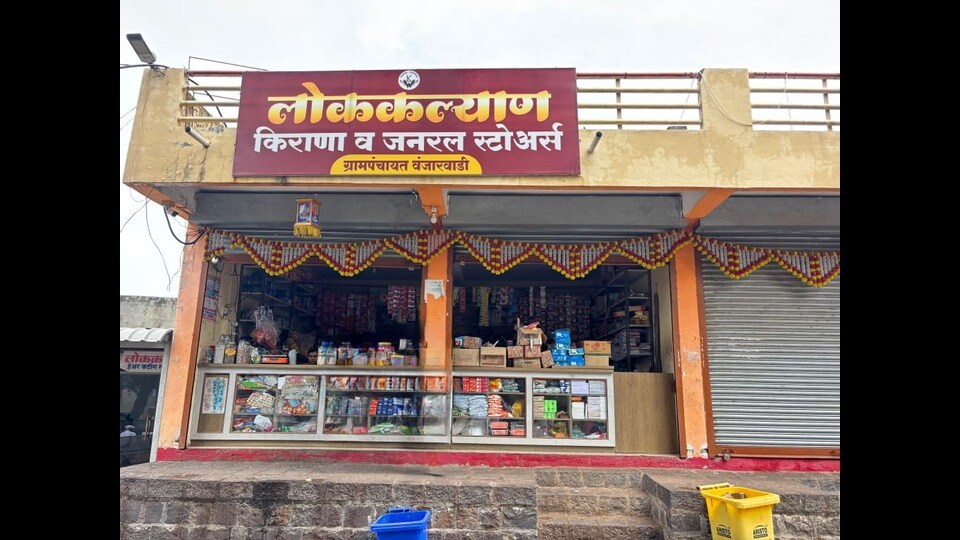
The experiment began in 2020, when the Covid-19 lockdown cut off villagers’ access to Beed town, 15 km away. “We started with a gram panchayat-run Lok Kalyan Kirana and General Store so that people wouldn’t struggle for essentials. Our aim was simple: quality products at fair prices,” recalled sarpanch Vaijinath Tandale.
Encouraged by the response, the panchayat expanded into other services, a gas agency, a flour mill, an RO plant, and even a barber shop.
The payment system was specifically designed to meet the needs of rural areas. Groceries were supplied on six months’ credit, with bills cleared after the harvest season. Any disputes were resolved within the gram panchayat itself. Today, the Lok Kalyan store makes a monthly profit of ₹15,000–18,000 after expenses, which is reinvested in village development.
For residents, the benefits go beyond savings. Earlier, they had to travel to Beed for a haircut.
“Now I get a haircut and shave for ₹60 in the village. The same costs ₹100 in town, plus the travel expense,” said villager Laxman Pawar.
The flour mill too has eased household budgets, charging just ₹2 per kg compared to ₹5–8 in Beed.
Water, once a major burden, has also become affordable. Villagers previously paid ₹20 for a 30-litre jar of filtered water in Beed, not counting travel costs. Today, the gram panchayat’s RO plant supplies the same quantity for ₹5. A water ATM further allows residents to draw a litre of purified water by inserting a ₹1 coin.
The panchayat hasn’t stopped at services. In the past few years, it planted over 5,000 fruit-bearing trees—mango, coconut, jamun, jackfruit—along 15 km of roads. Initially, mango harvests were distributed among villagers. However, with yields increasing, the panchayat is now exploring commercial opportunities.
“We are planning to export fruits in the next couple of years. Discussions are on,” Tandale said.
All revenue is ploughed back into community projects, with small deposits also made through daily pigmy schemes. “These shops are by the people and for the people,” Pawar added.


