
 E-Paper



PUTA members continue protest outside V-C office in Patiala
The PUTA has registered a strong protest against the practice as it affects the decision-making process of the university and subsequent accountability


Members of the Punjabi University Teachers’ Association (PUTA) continued their dharna in front of vice-chancellor (V-C) Prof BS Ghuman’s office from 11am to 1pm for the second consecutive day, on Thursday.
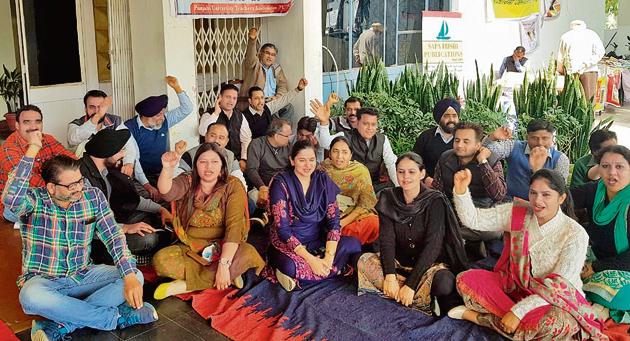
A large number of teachers participated in the protest to show their anger against the university authority. Led by PUTA president Jaswinder Singh Brar and general secretary Gurnam Singh Virk, the faculty members raised slogans against the Punjab government and the V-C for failing to resolve their problems.
Virk said, “Ad hocism continues in the varsity and is adversely affecting its working. All top posts — including dean academic affairs, registrar, controller examination, dean students’ welfare, director public relations and others — have no regular appointee, and are being run by faculty members as additional charges.”
The PUTA has registered a strong protest against the practice as it affects the decision-making process of the university and subsequent accountability.
PUTA members said that at present, there is no transparency, parity or time-bound dispersal of issues pertaining to the teaching community and the university working is in a state of labyrinth.
“We will continue to sit on a dharna till all our demands are fulfilled by the university authorities. In case the demands are not met, PUTA will be forced to intensify the stir,” the protesters said.
While addressing the teachers present during the protest, PUTA members said that their demands are for common good and genuine. They urged all university teachers to participate in the protest in large numbers.
The teachers are seeking timely payment of salaries, release of DA (dearness allowance) arrears of 2013, transfer of money from NPS (National Pension System) accounts to GPF (general provident fund) ones, revised salary and arrears to promoted staff, non-observance of one teacher-one post principle, appointment of regular dean and director planning and monitoring, revival of annual increment to ad-hoc teachers, counting of ad-hoc service, etc.


