
 E-Paper



CAG flags mismanagement of Jharkhand’s minor minerals
Pointing out loopholes in the grant and management of leases, principal accountant general (PAG) Indu Agrawal said the mining department could not institute a check-and-balance mechanism to ensure that deputy commissioners (DCs) do not grant leases for mining areas beyond their authority.

 Prefer HTon Google


The Comptroller and Auditor General (CAG) of India flagged mismanagement of minor minerals in Jharkhand for the year ended March 31, 2022, in a report laid on the table of the state assembly on Thursday, citing revenue loss and opportunities for pilferage.
Principal accountant general (PAG) Indu Agrawal shared a copy of the report and briefed on its key points during a press conference at her office in Doranda in the evening after laying the report in the assembly.
Agarwal told the media that the audit was conducted for one year, and mining offices of six districts, besides the Jharkhand Mineral Development Corporation (JSMDC) office, were selected to assess whether appropriate systems were being adopted to facilitate sustainable and scientific mining in the state.
“We conducted the audit from November 2022 to October 2023, and the period taken for the audit was from 2017 to 2022. As many as six districts, including Pakur, Sahebganj, Palamau, West Singhbhum, Dhanbad, and Chatra, were selected for detailed examinations,” she said.
Pointing out loopholes in the grant and management of leases, she said the mining department could not institute a check-and-balance mechanism to ensure that deputy commissioners (DCs) do not grant leases for mining areas beyond their authority.
“Mining lease over an area of three hectares (Ha) and above was required to be put to e-auction. However, in one case, DC Sahibganj granted a mining lease (4.74 Ha on raiyati land) over an area beyond his authority. In another case, the DMO, Sahibganj, not only entertained the application for a mining lease over an area of 3.136 Ha but also issued the LoI by arbitrarily reducing the area to 2.833 Ha without any request from the applicant for reduction of the lease area,” she pointed out.
Agrawal further said the report points out a delay in the auctioning of mines. “Auction of only 11 of 292 blocks was completed during 2018 to 2023 due to a lack of monitoring by the department and deficiencies in planning. As a result, minor mineral blocks with potential resources remained idle, leading to blockage of revenue,” she said.
The PAG stated that a declining trend in revenue was also observed. “Revenue receipts from minor minerals declined significantly from ₹1,082.22 crore in 2017-18 to ₹607.73 crore in 2021-22. Furthermore, the share of minor mineral receipts in the state’s total revenue also saw a decline, dropping from 5.36 per cent in 2017-18 to 2.23 per cent in 2021-22,” she said.
“An IT-based mineral administration system, the Jharkhand Integrated Mines and Mineral Management System (JIMMS), was introduced on May 15 to simplify complex mining processes. Despite a lapse of more than seven years, automation of records was found to be incomplete during the audit due to the unavailability of crucial records,” she added.
Pointing out mismanagement in the transportation of minerals, Agrawal said none of the vehicles was found equipped with the tools required to prevent the pilferage of minerals.
“The department of mines and geology had registered 72,449 mineral-carrying vehicles (MCVs) as of March 28, 2023, but none of these vehicles were equipped with radio-frequency identification, global positioning system, or any other vehicle tracking system, even after five years. Audit checked the weighbridge report of seven dealers of stone chips and found that in 85 per cent of cases, transporting challans issued through JIMMS were unavailable. In the case of 28 vehicles, 35 initial challans were followed by 50 additional challans issued before the expiry of the previous challans due to lacunae in JIMMS, leading to the risk of multi-utilisation of challans,” she said.
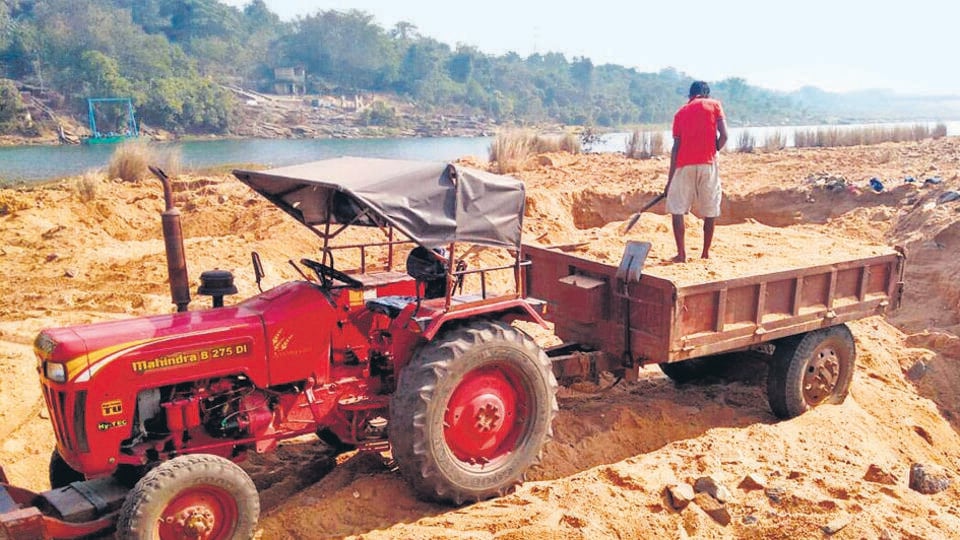
On mismanagement in sand ghats, PAG Agrawal said the report noted that out of 608 ghats, only 21 could be made operational.
She said the report also highlighted flaws in the process of approval and implementation of the mining plan. She said the plan was approved without proper documentation and completion of the legal process.
“It was also observed that 55 of the 63 leases had side walls with steep slopes instead of the recommended gentle slope of 45 degrees. This resulted in irregular excavation of non-mineable resources without creating benches and safety barriers. Lessees also excavated beyond the allowable depth, vertically infringing on non-mineable resources, with pit depth exceeding permissible limits by 2.5 to 50 metres,” she summed up.


