
 E-Paper



Smog check: Why burn stubble, make money from it
Stubble burning, said to be the main culprit behind the smog that most of the northern Indian cities, including Lucknow, are reeling under these days, could become


Stubble burning, said to be the main culprit behind the smog that most of the northern Indian cities, including Lucknow, are reeling under these days, could become a thing of the past if a government order and an available technology is used in letter and spirit.
Farmers burn the stubble that is generally left behind in farms when harvesters are deployed to harvest the crops. Harvesters, on rent, do the farmers’ job quickly and efficiently against the conventional manual harvesting using sickles.
“Sickles do close cropping, from just near the soil surface. Harvesters leave about a feet length of stalks standing in the fields. Farmers then burn these stalks to get rid of them for readying their field for the next crop. These stalks are just waste product for them with no monetary benefits. But we have a practical and ready technology that can check stubble burning --- or any other agriculture residue burning,” Vipul Gulati, a 28-year-old entrepreneur who has a bio-coal production unit in Kanpur Dehat.
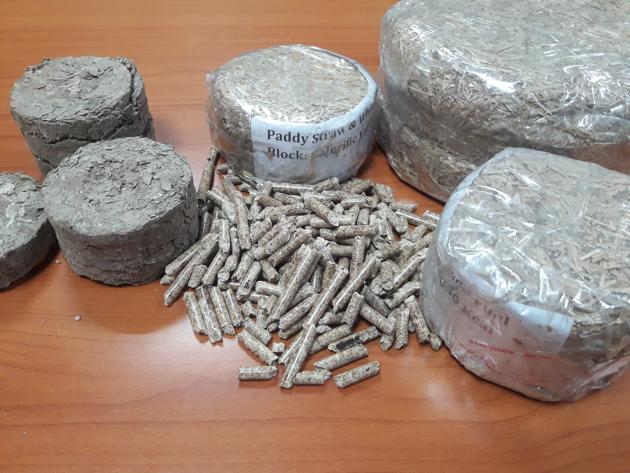
Gulati has a bio-coal briquette production unit. He buys agriculture residue like -- stubble of various crops -- from farmers and turns it into bio-coal.
The bio-coal is cheaper than the conventional coal of firewood, is environment-friendly, burns efficiently, produces far less carbon and polluting gases, says PS Ojha, state coordinator, Uttar Pradesh Bio-Energy Development Board, Lucknow.
“Stubble, when burnt in the fields, gives no profit to the farmers. But if the area where the farm is situated has bio-coal production units, then it can get extra income for the farmers when he sells the stubble to the units, gets income to the entrepreneur who establishes the unit, and on top of that it can give cheaper, efficient, and better fuel to the consumer. It has great potential to be used in brick kilns or thermal power plants,” said Ojha.
Gulati buys crop residue -- including stubble -- at the rate of Rs 200 per quintal from farmers.
“Farmers don’t have to do anything. They just get paid. I have my agents, on a commission basis, who cut the stubble from the farmers’ field. I then make the bio-coal briquette and sell them to brick kilns at the rate of Rs 5.50 per kg. It is a better bargain for the kilns as well as bio-coal is about is Rs 4-5 cheaper than the conventional coal or firewood. But it would be better if the government strictly implements the use of minimum 20% of bio-coal in the brick kilns and boilers. This will lead to high demand, which in turn would lead to coming up of more bio-coal production units across the state, and in turn, would lead to selling of stubble and crop residue to the units instead of just burning them and causing pollution.” Gulati said.
The Uttar Pradesh government in January 2018, quoting the National Policy for Management of Crop Residue, 2014, had ordered that all industrial units that have coal-based boilers, furnaces, brick kilns must meet 20% of their energy demand from bio-coal briquettes.
“This order can bring revolutionary changes, only if it is implemented well. All this hue and cry of stubble burning will vanish. It will lead to high bio-briquettes demand and spur establishment of bio-briquette units and farmers would begin selling the stubble instead of burning them,” said Shiv Rathan Tapadiya, one of the pioneers in bio-briquettes’ production in Uttar Pradesh.
“I used to visit Gujarat, where I saw such units. I purchased a machine and established a unit here in Mainpuri. Now, I have two machines,” said Tapadiya. Gulati has three machines. Entire UP has about 50 such units. There is a concentration of such units in Lakhimpur Kheri and Shahjahanpur -- they use sugarcane residue to make briquettes. Establishment of one unit had cost me about Rs 40 lakh,” said Tapadiya.
Tapadiya, too, says if the government’s January 2018 order about meeting minimum 20% energy requirements through bio-coal is followed, then stubble and all kinds of agriculture residue burning would vanish as the farmers would start getting money for selling them.
The UP Pollution Control Board, too, following the UP government’s order, had issued a directive reiterating the UP government’s order within days. Yet, the order is far from being implemented.
“If the demand for bio-coal rises, then automatically there would be a rise in the establishment of such production units. The government also has a provision of giving aid for the establishment of such units under its MSME promotion schemes,” said Ojha.
Tapadiya purchases about 3500 tonnes of agriculture residue each year. His machine produce 15 tonnes of bio-briquettes in 20 hours.
Ojha, describing technical merits of bio-coal over the conventional coal, says: “Bio-coal has 4000-4700 kcal of energy per kg on an average. The conventional coal is just marginally higher. Because bio-coal has very high combustion rate, it produces very low ash compared to conventional coal or wood. It also has virtually negligible carbon and sulphur dioxide emission.”
Bio coal is produced in several shapes -- briquettes, pellets, blocks etc.


