
 E-Paper



Two more men test positive in Punjab’s Covid-19 cluster, taking Mohali district count up to 50
Both are neighbours of the first positive case from Jawaharpur village in Dera Bassi


MOHALI
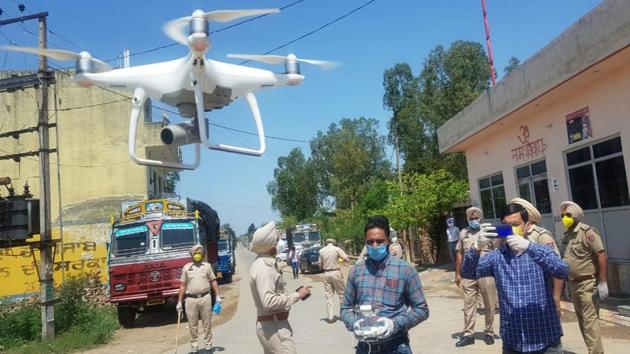
With two more persons testing positive for Covid-19 at Jawaharpur village in Dera Bassi town on Saturday, the total count of coronavirus cases in Mohali district touched 50.
The first case in the district was reported on March 20. The district has witnessed two deaths while five people have been cured in these 22 days. The active cases as of now are 43.
A 38-year-old man and a 58-year-old man, who works as barber, have tested positive. “They are neighbours of the first positive case of the village and had been in touch with him. They were tested after contact tracing,” said Mohali civil surgeon Dr Manjit Singh. The two have been shifted to Gian Sagar Hospital in Banur.
Samples of their family members and other contacts are being collected for testing, said the civil surgeon. In all, 244 samples have been collected from the village, of which reports in 41, including 38 new ones collected on Saturday, are awaited.
“The district administration is undertaking extensive contact tracing and sampling, which is leading to the identification of more cases. This would lead to their isolation in time and help in combating the coronavirus,” said Girish Dayalan, deputy commissioner, Mohali.
With this, the total number of positive cases at Jawaharpur village, which has emerged as the biggest Covid-19 cluster in Punjab, has gone up to 34, with most patients from the extended family of a 42-year-old panch, who was the first to test positive on April 4. The district administration has already declared the village, having a population of 3,000, a containment zone, completely banning the movement of people. Three neighbouring villages of Devi Naga, Mehmudpur and Haripur Kurha have also been sealed.
As a precautionary measure, the health authorities have also isolated a shopkeeper of Trivedi Camp in Dera Bassi, who was in touch with the positive cases in Jawaharpur. His report is awaited. A densely populated area, Trivedi Camp was set up initially for refugees at the time of Partition and houses about 5,000 people, mostly families of wholesale traders.
Eyes on PGI corona ward worker
The district administration has collected blood and throat swab samples of a man employed as a contractual labourer at the dedicate Covid-19 ward of the Post Graduate Institute of Medical Education and Research (PGIMER), suspecting him to be the coronavirus carrier, who led to the outbreak in Jawaharpur village.
Contact tracing of the first positive case in the village Jawaharpur – the 42-year-old panch — led them to this man, who is his cousin and stays in the same village.
“The person so far is asymptomatic and we are getting his tests conducted on urgent basis. The reports are awaited,” said Mohali deputy commissioner Girish Dayalan.
The panch had no travel history and all employees of his factory who had been in touch with the Tablighi Jamaat Markaz attendees had tested negative.
Visiting the ground zero
It’s silent, no one’s around as drones fly over Jawaharpur village in Dera Bassi, now a Covid-19 positive cluster with 34 persons infected. The villagers are huddled inside their homes. Some say they have thrown excess milk into drains with no one to buy it.
The district authorities come for patrolling thrice a day and apart from the drones to check movement, a station house officer has been stationed at the entry point to ensure no one comes into or leaves the village.
“There is no fodder for the cattle, they are dying of hunger. Each animal costs about Rs 1 lakh,” laments said Joga Singh, a former sarpanch of the village.
Though fodder is being sold in the village, people don’t have money. No one’s allowed to even go to an ATM, he adds.
Curiously however, even though there are claims of milk being “thrown away”, a helpline set up by the administration for the villagers to ask for essential items being sent to their doorsteps received requests for a packet of Verka milk and cold drinks.
The village, with a population of about 3,000 has 10 dairy farming families supplying milk to different houses in the Mohali and neighbouring areas.
“We have to destroy the milk as we cannot supply it to our customers,” says Manish, a local.
Avtaar Singh, also a resident, says no medicines are available and rations are running out. “We are not allowed to go into the fields.”
There are about 150 cattle in the village for which the administration claims to have provided fodder.
“No movement will be allowed at any cost in the village to contain the spread of the disease,” says Kuldeep Bawa, sub divisional magistrate (SDM) Dera Bassi. People can call the helpline if they want anything, he adds.
As for milk, he says people are throwing it away instead of drinking it.
A volunteer was also making the rounds of the village to check if people required essential items.
The administration had distributed 90 packets of dry ration in the last 15 days to underprivileged families before sealing the village.


