


 Live Score
 Teams
Teams Players
Another Ashes, another Broad-Anderson show in the offing
Hunting in pairs may come to an end soon. But for now, enjoy this duopoly

 Prefer HTon Google


Sydney Gregory is remembered for many reasons. He was born at the present site of the Sydney Cricket Ground, played in Sydney’s inaugural Test in 1894-95, and most importantly, holds the record for the most Ashes Tests played – 52. An accomplished run-getter, Gregory is also remembered as a brilliant cover-point in his Wisden obituary. But he wasn’t a bowler. To find a pure bowler on that illustrious list, and not a part-timer who just rolled over his arm during the pre-War days, you have to skip 15 rows till Shane Keith Warne pops up with 36 Tests to his name. Below his name, placed side by side, are James Anderson and Stuart Broad with 35 Ashes Tests apiece.
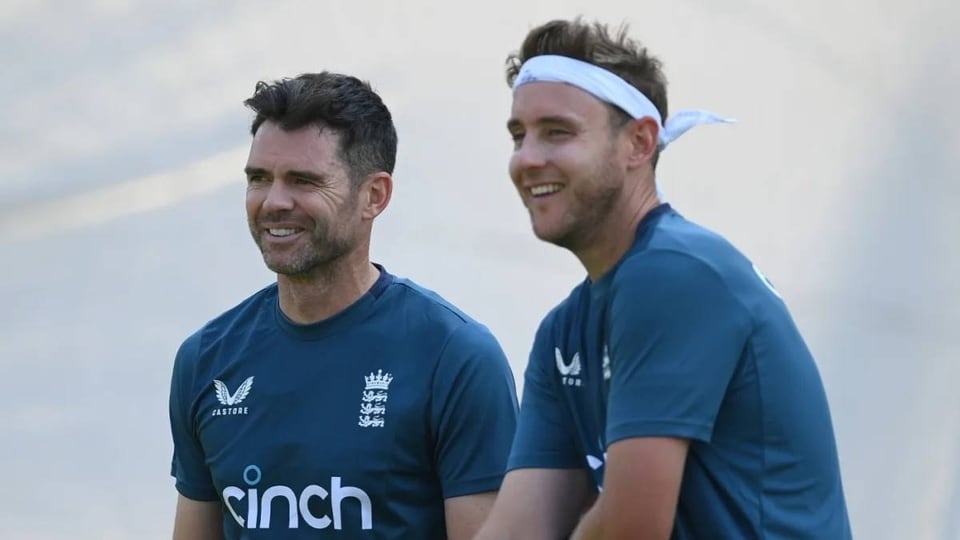
And they are still not done.
By now, we are familiar with the trivia associated with Anderson, 40, and Broad, 36 —cricket’s most successful and longest serving pace bowling combination, with 1,017 wickets in 134 Tests, primed to play their ninth Ashes together, etc., etc., — the list can be comprehensive. That they took 15 years to reach one Test short of what Warne needed 14 years to achieve is another way of highlighting the stamina and will of two modern greats. An Ashes at home could be the farewell series for them. But if it isn’t, England surely won’t mind.
For the record, Anderson and Broad are not cricket’s most prolific fast bowling duo. Curtly Ambrose and Courtney Walsh averaged eight wickets per match. Despite playing just 26 Tests together, Dennis Lillee and Jeff Thomson averaged 8.34. Slightly better were Malcolm Marshall and Michael Holding, who averaged 8.8 wickets per match. No one came close to Wasim Akram and Waqar Younis, who dismissed 559 batsmen, averaging 9.16 wickets per match.
Where Anderson and Broad have possibly trumped each of them is in their longevity, allowing modern cricket to hold on to a long-cherished part of red-ball cricket: a great bowling pair. Modern cricket has dabbled with a few pairs. Pat Cummins and Mitchell Starc, though captivating in tandem, haven’t bowled together that long. Jasprit Bumrah and Mohammed Shami were a thing till Bumrah injured his back. That leaves us with Trent Boult and Tim Southee, Anderson and Broad and a scary suggestion that the practice of hunting in pairs might be extinct in a few years.
The most exhilarating exhibits of modern fast bowling are not venturing into red-ball cricket anymore. Jofra Archer has been reportedly offered a year-round franchise contract. More and more pacers are veering towards upskilling themselves according to T20 norms rather than focusing on bowling 10 good length balls on the fourth stump. Extreme pace is welcome. But more in vogue are bowlers who can also hit a six or two. Switching between formats to keep a place in the central contracts isn’t a priority anymore, as exhibited by Boult. Bumrah is an exception till he burnt out. But Anderson and Broad stand tall.
To arrive at this happy conundrum wasn’t easy. Questions have been raised, most of them pertinent, about the logic of rotating Anderson and Broad when they play only one format. But few understood the deeper intent to begin with. One of the downsides of being blessed with a once-in-a-generation bowling pair is the complacence it can prompt, that a squad will have them around till the replacements magically fill their shoes overnight.
Sooner or later, all big sides have had to cope with this problem. But Andrew Strauss and later Rob Key, the former and current England’s director of cricket, chose to think out of the box after Anderson and Broad had been quietly phased out of white-ball cricket. The idea was simple — save them for the most important games while building an attack around them. Hence the rotation policy. Broad didn’t take very kindly to it, almost retiring after being dropped for the tour of the West Indies in 2022.
He came around though, that too without being overtly conscious about it. Being paired with Anderson of course has its perks, like bowling at the nets for long hours. That enabled them to not just clear their minds but also devote themselves to the only vocation they were offered —bowling with the red ball. With age came refinement, a knack for finding the weakness in batters earlier than others. Which is why Broad had David Warner’s number in the 2019 Ashes, dismissing him seven out of 10 innings. Anderson’s brilliance was derived from the precision of his spells, leaving batters, his teammates and the general audience in awe of how much he could alter the complexion of the game with the slightest change of wrist position or scrambling the seam at the last second.
What also allowed them to prosper in the high art of seam bowling was the administrative consensus that they must not be disturbed. Hence no participation in IPL, no pressure to learn T20 tricks or get their heads down and learn a few shots. For a culture that looks so busy perfecting their white-ball motto while trying to redefine Test cricket, this was one of the few things England got right.


