


 Live Score
 Cricket Teams
 Cricket Players
ICC World Cup 2019: From stubborn bails to rain, the talking points so far
Here are the major talking points of ICC World Cup 2019 so far


From bails which refuse to fall easily to rain threat that hovers over almost every match, and the teams that are most likely to reach the semis—halfway into the World Cup, here are a few talking points.
Race for the final 4
With 26 games gone, the four teams that currently top the table—New Zealand, Australia, England and India—seem to be increasing their gap from the rest, steadily breaking free from the pack. But this may be an illusion. (Also Check: Full Coverage of ICC World Cup 2019)
Of these, New Zealand and India are unbeaten and hence have a little more breathing space.
England and Australia have lost a match each and another loss against any team in the bottom six could put them in a precarious position. Even two washouts, which is highly likely, could make the fight for the fourth spot interesting.
Also Read: Kohli on verge of breaking Tendulkar, Lara’s World Record
New Zealand though have their toughest matches lined up in the second half of the group league—West Indies, Pakistan, Australia and England—and if their batting against South Africa is something to go by, all four would fancy their chances. Australia’s remaining matches are England, New Zealand and South Africa. This means there is bound to be serious upheaval at the top. Watch out for West Indies, South Africa and a really hurt Pakistan.
Molehill for a mountain
In the build-up, people talked about ODIs breaking the 500-run mark more than they spoke about Eliud Kipchoge’s efforts to overcome the two-hour barrier. Halfway into the tournament, fans are still waiting for a 400-plus score.
Highlights of Australia vs Bangladesh World Cup match
Pitches have been flattish, and the grounds are a lot smaller than the previous edition in Australia where 400 was breached thrice. With England experiencing an unusually wet June, matches that have been played during or immediately after intermittent phases of rain, have not been high-scoring. Sweating under the covers have made wickets damp and scoring difficult. And since in England only the wicket and the bowling run-ups are covered and not the entire ground like in most other countries, rain means the outfield gets sluggish and the ball doesn’t travel that well.
Also Read: BCCI pulls up Ganguly, Tendulkar and many others on Conflict of Interest issue
Washouts and losses
This World Cup has already seen four matches abandoned—that’s two more than all previous World Cups put together—and quite a few truncated. It has been frustrating for teams like Bangladesh and West Indies and to some extent India. Bangladesh, having beaten South Africa, were fancying their chances against off-colour Sri Lanka. But that match was washed out and points shared.
West Indies had South Africa on the mat early but had to settle for a point due to rain. India saw their match against New Zealand washed out—a win would have taken India to the top of the table and increased their chances of finishing the league phase there. Finishing on top would have got them the fourth placed team as semi-final opponents. An advantage, no matter how minuscule.
Stubborn bails
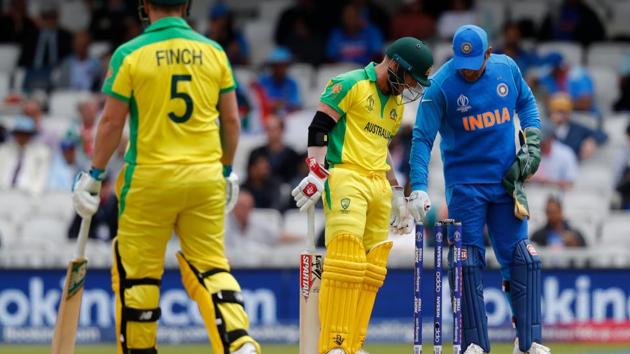
Jasprit Bumrah was bemused when he saw Australia opener David Warner chop one onto the stumps, but the bails stayed firmly in the groove. That was the fifth time it happened in this World Cup. Zing bails, which light up immediately after losing contact with the stumps, are heavier than normal bails because of the LED lights and a full circuit inside them.
“The Zing wicket system has operated in well over a thousand games and this issue has not happened frequently. This recent cluster currently has us stumped,” David Ligertwood, Zing director said in a statement. So, the bails with light aren’t light enough and the technology that was supposed to help television umpires review better, is itself now up for a review.
It is best summed up by a recent tweet: “Positive feature of zing bails: they light up when removed from the stumps. Negative feature of zing bails: they light up when not removed from the stumps. They are the ULTIMATE in EXISTENTIAL BEINGS. They serve no purpose. They just are. We should rename them “ZEN BAILS.”


