Dissections of India’s World Cup history will leave you with a fuzzy feeling and an uncomfortable question: Which version would you prefer? The team that goes through the group phase like hot knife in butter before faltering in the knockouts, like in 2015, 2016 or 2019? Or would you rather pick the uncertain phase of 2011—a tied match with England, followed by defeat to South Africa, interspersed with low-key victories against Bangladesh, Ireland and Netherlands before West Indies capitulated—before India peaked at the right time?
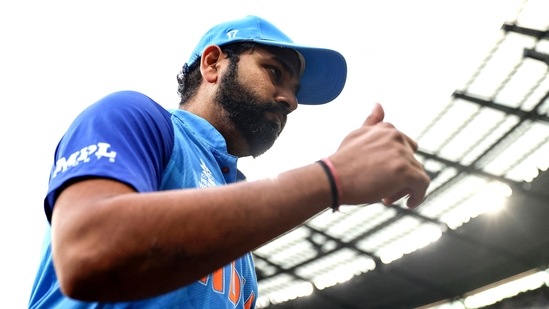
India's Rohit Sharma is seen before the ICC men's Twenty20 World Cup 2022 cricket match between India and Zimbabwe at Melbourne Cricket Ground
You get the drift once you compare India’s current campaign. Defeat to South Africa, two matches going to the wire against Pakistan and Bangladesh apart from the wins against Zimbabwe and Netherlands, India haven’t been exactly emphatic or champion-like so far.
Are they peaking at the right time then? On this question hinges the future of Indian cricket and much more. Home to the biggest franchise league in the world, undisputed masters of world cricket, India don’t know how to win knockouts at ICC events. And so for the better half of the last decade, Indian cricket’s biggest cover-up entails burying this truth with one-sided bilateral tours and, of course, the IPL. They get one more chance to correct that in two days.
The immediate history has been unconvincing, to say the least. Capitulation has been more or less a common theme of defeats throughout 2015, 2016, 2017 and 2019. Even if the bowling has been up to scratch on occasions, glaring has been the batting deficiency. Which, to be honest, wasn’t palpable at all in the group phase. In 2019, Rohit Sharma was going through a dream streak. In the 2017 Champions Trophy, India were literally crushing it in batting. Similar was the case in 2016, where India were improving every match and even in 2015, when India reached the semi-final on the back of scoring 302/6 against Bangladesh at the MCG.
This time though, India came a slightly confused batting unit, pronouncing to the world their intention of playing fearless cricket but asking their top-order to hold back a little in the powerplay. Only Suryakumar Yadav has stuck to his game.
Both KL Rahul and Virat Kohli have the runs to validate their gradual approach but in not flinching from playing aggressively, Rohit Sharma has probably for the first time not lent that solidity expected from the opening partnerships. Between Rahul and him, India’s best opening partnership has been 27 against Zimbabwe. The powerplay scores so far have been 31/3, 32/1, 33/2, 37/1 and 46/1. And barring his half-century against Netherlands—which honestly wasn’t his best effort—Sharma hasn’t survived the powerplay in another match.
Another long-running conundrum is the Rishabh Pant-Dinesh Karthik question. Karthik’s form has been circumstantial to a large extent but in not being able to turn it on against South Africa despite getting a long time to settle may not make his case look favourable. When Rishabh Pant finally got a game because the management wanted everyone should get some game time, he lasted just three balls against Sean Williams. If India goes down the matchup route, Pant makes sense against Adil Rashid, Shadab Khan, Mohammad Nawaz, Mitchell Santner and Ish Sodhi—all of whom turn the ball away from the right-hander. But one match may be too small a petri dish for India to change the combination at this juncture.
“I'm not bothered about that (Pant’s dismissal) at all because I think he took the right option,” India coach Rahul Dravid said later. “His role was to take on the left-hand spinner which was there, and sometimes it comes off and sometimes it doesn't. I don't think we judge people on one game, and sometimes whether we play them or not is not based on one game.”
The most basic boxes have been ticked off though.
“A couple of the things that we did want to achieve was to try and bat first if we got the opportunity,” said Dravid. “Obviously, we needed to win the toss for that. Just because, honestly we had bowled first against Pakistan when we came here, we just wanted to experience what it was to sort of set a score in these kinds of conditions. Also, we felt that if we batted first, it would give us an opportunity to play 20 overs and just get into that ability of still trying to get a par, par-plus score batting first.”
That India have been able to string a few decent bowling performances without Jasprit Bumrah who was supposed to have rendered them handicapped tells you that the team has been there or thereabout in terms of belief. The next phase however could spell the difference between this side and the ones in the past. Safe to say, India have fielded stronger teams and lost their way before.
But this bunch has Paddy Upton, a seasoned mental conditioning coach. And a calm, collected captain in Rohit Sharma who leads the charge and lets the batters do things their way. Dravid had even simplified the task to just winning the next three-four games without getting into the stages and occasions. Ahead of them is a curve they have faced many times but maybe it’s good India still look a bit unsettled. That way, you know they will try to focus on that instead of letting the occasion get to them.
Somshuvra Laha is a sports journalist with over 11 years' experience writing on cricket, football and other sports. He has covered the 2019 ICC Cricket World Cup, the 2016 ICC World Twenty20, cricket tours of South Africa, West Indies and Bangladesh and the 2010 Commonwealth Games for Hindustan Times.Read More


 Live Score
 Cricket Teams
 Cricket Players