


 Live Score
 Cricket Teams
 Cricket Players
The genius of the Mumbai Indians blueprint
If you’re an IPL nut with a sense of humour, you might say that blueprints are blue because the Mumbai Indians are so good at them.


Ever wondered why blueprints, those documents that form the basis of the almost every structure we inhabit, are blue?
If you’re a chem nerd, you might point out that it’s because original tracing paper designs, when laid on special paper, exposed to the sun, and developed in a chemical bath, reacted to form a blue dye except where the design blocked the light, leaving white lines on blue paper.
If you’re an IPL nut with a sense of humour, you might say that blueprints are blue because the Mumbai Indians are so good at them.
Mumbai Indians have taken the city’s famously ‘khadoos’ attitude from the field to the boardrooms, making some canny, calculated calls. This is a team whose design was traced with painstaking precision and ingenuity at the auction table. It’s a blueprint that has reaped four titles and their sixth final.
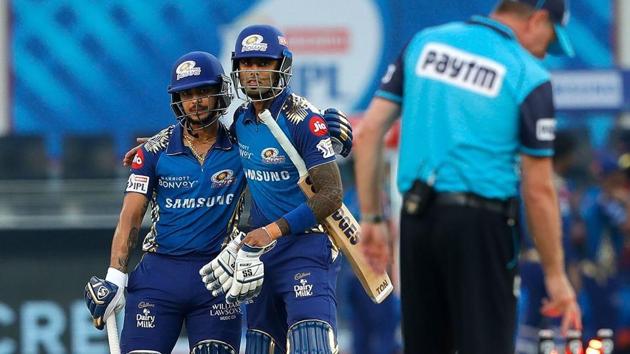
Just glance through the Mumbai starting XI, and you’ll get an idea of what I mean. It’s not a team. It’s a formula. An overseas batter who is comfortable against pace and can take advantage of the powerplay (Quentin de Kock, previously the likes of Evan Lewis.) Alongside him, a prolific anchor (Rohit Sharma). Then an Indian top order bat to counter the abundance of spin in the IPL, with at least one left hander (Ishan Kishan, Surya Kumar Yadav fill these roles, previously played by Ambati Rayudu, leftie Nitish Rana and Dinesh Karthik).
We’ll talk about the hitters, the Pandya brothers and Keiron Pollard in a bit, but look first at the variety of roles in the bowling department: A leg spinner who can bowl the googly, (Rahul Chahar, previously Mayank Markande). A left arm spinner (Krunal). Then fast bowlers with wildly different release points: The left arm angle (Trent Boult, previously it was Mitchell Johnson). A freak with a deadly yorker--and Mumbai have been lucky to usually have two--Jasprit Bumrah and Lasith Malinga. This year, an overseas quick to intimidate Indian batters (Nathan Coulter-Nile). And finally they have a 12th option, an off spiner (Jayant Yadav) who can be deployed against left handed batting line ups.
You see the genius of the design when you zoom out and look at the entire squad and see that the bench is almost a mirror image of the first XI, Indian for Indian, overseas for overseas.
Chris Lynn can come in for de Kock, with Kishan taking the gloves. Saurabh Tiwary can step in for Kishan.
Anmolpreet singh covers Yadav or Sharma. Anukul Roy covers for Krunal. Mitch McCleneghan covers for Boult. Coulter Nile has James Pattinson as his shadow. Sherfane Rutherford’s six
hitting talents are a backup to Pollard, minus the experience. Then there are the little known players, simultaneously both back ups and future investments: leggie Prince Balwant Rai for Chahar, and left arm seamer Mohsin Khan for Bumrah.
It’s like Mumbai went to the auction table and ordered the perfect T20 squad. Then they said, ‘jara roti repeat karna’.
Now to the Pandyas, Bumrah and Pollard, the explosive core of this exceptional side.
Mumbai’s early investments in scouting, both data-driven and traditional, reaped rich rewards between 2014 to 2016 when they spotted the Pandyas and Bumrah, all out of Gujarat (Scout Kiran More, who runs an academy in Baroda, roped in the Pandyas, head scout John Wright picked Bumrah). Obtaining the trio early at rock bottom prices bought Mumbai more than three gun players; the Pandya brothers’ all round skills bought their team flexibility.
They always have serious batting till No.7 and a sixth bowling option, something that has served them well this season with Hardik not bowling.
And just to show that it’s not all about the numbers, look at Pollard and Sharma to consider the loyalty factor. While Mumbai Indians have made switches at auctions as per resources available, these two enjoy a long rope and will be backed by the franchise, as we saw with Pollard’s form in 2018 and Sharma’s injury this season. Their leadership and ability to drive team culture into the next generation counts for them, as does their openness to look at the data: Sharma recently credited analyst CKM Dhananjai with their success, and Pollard’s other franchise, Trinbago Knight Riders, are also famously data-driven.
You can see just how Mumbai are ahead of the curve by observing their final opponents, themselves a shrewd analytical team. The balance of the Delhi Capitals squad was severely affected by Rishab Pant’s injury, forcing them to drop Shimron Hetmeyer. Add to that the fact that, ahead of the 2020 season, Delhi let go of Trent Boult, who has now wreaked havoc for Mumbai.
A bad auction strategy means a bad season, but a good one does not guarantee a title. Mumbai may or may not prevail on Tuesday, but they have a formula that ensures they will, for a few years now, colour most of the IPL blue.


