
 E-Paper



Tiger data not updated as annual survey not done in reserves, probe into wildlife crimes suffers
The Wildlife Institute of India (WII) lacks an updated database about tiger reserves after the 2014 national estimation of big cats, posing a bottleneck in investigations into wildlife crimes, experts and activists said.


The Wildlife Institute of India (WII) lacks an updated database about tiger reserves after the 2014 national estimation of big cats, posing a bottleneck in investigations into wildlife crimes, experts and activists said.
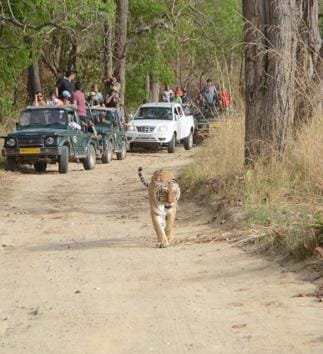
On May 9, the Special Task Force (STF) of Meerut and forest department officials of Bijnore, Uttar Pradesh, seized a tiger skin and nearly 18 kg tiger bones near Nagina, bordering Kotdwar and the Corbett Tiger Reserve. Two people from the Bawariya community of Haryana were arrested.
The place of arrest is close to UP’s Kothkhadar, where a man, accused of poaching five tigers in 2016, informed officials that tiger parts had been kept in pits.
Wildlife activists claimed the source of tiger parts could be Corbett. But in the absence of a stripe analysis of the reserve, it was difficult to ascertain if the tigers were poached in Uttarakhand.
“WII has not been doing camera trapping in Corbett since 2015. Hence I am sure they do not have the database to match the stripe pattern,” wildlife activist Rajeev Mehta said.
“Unless the tiger repository has updated data, no tiger crime in the country could be decoded. The tiger skins could be from Corbett and Rajaji, they being the closest reserves. To authenticate this, database is needed,” he added.
According to National Tiger Conservation Authority (NTCA) protocols, reserves are required to do an annual monitoring of tigers, which is called Phase IV survey. The survey is crucial to understanding the health and status of big cats in protected areas.
Experts at Dehradun-based WII, now engaged with the All-India Tiger Estimation at 50 reserves, are yet to receive annual monitoring details from all the reserves.
“To run the national repository, it should be the mandate of NTCA to make the data available to us. We are not the authority to direct the reserves,” WII director VB Mathur said.
On NTCA’s directions, WII experts have trained officers and staff in the last 15 years on how to conduct Phase IV annual monitoring. The reserves compile the data and submit it to NTCA, which in turn sends it to WII. Officials close to the monitoring exercise claim that only 50% of the reserves have submitted the annual reports to NTCA.
“The annual monitoring helps in preparing baseline data for the national estimation. It helps in understanding index and areas. Annual reports make our work easier during the estimation,” said Qamar Qureshi, a tiger expert at WII.
Chief wildlife warden DVS Khati said annual monitoring details about Corbett and Rajaji have been submitted to NTCA.
Anup Kumar Nayak, member secretary of NTCA, said, “I have recently joined the department and will check and resolve this issue (laxity in annual monitoring).”
Tigress found dead in Almora
An adult tigress was found dead in Almora forest division late on Sunday night, the sixth big cat mortality in Uttarakhand this year and second in a week’s time, officials said.
The post-mortem was carried out on Monday. It was claimed that the big cat carcass was housed in a washroom the whole night, so that the examination could take place in the morning.
The divisional forest officer (DFO) rejected the claims. “I don’t think that’s the case. It’s a tough terrain and we need to arrange two veterinarians. Till then the animal was kept at our range office in Dabra,” DFO Pankaj Kumar said.
On May 10, a 2.6-year-old tiger was found dead in Haridwar forest division.


