
 E-Paper



Cases in Delhi continue alarming rise: 8,593 new infections reported
The day saw the highest daily test count, as well as the most RT-PCR tests conducted on a single day in the city.

 Prefer HTon Google


In yet another worrying sign for Delhi, the number of daily new coronavirus disease (Covid-19) cases in the capital touched another peak, with over 8,000 cases being recorded in a single day for the first time on Wednesday.
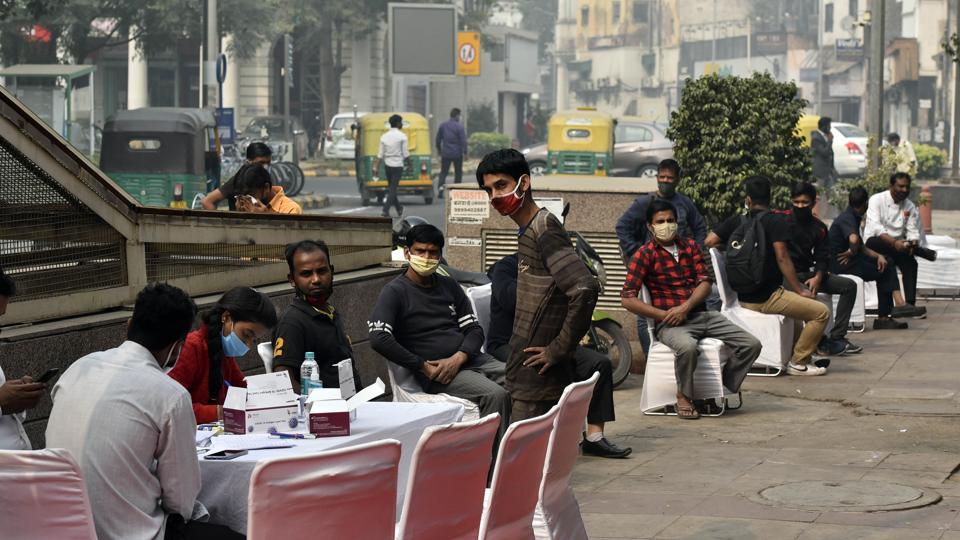
The city is in the throes of a third wave of the disease, with cases rising by the day, and more hospitalisations taking place, with the Delhi high court stepping in and asking the state government for a plan to fight the virus.
Delhi reported 8,593 cases as per Wednesday’s Delhi government health bulletin.
However, the day also saw the highest daily test count, as well as the most RT-PCR tests conducted on a single day in the city.

While a total of 64,121 tests were conducted, 19,304 of these were of the more reliable RT-PCR variety.
The city also recorded 85 deaths due to the infection, the highest number of single-day deaths since June 16 when Delhi added 437 deaths to its total toll while reconciling old data.
So far, 459,975 people have been infected in the Capital and 7,228 of them have died.
The city saw a surge in the number of cases over the fortnight, recording over 5,000 cases each day except on a Sunday. On average, 6,898 cases were reported each day during the last seven days, compared to 5,536 the week before, and 3,941 the week before that. A committee headed by NITI Aayog member Dr VK Paul had earlier predicted that Delhi could see around 15,000 cases a day during the winters.
Covid update: Sputnik-V 92% effective; Pfizer challenge; Delhi HC on surge
“When you compare the number of cases to the numbers during previous surge, you have to see that the government is testing a lot of people now. Yesterday, over 59,000 people were tested; only 17 to 18,000 people were being tested during previous peaks. I feel that the number of cases will likely go down in the next few days,” said Delhi health minister Satyendar Jain.
“Apart from people being out and about during the festive season, the pollution levels have also been high. And, now there is enough evidence to show that pollution can not only lead to severe Covid-19, but also increase in transmission of the infection,” said Dr Shobha Broor, former head of the department of microbiology at the All India Institute of Medical Sciences (AIIMS). She said small get-togethers with relatives during the festive season could potentially accelerate the transmission of the virus, as people are not as careful with following preventive measures when they are with family members.
Despite the rising number of cases, the results of the fourth round of Delhi’s serological survey shows that there was an increase of just 0.4% between early September and mid-October in the proportion of people that had antibodies against the infection.
“An increase of 0.4% means that four cases were reported for 1,000 population translating to 4,000 cases per million population during the one-and-a-half months,” said Dr T Jacob John, former head of the department of virology at the Christian Medical College, Vellore.
Along with the number of cases, the city also saw a spike in the number of deaths over the last week, recording over 80 deaths a day twice. The number of deaths is inching close to the highest 101, during the June-July surge in cases, when treatment protocols were still being decided.
On average, 75 people died of the infection each day during the last seven days, as compared to 44 the week before.
The case fatality rate (CFR) — the proportion of the people who die among those who test positive — remained at 1.57%.
“The biggest reason for death due to Covid-19 is a drop in oxygen saturation. So, we have asked our centres to test the oxygen level of the patients undergoing COvid-19 test so that even if they do not feel other symptoms they can receive timely treatment,” said Jain on Wednesday during a press briefing.
The doctors have previously warned about “happy hypoxia” associated with Covid-19 where the patient’s oxygen levels drop without any apparent breathing difficulty.
Another concern that the government is facing is the shortage of ICU beds. With over 5,000 cases being reported over the fortnight, hospitals are filling up fast. As on Tuesday, 8,497 persons with the infection were admitted to hospitals.
Almost 52% of the total 16,500 beds earmarked for the treatment of Covid-19 in the government and private hospitals in the city are occupied. And, 85% of the intensive care unit beds – with and without ventilators – are occupied.
The government on Wednesday wrote to the centre to add 1,000 beds and 300 ICU beds in its hospitals. “We have written to the Centre to increase 1,000 Covid-19 beds and 300 ICU beds in its hospitals. We have also approached the Supreme Court to challenge the high court decision on reserving ICU beds in big private hospitals,” said Jain. The Delhi government in September had directed 33 big private hospitals to reserve 80% of their total ICU beds for the treatment of Covid-19. The matter was challenged by a hospital association in the high court.


