
 E-Paper



DDA requests Delhi govt to revise compensatory plantation policy
Citing land constraints, the land-owning agency has requested the government to revise the number of trees to be planted under compensatory plantation from 10 saplings to two for every tree that is cut.

 Prefer HTon Google


The Delhi Development Authority (DDA) has requested the Delhi government to revise the compensatory plantation norms—10 saplings have to be planted for every tree that is cut—under the Delhi Preservation of Trees Act, 1994, as it is increasingly becoming difficult to provide land for compensatory plantation in the Capital.
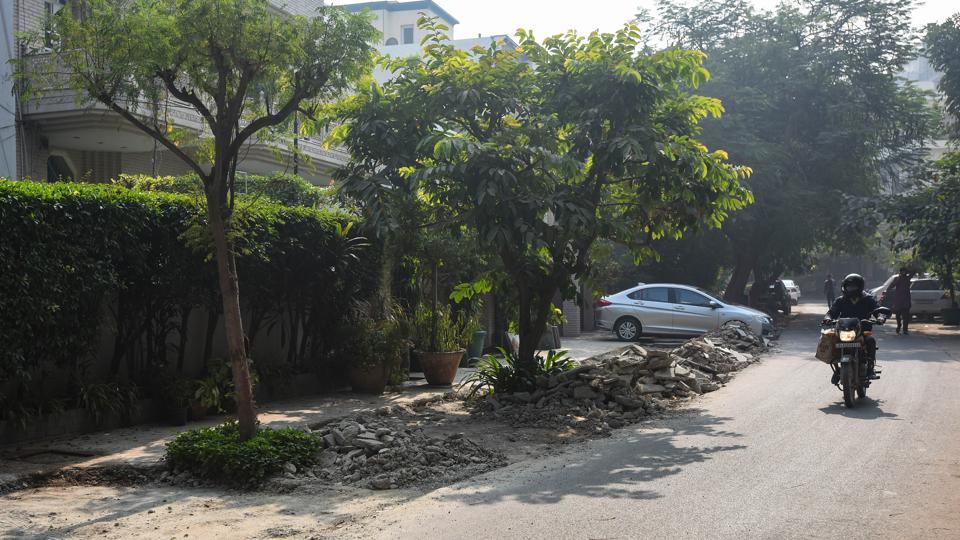
Citing land constraints, the land-owning agency has requested the government to revise the number of trees to be planted under compensatory plantation from 10 saplings to two for every tree that is cut.
DDA officials said that in this financial year alone they have received compensatory plantation requests from various development agencies for approximately three lakh trees, for which 300 hectares of area is required.
Citing the increase in Delhi’s green cover from 268 sqkm to 324 sqkm in 2019, DDA vice-chairman Anurag Jain said that the Delhi government’s compensatory plantation policy of planting trees in 1:10 ratio has played an important role.
Jain said, “Given the land constraints, it is becoming increasingly difficult to support compensatory plantation and compensatory afforestation for development projects. Therefore, having achieved its purpose, the policy of Delhi government needs to be revisited. We have taken up this issue with the Delhi government.”
He added, “As per the third-party audit conducted by Forest Research Institute, Dehradun, the survival rate of saplings planted by DDA is in the range of 80-90%.”
A senior official with the environment department, requesting anonymity, said, “We have received the DDA’s proposal. The matter was discussed and is under consideration, but no decision has been taken so far.”
Apart from compensatory plantation, the Delhi government recently approved a tree transplantation policy under which development agencies have to transplant 80% of the trees affected by their projects to a new location. A senior DDA official said that more land is required for transplantation.
The official said compensatory plantation is done in areas earmarked as green spaces for recreational purpose in the master plan. As per the Master Plan of Delhi-2021, “green /recreational use constitutes 8,722 hectare of land (including 1,577 hectare under the Northern, Southern and Central Ridge)”. Compensation plantation is mainly done in green spaces other than the ridge area.
A senior DDA official said that over the years, land for compensatory plantation allotted to the development agency has been part of biodiversity parks, the Yamuna floodplains, district and regional parks, etc. The compensatory plantation is done either by the development agency such as NHAI, PWD, DMRC etc itself or the forest department on behalf of the development agency. DDA will be doing compensatory plantation for various agencies for the first time this year due to land constraints.
This year, DDA has allotted land to plant around 298,000 saplings and allotted 50 hectares in Dwarka to various development agencies. In the past few years, it has allotted land for over 200,000 saplings for compensatory plantation to various agencies, said a senior DDA official.
The official said, “For the first time, we are now providing land for compensatory plantation before meeting our annual plantation targets. This time we will be doing compensatory plantation for various agencies. As for tree transplantation, we have told agencies to do it near the project site.”
While environmentalists and urban planners agree that availability of land is an issue, they say it is now time to prioritise development projects. Some agree that there is a need to re-look at the compensatory plantation policy.
Vijay Dhasmana, ecologist and curator of Aravali Biodiversity Park, Gurugram, said, “Land is a scarce resource. The DDA is right in their view that there will be no land left if we continue with present compensatory plantation guidelines. The problem is that there is no vision for holistic development of the city.”
AK Jain, former DDA planning commissioner, said that the present policy has been a deterrent against indiscriminate tree cutting for development projects and people, therefore, it should continue. “There is a need to prioritise development projects in order to decongest the city. As for shortage of land, it shouldn’t be just DDA’s responsibility to provide land. The Delhi government has large land parcels in the green belt along the Delhi Haryana border which can be used for compensatory plantation.”
Environmentalist Kanchi Kohli, a researcher with the Centre for Policy Research, said, “The proposal represents an urban imagination which treats trees and green public spaces as a burden. We start with proposals for tree removal, rather than tree protection. If we continue to approach urban land only as real estate and to build concrete infrastructure, there will never be enough land for compensatory plantation. We have at least four decades of evidence to show compensatory afforestation has been a failure, that too by design.”
But considering the pace at which development work is going on in the city, especially in urbanised areas, some experts say that there is a need to rework the compensatory plantation policy.
Sabyasachi Das, former DDA planning commissioner, said that plantation can’t be done on land earmarked for commercial or other development uses as future requirements have to be kept in mind. “Earlier, we used to give land on the Yamuna floodplains. But there is a limit to which plantation can be done in the floodplains. Ideally, a majority of compensatory plantation or transplantation should be done near the project site. There is a need to reduce the amount of compensatory plantation as it will become difficult to undertake development projects in the future. A solution has to be found,” said Das.
Dhasmana says that there is a need to rework the compensatory plantation policy but for a different reason. “There is a need to review the policy, as compensatory plantation done in the city is a complete eyewash. The idea is flawed as just planting trees anywhere is not good enough; we have to create habitats. Unfortunately, we are seeing even land rich in wilderness being used for compensatory plantation. This is not how it should be,” Dhasmana said.
The Delhi government refused to comment on the matter.


