
 E-Paper



Delhi: Air quality improves marginally after Sunday’s rain
The national capital’s AQI improved to 325 on Monday morning from 395 on Sunday evening. An AQI between 401 and 500 and 301 and 400 is considered in the “very poor” and “severe” category, respectively


Delhi’s air quality index (AQI) improved from “severe” on Sunday afternoon to “very poor” category by late evening. The AQI further improved on Monday morning, but still remained in the “very poor category.
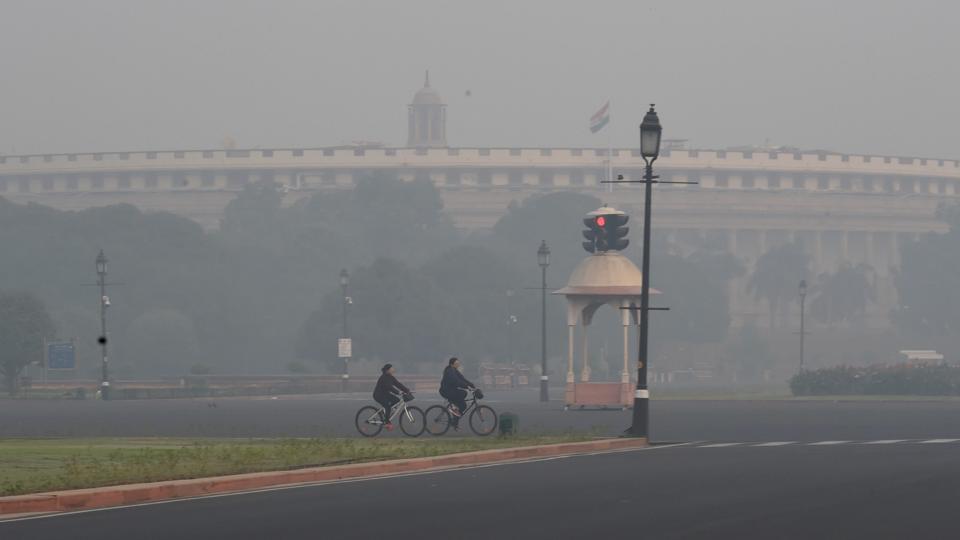
The national capital’s AQI improved to 325 on Monday morning from 395 on Sunday evening. An AQI between 401 and 500 and 301 and 400 is considered in the “very poor” and “severe” category, respectively.
Severe air quality was recorded on the Diwali day, which was celebrated on Saturday (November 14), but dispersed quickly by the evening because of rainfall and thunderstorms triggered by a Western disturbance in the western Himalayan region.
Also read | Diwali pollution: Delhi-NCR exhibits irresponsibility, again
Some parts of Delhi had received rainfall, measuring up to 2 millimetres (mm), till at around 6.30pm on Sunday accompanied by winds blowing up to 30 kilometres per hour (kmph).
The wind speed helped disperse Diwali-induced air pollution accumulated over the past two days.
Favourable meteorological conditions helped improve the national capital’s AQI this year after Diwali, which was far worse during the corresponding period last year.
In 2019, Diwali was celebrated on October 27. The AQI on October 27 and 28 was 337 and 368, respectively, and was in the “very poor” category. On October 29 and 30, the AQI further worsened to the “severe” category and showed 401 and 419, respectively.
The Union Ministry of Earth Sciences’ (MoES) air quality early warning system has forecast that wind direction would likely to be easterly or north-easterly on Monday and wind would blow up to six kmph.
“The AQI is likely to remain in the ‘very poor’ category on Monday. Wind speed is unlikely to pick up significantly. As a result, no major improvement in the AQI is expected,” said Vijay Soni, a scientist at India Meteorological Department’s (IMD) air quality division.
Central Pollution Control Board’s (CPCB) evaluation report on air and noise pollution levels was released on Sunday. CPCB data showed that the AQI was far higher than last year, despite a blanket ban on sale and use of firecrackers because of the raging coronavirus disease (Covid-19) outbreak and pollution woes.
Besides, there was no significant dip in noise pollution levels.
Delhi’s average particulate matter (PM) 10 and PM 2.5 concentrations on Diwali day was 645 micrograms (mg) per cubic metres (m), 6.45 times of the national standard and 483 mg per cubic m, eight times of the national safe standard.
CPCB attributed the AQI to unfavourable meteorological conditions along with an impact of raging stubble fires in neighbouring Haryana, Punjab and parts of western Uttar Pradesh.
This year the surface temperature and average mixing height were recorded to be the lowest in the last five years. A lower mixing height limits vertical dispersion.
The hourly average concentration of PM2.5 started increasing since 11pm on Saturday (November 14) and reached its peak in most of the weather stations at around 1am, the report added.
“This year air pollution levels both during pre-Diwali and the Diwali day have been higher than last year. One of main reasons for this is the contribution of stubble fires to Delhi’s PM 2.5 concentrations on both the days. On the Diwali day, stubble fires contributed to 32% of Delhi’s PM 2.5 load and on the pre-Diwali day it was 38%. Meteorological conditions are also adverse because Diwali was in mid-November this year, when mixing height is low (mixing height is the height at which pollutants mix in the air). The contribution of firecrackers or festivities is lower this year, as compared to 2019. Besides, pollution levels had spiked substantially last year on the Diwali day, as compared to pre-Diwali,” said a CPCB scientist on condition of anonymity.
The minimum temperature in Delhi on Monday morning was 16 degrees Celsius (C) -- 2 degrees C above normal. It is likely to fall below 10 degrees C in the next two-three days, according to IMD.

Stay updated with all top Cities including, Bengaluru, Delhi, Mumbai and more across India. Stay informed on the latest happenings in World News along with Delhi Election 2025 and Delhi Election Result 2025 Live, New Delhi Election Result Live, Kalkaji Election Result Live at Hindustan Times.


