
 E-Paper



High wind speed improves Delhi’s air quality to ‘poor’ zone
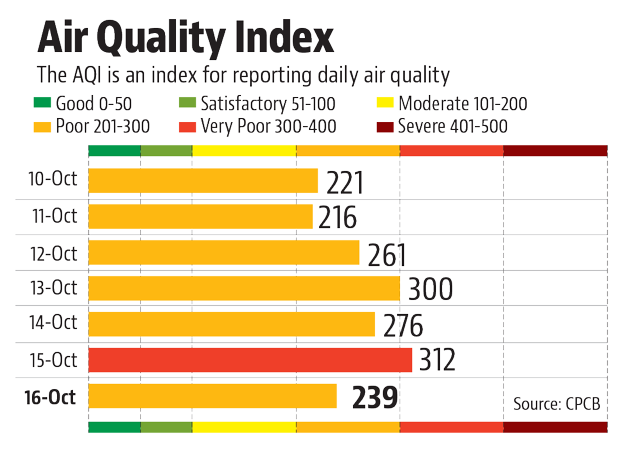
Central Pollution Control Board’s (CPCB) 4 pm bulletin on Friday recorded the overall AQI of Delhi at 239 -- categorised in the poor category. Meteorological officials said some more improvement could happen from Saturday as the wind direction is expected to change to easterly from the north-westerly at present.

 Prefer HTon Google


High wind speed cleared Delhi’s hazy and polluted skies to a considerable extent and improved the overall air quality index (AQI) to 239 in the ‘poor’ zone on Friday, a day after it had slipped into the ‘very poor’ category for the first time this season on Thursday.

Central Pollution Control Board’s (CPCB) 4 pm bulletin on Friday recorded the overall AQI of Delhi at 239 -- categorised in the poor category. Meteorological officials said some more improvement could happen from Saturday as the wind direction is expected to change to easterly from the north-westerly at present.
On Thursday, the day when the winter segment of the Supreme Court-approved Graded Response Action Plan (Grap) — a set of anti-pollution restrictions that include pre-emptive measures to stop the air quality from deteriorating to emergency levels — kicked in, Delhi’s AQI slipped into the red zone, recording an AQI of 312 in the CPCB scale.
On Friday, however, levels of PM 2.5 (ultrafine particulate matter with diameter less than 2.5 micrometres) and PM 10 (particulate matter with diameter less than 10 micrometres) also saw a downward trend through the day.
Also Read: AQI reaches ‘very poor’ on the first day of Grap winter plan in Delhi
From 155.1ug/m3 recorded at 2pm on Thursday, the level of PM 2.5 dropped to 104.7ug/m3 at 2pm on Friday. PM 10 levels also decreased from 317ug/m3 at 2pm on Thursday to reach 237.2ug/m2 at 2pm on Friday.
The permitted limits of PM10 and PM2.5 are 100µg/m3 and 60µg/m3, respectively.
Apart from the Jahangirpuri and Wazirpur CPCB monitoring stations, the hourly average AQI at all other observatories had improved from the ‘very poor’ zone to the ‘poor’ zone.
Some stations such as Najafgarh, Lodi Road, Aya Nagar and Okhla had improved to the ‘moderate’ category by Friday evening.
Scientists from the India Meteorological Department (IMD) said this improvement was mainly because the wind speed during the day rose to around 10-12kmph, helping disperse pollutants that had accumulated closer to the surface.
VK Soni, head of IMD’s Environment Monitoring Research Centre, said the wind speed during the day remained in the range of 10-12kmph. So, even though the wind direction remained north-westerly, the ventilation co-efficient was high, Soni said.
The wind speed till 9am on Thursday was calm. Even though it picked up to reach 6kmph around 11 am, the direction was north-westerly, which brought smoke residue from the neighbouring states of Punjab and Haryana.
The higher the coefficient, the more efficiently the atmosphere is able to dispose of the pollutants and better is the air quality.
Also Read: AAP, BJP trade charges over farm fires, pollution
“Through the day, Delhi’s average wind speed was 10-12kmph, blowing from the north-west direction. However, by evening, the wind speed reduced. But from Saturday we are expecting some improvement as the wind direction will change to easterly,” Soni said.
Kuldeep Srivastava, head of IMD’s regional weather forecasting centre, also said that in the next two days, there is no sign of any significant deterioration in the air quality.
The Union ministry of earth science’s System of Air Quality and Weather Forecasting and Research (Safar) data also showed that the contribution of stubble burning from the neighbouring states of Punjab and Haryana in the city’s air pollution levels remained low.
“The share of stubble burning on Delhi’s air quality was 18% on Friday. The number of fires spotted over Punjab and Haryana were 583,” the Safar air quality report read.
On a scale of 0-500, a value of 0-50, the air quality is considered good (minimal health risk), 51 -100 is satisfactory (minor discomfort to sensitive people), 100-200 is moderate (breathing discomfort to people with lungs and heart disease), 200-300 is poor (breathing discomfort to most people on prolonged exposure), 300-400 is very poor (respiratory illness on prolonged exposure) and 400-500 is severe (affects healthy people and seriously impacts those with existing diseases).


