
 E-Paper



Many mourn the dead, some mourn severed ties with neighbours of years
Amid blame games that continued between several Hindus and Muslims regarding who caused the violence – both in terms cause and effect – few things remained constant —


As Nafeesa Begum cried inconsolably, her five-year-old granddaughter Gudiya patted her occasionally. It was around 3pm Thursday and a large crowd had gathered in the narrow lane outside their home in north-east Delhi’s Kabir Nagar. In half-an-hour, when the hearse carrying her 27-year-old son Ishtiaque Khan’s body turned into the lane, a collective wail rose from the house.
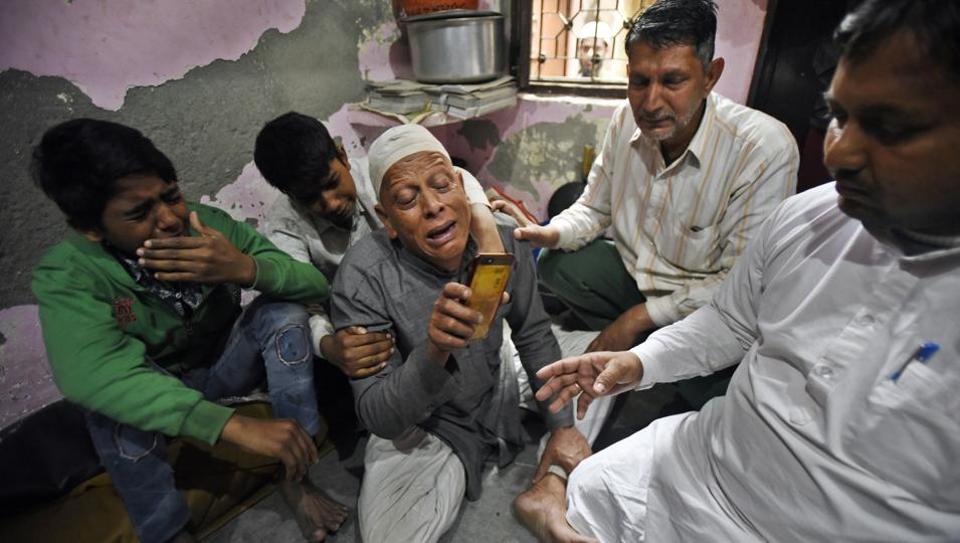
Khan, relatives said, was the victim of a stray bullet during the rioting on Monday. “He had heard about the violence and had rushed to a grocery shop to buy some essentials for his two children – one aged five and the other a toddler,” said Begum.
A lot has changed since then. The Jafrabad chowk and Maujpur chowk were opened to traffic on Thursday. While the first was the site of a sit-in protest by Muslim women against the Citizenship (Amendment) Act (CAA), the other was occupied by Hindus who stood in support of the law and played Hanuman Chalisa on loop on loudspeakers installed temporarily along the blocked road. All makeshift arrangements were cleared by the police.
In Chand Bagh, around 3km from Kabir Nagar, another group gathered to attend the funeral of a four-year-old girl around 4pm. She suffered from kidney ailment and died during the riots – for want of urgent medical care, her relatives said.
“There has been a lot of damage to lives, homes, businesses and livelihoods— the hardest hit are the poor. How does it matter if they were Hindus or Muslims?” Mohammad Asif, a resident of Kabir Nagar, said.
What has hurt Asif more was how friendly ties with neighbours have changed after the recent violence, he said, identifying one of his childhood friends, a Hindu, as the first to have deserted him when the riot was at its peak.
However, people also shared multiple accounts of Hindus and Muslims protecting one another and each others’ religious places.
Amid blame games that continued between several Hindus and Muslims regarding who caused the violence – both in terms cause and effect – few things remained constant such as despair over the losses, challenges to livelihood, difficulty in attending schools and colleges, accessing health care services, kitchens running out of ration, children getting anxious and more than anything, free movement in these localities which people of all faiths have shared in large numbers for generations.
In some neighbourhoods, residents could be seen on Thursday taking measurements for iron gates to be put in their lanes to ensure protection of such violence in future. Streetlights were also being repaired in both arterial roads and lanes.
Since Sunday, when the riots started from the Jafrabad-Maujpur stretch, several have left the area in fear of being attacked. Most of them were people whose residents are on the main roads who feared maximum damage – their apprehensions eventually came true – and other than them were labourers and migrant workers who reside as tenants in the unauthorised colonies and slums in these localities.
“Four labourers working with me have fled to their villages in Uttar Pradesh. Work has been severely affected. We are unsure how much time will it take for business to get back to normal,” said Ranjeet Singh, a contractor based in Jyoti Nagar, another riot-hit locality.
The violence in north-east Delhi began on Sunday in the Jafrabad-Maujpur arterial stretch with clashes between groups supporting and protesting against the CAA. On that day, Bharatiya Janata Paty (BJP) leader Kapil Mishra attended a public gathering in the area and gave an ultimatum to the police to clear the protest site led by anti-CAA protesters in three days.
While residents of the riot-hit areas continued demanding crackdown on Mishra, the BJP leader on Thursday organised a so-called demonstration in New Delhi’s Jantar Mantar, demanding “peace” be restored.
Monday and Tuesday witnessed widespread rampage, arsons, murders and vandalism by armed mobs with the epicentre of the violence changing with time – engulfing one neighbourhood after another. Both Hindus and Muslims were victims of the violence – they were killed, their homes and shops ransacked and torched, mosques and shrines set ablaze and hundreds of vehicles burnt.
The violence has claimed at least 38 lives and wounded about 350 people.
In Chand Bagh, around 4 km from Jafrabad, the violence primarily began on Monday afternoon when the police tried clearing an anti-CAA protest site and Muslims resisted. Taking advantage of the melee, residents recalled, a mob engaged in stone-pelting. This led to a full-blown communal violence, they said.
The Chand Bagh violence spread on both sides of the roads connecting the Yamuna embankment region with Loni in Delhi-Ghaziabad border – affecting neighbourhoods that include Yamuna Vihar, Khajoori, Bhajanpura, Gokalpuri, Brijpuri and Dayalpur. By evening, the violence crawled through the interconnected maze of narrow lanes to cover other localities such as Karawal Nagar, Mustafabad, Brahmpuri and Shiv Vihar , police officials and north-east Delhi said.
Charred houses, broken shops, damaged vehicles that dot the roads, damages walls, bullet and tear gas shells and debris being cleared by labourers engaged by civic agencies bear testimony to the shifting locus of the violence.
In 2006, the same region had witnessed widespread protests during a sealing operation against unauthorised commercial spaces. “Two children had died because of gunfire in Seelampur and the people went mad against the police. But it was not a Hindu-Muslim affair,” said Deepak Kumar, a resident of Kardampura, a riot-affected area.
A resident of Chand Bagh, Mohammad Gulfam, recalled how for more than a decade, the locality was frequently raided by anti-terror agencies and Muslim men often picked up for interrogation or arrested. “Even during those times, on several occasions Hindus showed solidarity and resisted the security officials. Things have changed now,” he said.
When asked what has changed over the years, several residents in these areas cited over-population, poverty and perpetual unemployment in these localities which, they said, have affected the social fabric.
On Thursday, in areas such as Jafrabad, Babarpur, Maujour, Gokalpuri and Ashok Nagar, traffic was normal though most shops remained closed. Police and central security officials could be seen deployed on the roads. In areas such as Chand Bagh and Yamuna Vihar, police could be seen doing frequent flag marches and “area dominance” rounds, using loudspeakers to enforce an informal curfew – shooing away both residents and media personnel. In areas such as Shiv Vihar, the police were on the toes as sporadic instances of vandalism and stone pelting kept happening till Thursday morning.


