
 E-Paper



Three e-buses to run on trial basis from next month
The three-month-long trial is part of the government’s plan to induct a fleet of 1,000 electric buses in the city by June 2019.


Three electric buses will be rolled out for a limited period in the national Capital from next month, the Delhi government said on Monday.
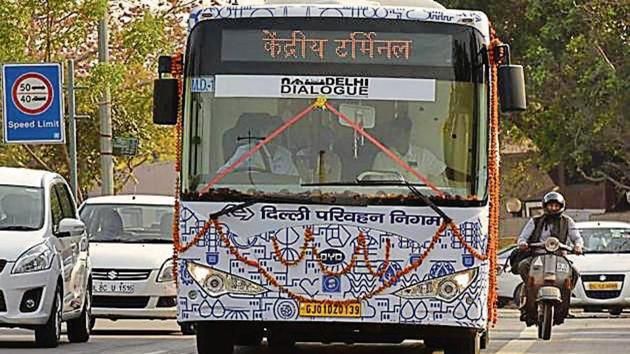
The three-month-long trial is part of the government’s plan to induct a fleet of 1,000 electric buses in the city by June 2019.
“The e-buses will be provided by three different manufacturers so that the government can identify the model best suited for Delhi’s conditions. This is being done to assess the performance of e-buses and its infrastructure requirements,” said state transport minister Kailash Gahlot.
On July 11, the Delhi government had given its in-principle approval for running 1,000 low-floor AC electric buses in the city which would cost Rs 2,870 crore. It had also appointed the Delhi Integrated Multi-Modal Transit System (DIMTS), which currently operates cluster buses in the city, as the consultant for the project.
Officials from DIMTS said running the three buses would be part of its study on electric mobility, a report of which will be submitted to the Delhi government by November. This will be the second time the Delhi government will be running e-buses on pilot basis. In March 2016, one bus was launched for trial and was returned to a Chinese manufacturing company after three months of plying on Delhi roads.
“Findings of the first trial were focussed mostly on the operations of the buses. This trial one will focus on identifying how depots need to be created for these buses because the fleet that is going to come in Delhi is going to be the largest in India,” a DIMTS official said on condition of anonymity. The transport department will construct six special bus depots for these buses — East Vinod Nagar, Bawana Sector-5, Burari, Rohini Sector-37, Revla Khanpur and Narela.
The 2016 study by the Delhi Transport Corporation (DTC) found that the deployed e-bus had marginally low operational costs compared to the CNG low-floor buses plying on city roads. The report stated that the problem was their high procurement cost. “AC CNG low-floor buses that are currently running on Delhi roads cost around Rs 85 lakh each, while an AC electric bus costs Rs 2.5 crore,” the 2016 report said.
While announcing the cabinet’s decision to bring 1,000 e-buses in Delhi by June 2019, chief minister Arvind Kejriwal had called it a “big step” towards modernising Delhi’s public transport system and for reducing pollution.

Stay updated with all top Cities including, Bengaluru, Delhi, Mumbai and more across India. Stay informed on the latest happenings in World News along with Delhi Election 2025 and Delhi Election Result 2025 Live, New Delhi Election Result Live, Kalkaji Election Result Live at Hindustan Times.


