
 E-Paper



1-year report card: A few false notes in an AAP-roarious medley
The catchy phrase summarised one year of the Arvind Kejriwal government that was sworn in on February 14 last year, a roller-coaster 12 months that have seen bitter political wrangling between the city government and the Centre, repeated public spats between the chief minister and the lieutenant governor and a bureaucracy hamstrung between the two.


“Wo pareshan karte rahe, hum kaam karte rahe (they kept putting hurdles, we kept performing) — the Aam Aadmi Party government plastered this slogan on giant billboards across the Capital a few months back.
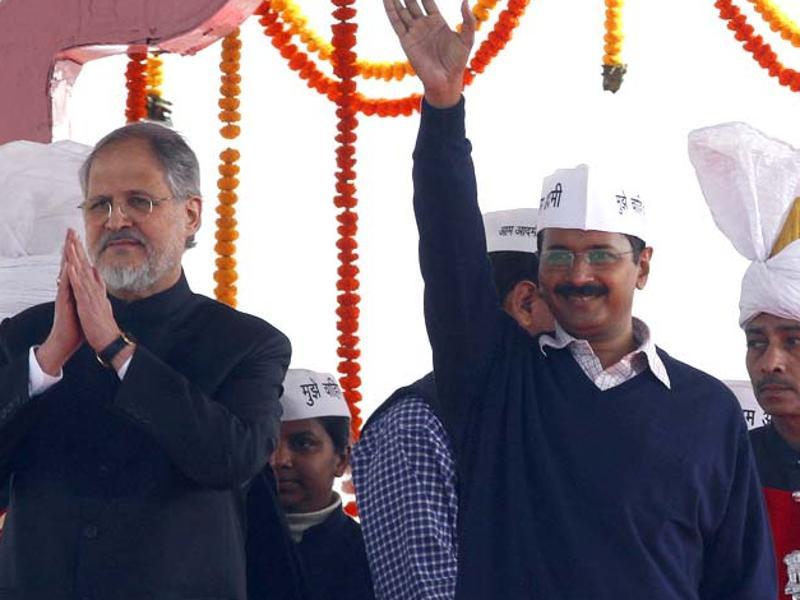
The catchy phrase summarised one year of the Arvind Kejriwal government that was sworn in on February 14 last year, a roller-coaster 12 months that have seen bitter political wrangling between the city government and the Centre, repeated public spats between the chief minister and the lieutenant governor and a bureaucracy hamstrung between the two.
Opponents may have termed the advertisement ‘political’ and accused the AAP of spending public money for promotions but the slogan mirrored the tone of the Kejriwal government – that the Centre was determined to not let the city administration succeed.
At the centre of the fight was Delhi’s unique constitutional position. The city graduated to a partial state from a Union territory in 1993 when it got a legislative assembly.
The public showdowns between the Delhi secretariat and the L-G’s office fuelled the biggest political demand in the city— full statehood.
Read | Delhi needs strong governance model based on clear chain of command
But unlike earlier times when the issue would be fanned during elections and be quickly buried afterwards, the AAP government kept the demand alive through its first 12 months in power, its voice only getting shriller with passing time.
The constant tug-of-war over administrative jurisdiction, control over police and other civic agencies like the municipal corporations and the Delhi Development Authority bear witness to the prolonged political tussle. The Delhi high court is hearing a bunch of PILs and writ petitions on related issues.
However, AAP leaders deny that their actions are aimed at making a case for full statehood— a key poll promise. “Our sole aim has been to deliver despite the obstacles put up by the central government. The results are for all to see,” a senior AAP leader said.
Sources said the tension between the Centre and AAP government escalated after the Delhi Police filed a kidnapping case in May last year against a team of the Anti-Corruption Branch — Kejriwal’s flagship project — that arrested a Delhi Police head constable on charges of extorting money from a scrap dealer.
The incident, as described by a senior party leader, was symbolic of attempts to blunt the anti-corruption resolve of the government—the plank on which AAP rode to a crushing victory and wanted to deliver on its promises.
Janlokpal Bill
However, the ruling party faced criticism for tabling the JanLokpal Bill nearly nine months after sweeping back to power with a brute majority. Arvind Kejriwal had quit during its first stint after 49 days as they were not allowed to table the bill in Delhi assembly on technical grounds.
Many political opponents, including former party leaders such as Yogendra Yadav and Prashant Bhushan, accused the government of diluting the bill as compared to the draft that was prepared during the janlokpal movement, and one that was AAP government tried to table in assembly in 2014.
Read | AAP workers raise concerns over ‘disconnect’ within party, MCD polls
The bill was finally cleared in Delhi assembly last year with amendments of clauses dealing with the selection committee of the Janlokpal and impeachment process.
But Ashish Talwar, Kejriwal’s political adviser, insisted the time taken to introduce the bill was a non-issue. “When people say that the government tabled the bill in assembly 2014 within 49 days, they conveniently forget we were running against time as the model code of conduct for the general elections could have set in anytime,” Talwar said.
Swaraj Budget
One of the biggest political pitches of the AAP government has been to introduce new models of governance, one among them being to decentralise power and increase people’s participation in decision making. Swaraj Bill, which aimed to do so, is still to be tabled in the assembly.
AAP leaders say while the bill will be cleared in Assembly in due course, the state government has already implemented the idea on the ground through successful implementation of the Swaraj Budget— participatory budgeting where eligible voters choose development project at mohalla sabhas.
“Development projects worth Rs 220 crore were decided by citizens last fiscal. This year, participatory budgeting would be done across the 70 assembly seats. Rs 20 crore will be allocated to each assembly seat,” an AAP functionary said.
“Multiply that amount to a period of next four years. It will be area residents who would be taking a call on projects worth hundreds of crores,” he said.

Stay updated with all top Cities including, Bengaluru, Delhi, Mumbai and more across India. Stay informed on the latest happenings in World News along with Delhi Election 2025 and Delhi Election Result 2025 Live, New Delhi Election Result Live, Kalkaji Election Result Live at Hindustan Times.


