
 E-Paper



Ghaziabad air more polluted than Delhi, Noida safer
Not only Delhi, but the entire neighbourhood seems headed for a major health crisis with air pollution levels rising alarmingly and crossing the toxic mark of the pre-CNG days, Chetan Chauhan reports.


Not only Delhi, but the entire neighbourhood seems headed for a major health crisis with air pollution levels rising alarmingly and crossing the toxic mark of the pre-CNG days.

The latest Central Pollution Control Board (CPCB) report has rung the alarm bell for the national capital region. It says the particulate matter (PM) level in Ghaziabad in 2010 was higher than that in Delhi and the third highest in India after Gwalior, Madhya Pradesh, and West Singhbhum, Jharkhand.
In 2008, Delhi had emerged as the city with the highest PM level. The Capital, however, lost the pole position as smaller cities, including Ghaziabad, were getting polluted faster.
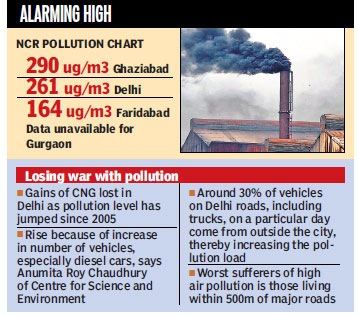
The PM levels almost doubled in the emergent industrial town. In 2010, the PM level in Ghaziabad was 290 micro grams per cubic meter of air (µg/cubic metre) as compared to 261 µg/cubic metre for Delhi. Increasing pollution in the Uttar Pradesh town had some effect with the National Green Tribunal imposing a ban on new industries there.
Ghaziabad’s dubious rise on the pollution chart does not mean that Capital’s particulate pollution level has fallen.
The CPCB data shows that the Capital’s particulate pollution — a cause for breathing problems and sneezing — had increased steadily since 2005 despite the Delhi government building several flyovers to reduce traffic congestion at important intersections.
Most disturbingly for environmentalists, the growth of pollutants in the Capital’s air was faster than in the 1990s, which prompted the Supreme Court to intervene, resulting in the introduction of the relatively cleaner compressed natural gas (CNG) for public transport.
The particulate matter level when CNG was introduced in 2000 was 150 µg/cubic metre -- double the national standard. The level dipped to 130 µg/cubic metre by 2005 and then steadily rose to 261 µg/cubic metre in 2010. The level of another lethal toxicant, nitrogen dioxide, has also risen steadily in Delhi since 2007, the CPCB report said.
Rocketing real estate prices and crowding in the Capital have had hurtful effects on the neighbouring towns, especially Faridabad, for which the comparative data since 2004 was available. PM pollution had been rising in Delhi’s southern neighbour since 2008, reaching 164 µg/cubic metre by 2010.
Noida was still better off in the NCR. Its PM level, at 132 µg/cubic metre, was the lowest in the region but still twice the national standard (60 µg/cubic metre) for residential areas.

Stay updated with all top Cities including, Bengaluru, Delhi, Mumbai and more across India. Stay informed on the latest happenings in World News along with Delhi Election 2025 and Delhi Election Result 2025 Live, New Delhi Election Result Live, Kalkaji Election Result Live at Hindustan Times.


