
 E-Paper



Going green: Government steps on gas
The government will soon notify new rules making it must for car manufacturers to improve per kilometer mileage of their fleet by around 20% in next eight years and have fuel efficiency based rating for cars from next year, Chetan Chauhan reports.

 Prefer HTon Google


The government will soon notify new rules making it must for car manufacturers to improve per kilometer mileage of their fleet by around 20% in next eight years and have fuel efficiency based rating for cars from next year.

The new fuel economy rules sent to Law ministry for final vetting after approval from Prime Minister’s Office also prescribes penalty for car manufacturers failing to meet the new specifications.
"The penalty will depend on the deviation from the standard and would be a disincentive to sell fuel guzzling cars," said a senior government official, requesting anonymity.
Primarily the new norms will do two things.
First, introduce a five star based labeling system meaning the most fuel efficient car in a particular weight category say up to 1,000 tonnes (small car) will get five star rating. The lowest will have one star rating.
"The vehicles not meeting even the lowest level will have to be phased out," said a senior official of Bureau of Energy Efficiency (BEE), tasked with formulating a labeling mechanism with the auto-industry.
Ajay Mathur, former BEE director general had recently told HT that the labels will be for a category of vehicles such as small, medium and big cars to help consumers to take an informed decision on how much they can save on fuel by buying a particular star rated car.
Linked with the labeling would be fuel efficiency standards for entire fleet of a car manufacturer, called Corporate Average Fuel Economy (CAFE) standards and measured in terms of global warming causing carbon dioxide emissions.
BEE has suggested 10 alterative to car manufacturers to meet the new norms.
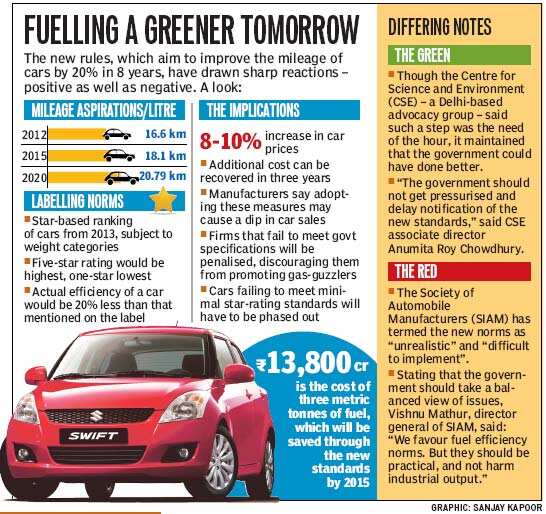
As of now, the average fuel mileage of auto industry is 16.6 kms per litre of fuel. The government wants to increase it to 18.1 kms/litre by 2015 and 20.79 kms/litre by 2020.
The new norms have auto manufacturers and environmentalists pitted against each other.
The Society of Automobile Manufacturers (SIAM) has termed the new norms as "unrealistic" and "difficult to implement" whereas Delhi based advocacy group Centre for Science and Environment (CSE) said it would have been much better.
"The government should not get pressurized and delay notification of the new standards," said CSE’s associate director Anumita Roy Chowdhury. SIAM director general Vishnu Mathur retorted: "We are in favour of fuel efficiency norms. But they should be practical and should not drive out industrial out-put."
The government officials expect the rules to be notified by this September with the labeling mechanism coming into force from April 2013.
The BEE has estimated the new standards would mean an up to eight percent increase in car prices which the buyers would be able to recover in three years because of fuel savings. For India, it will mean saving 3 million metric tons of oil (Rs. 13,800 crore annually) by 2015 and 11 million metric tonnes of oil (Rs. 45,000 crore annually) after 2020.
New fuel efficiency norms
2011 : 6 litres for 100 kms or 16.61 km per litre of fuel
2015 : 5.51 litres for 100 kms or 18.1 km per litre of fuel
2020 : 4.81 litres for 1000 kms or 20.79 km per litre of fuel.
Labelling
A must star based ranking of cars depending for different weight categories from 2013.
One star least fuel efficient and five star most efficient.
Efficiency of a car would be 20% less than that mentioned on the label.
Implications
Up to 8-10% increase in car prices
Additional cost for car buyer could be recovered in three years
Three metric tonnes of fuel to be saved by 2015
Car manufacturers say it could cause dip in car sales, which increased by 30% in 2011.


