E-Paper



A database of governors in India: Part 1 | Number Theory
.

 Prefer HTon Google


The office of the Governor is a critical bridge between the central and state executive in India. While the Governor is the state equivalent of the President as the ceremonial head of the executive, the discretionary powers bestowed on the office have served to sometimes give a partisan colour to it, especially when different parties are in power in the state and the centre. Controversies notwithstanding, the governor’s post is among the most important constitutional offices in the country. Because it is neither elected nor contingent on professional expertise (such as judges), it is also one of the most important acts of granting political patronage by the central executive. It is in this context that HT has prepared a comprehensive database of all governors India has had since independence to add to its existing portfolio of databases of council of ministers, chief ministers, deputy chief ministers and Supreme Court judges.

This three-part data journalism series will describe various aspects of gubernatorial appointments and the persons who have held this office in India. The first part outlines the methodology and traces gubernatorial appointments across decades under different presidents and prime ministers. The second part examines the governors’ professional trajectories before and after their appointments, along with their socio-religious profiles. The third and final part focuses on the nature of their tenures at the state level and their average duration in office.
- A note on methodologyThis analysis includes states and union territories (UTs) which have a legislative assembly and a Governor or Lieutenant Governor (LG). This means that UTs without a legislative assembly such as Chandigarh or Andaman and Nicobar Islands, have not been included. The names and tenures of Governors and LGs have been taken from state/UT government websites. This information has been augmented with HT’s own research on their demographic and political backgrounds using various sources and HT’s databases described above, and cross-checked for accuracy. The database covers all appointments from 15-08-1947 to 30-06-2025.
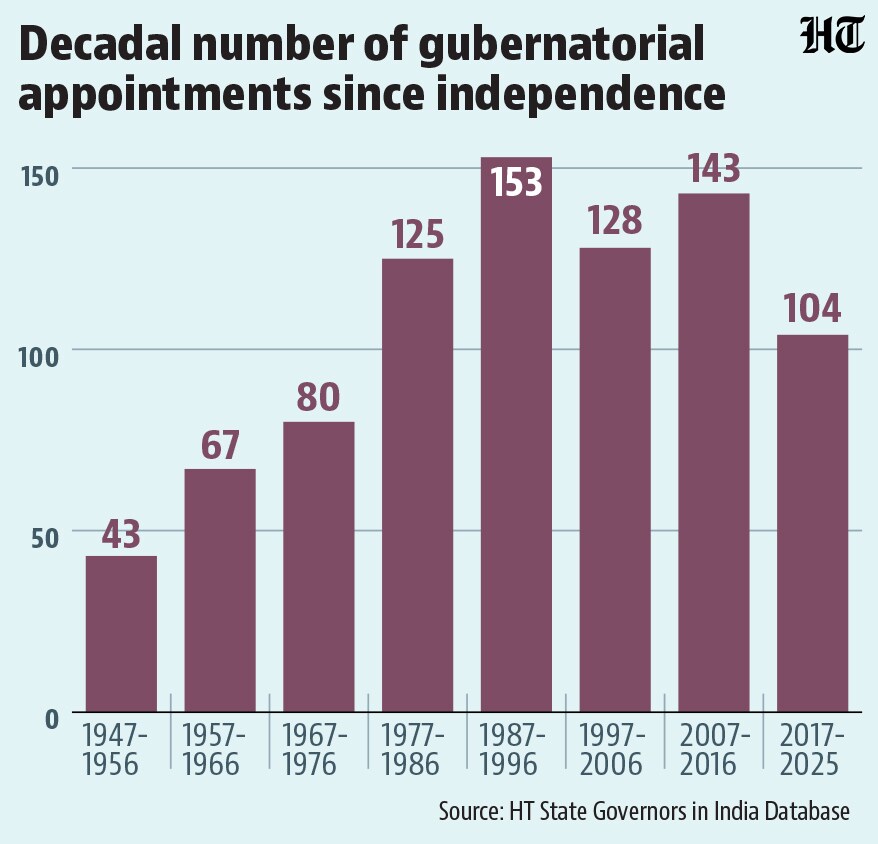
 India has had 843 governors so farIndia’s federal landscape has changed drastically since independence because many of today’s states did not exist in 1947. British India had just 11 governors and more than 560 kingdoms or principalities, which had neither legislative assemblies nor governors. All governors appointed by the British were removed at independence. On 15 August 1947, India appointed just six governors for the states of Assam, Bihar, Odisha, West Bengal, Punjab and the United Provinces (largely the current-day Uttar Pradesh). These appointments would continue to happen. New states coming into being also increased the number of gubernatorial positions, from 6 in 1947 to 31 today. To be sure, there are 484 unique names among the total 843 governors in the database. A person’s name is repeated as many times as they took an oath to the office of the governor.
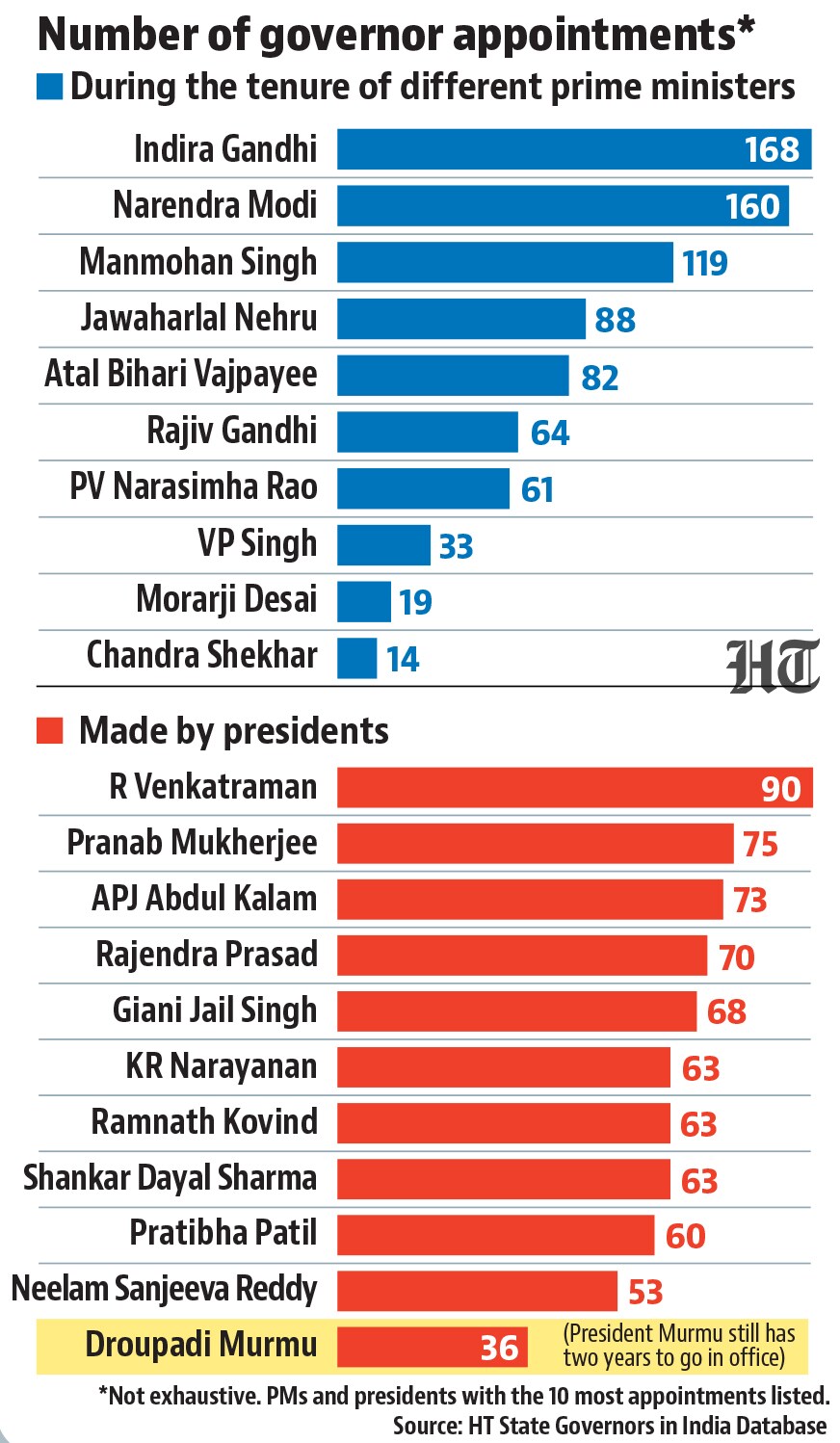
- Indira Gandhi and R Venkataraman appointed most Governors as Prime Minister and PresidentConstitutionally, it is the President who appoints a governor. However, it is done on the recommendation of the union government of the day in office. This makes it interesting to compare the number of governors appointed by every Prime Minister and President in India. Among the former, it is Indira Gandhi who appointed the highest number of governors (168) during her three terms as the Prime Minister. Second in the list is Narendra Modi, who has appointed 160 Governors since May 2014. Among Presidents, R Venkataraman made 90 gubernatorial appointments during his time in office from 1987 to 1992. One of the reasons for this unusually high number is that his tenure as president saw four prime ministers: Rajiv Gandhi, V P Singh, Chandrasekhar and P V Narsimha Rao.
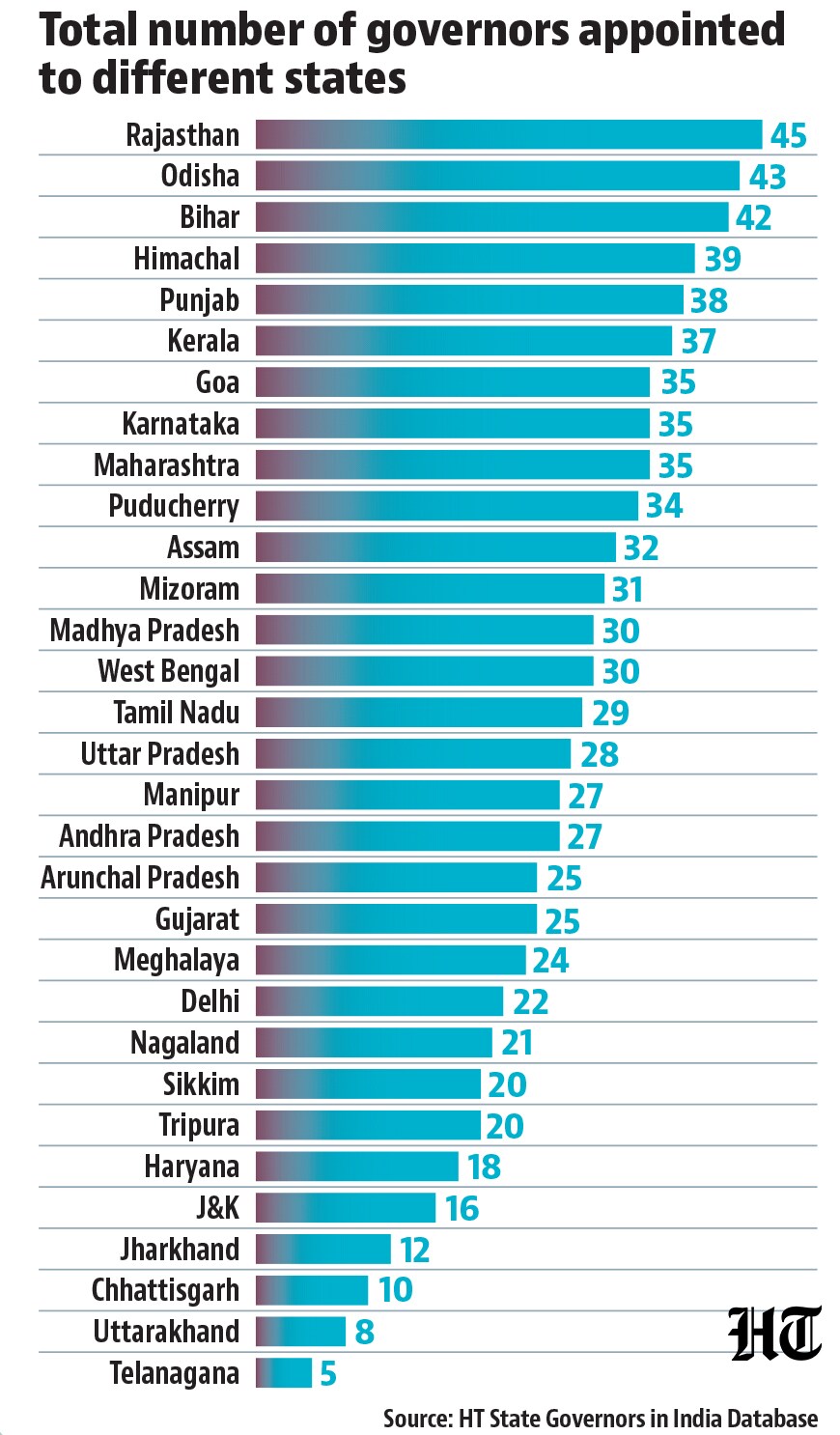
- Rajasthan has seen the highest number of gubernatorial appointments in IndiaSince governors do not have a fixed term, it is interesting to track how many governors have been there in each state in India. Rajasthan has had a total of 45 governors appointed, making it the state with the most appointments. It is followed by Odisha with 43 governors and Bihar with 42. Among the major states, Uttar Pradesh, Andhra Pradesh, and Gujarat have had 28, 27 and 25 governors, while Haryana has had 18 governors so far. It is important to note that the timing of first appointments varies by state; Gujarat was established as an independent state in 1960, and Haryana followed in 1966. If one were to adjust the number of governors a state has had for the time when the office came into being, Arunachal Pradesh becomes the state with the maximum number of governors per day the office has been in existence.