
 E-Paper



Breaking down the UPI revolution in India | Number Theory
.
Updated on: Aug 14, 2025, 08:05:05 IST

 Prefer HTon Google
Share via


Copy link

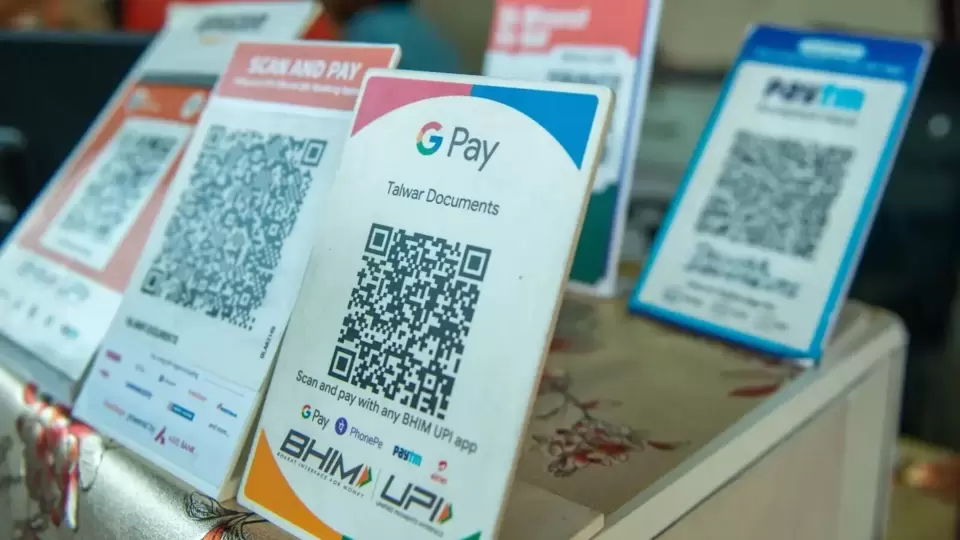
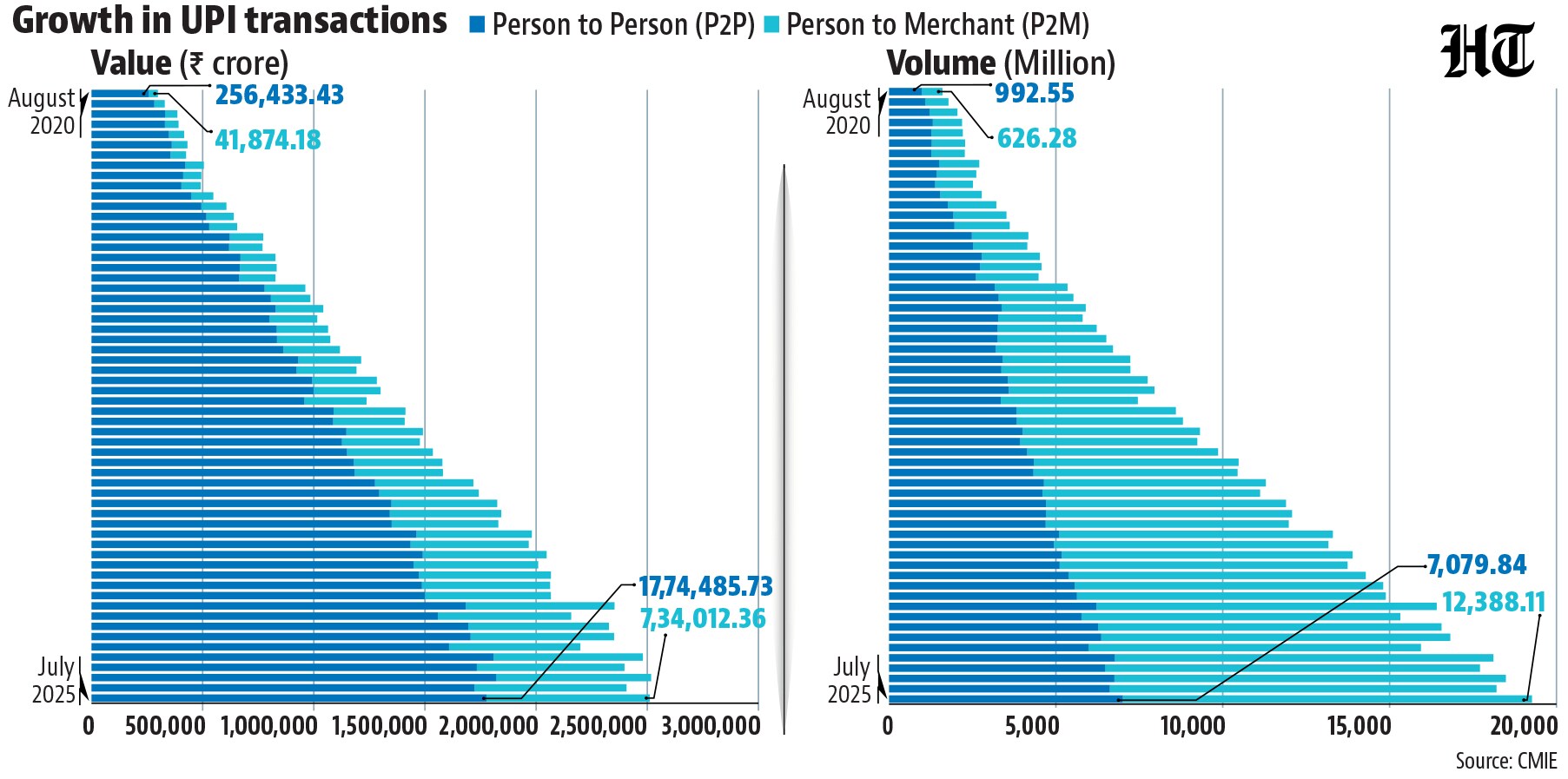
The value of Unified Payments Interface (UPI) transactions in India was ₹25 lakh crore in July 2025. Given the fact that UPI came into being less than a decade ago — it was launched in July 2016 — and had transactions of just ₹38 lakh in its first month, this is a huge revolution in India’s payments space. What do Indians UPI on? Who do they UPI to? (Yes, it’s now a verb that can be used in several contexts, that’s how popular it is) . How popular is UPI compared to other retail payment methods? Here are three charts which answer these questions.
Breaking down the UPI revolution in India
 P2P dominates UPI transactions in value but it’s P2M by volumeWhat really differentiates UPI from other retail payment methods is that it can also be used to make payments to persons and not just traders who have a point-of-sale machine for things such as a credit or debit card. This has been a huge tailwind for growth of UPI transactions. In value terms, 70% of UPI payments were of the Person to Person (P2P) nature, with an average ticket size of more than ₹2,500, even though it is Person to Merchant (P2M) payments which dominate in volume terms. This suggests that UPI has pretty much substituted traditional ways of making interpersonal payments, such as cheques, and more importantly, cash. The volume of transactions using paper-based instruments has declined from 87 million at the end of November 2019 to 47 million by June 2025.
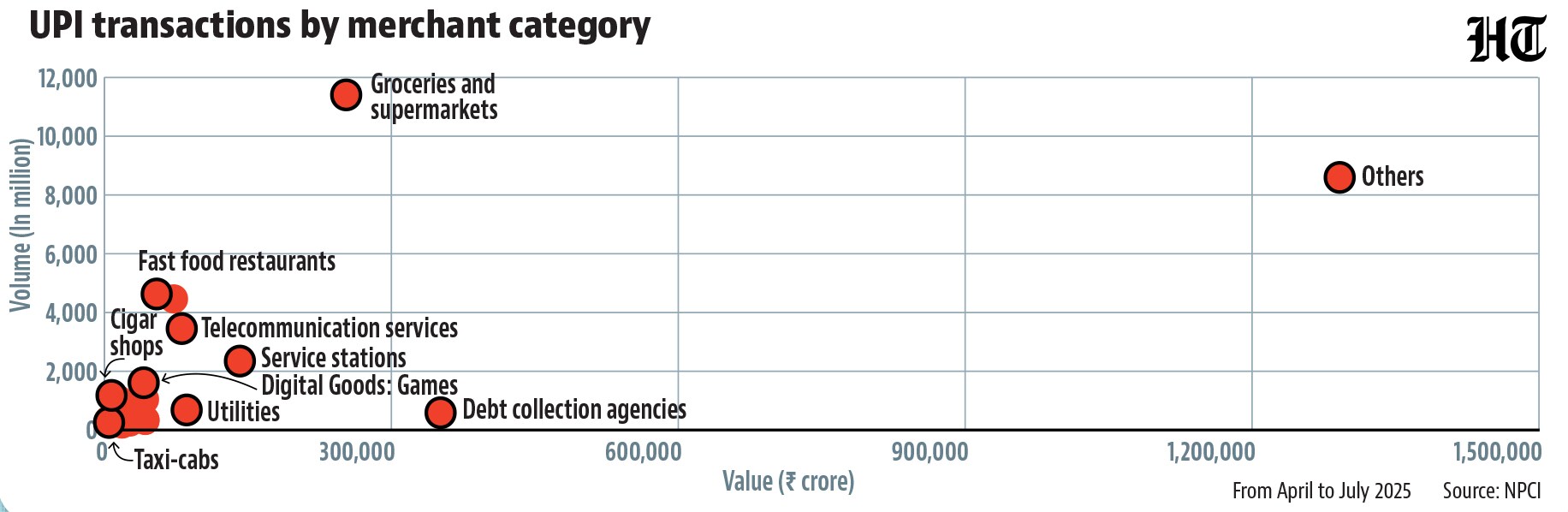
- Even in the P2M space, there are divergences between value and volume-based sharesUPI’s integration into daily commerce is evident from the fact that by sheer volume, groceries and supermarkets lead by a wide margin in payments made to merchants, clocking over 11 billion payments in four months from April to July, and an average ticket size of just over ₹220 per transaction. Data prior to April is not publicly available on the NPCI website. Fast food outlets and restaurants follow, with millions of small payments each month, indicating that snacking, or ordering in — with an average ticket size of around ₹118 and ₹162 respectively—has become another common avenue for digital payments. By value, however, the rankings see a change, while groceries still feature prominently, categories such as debt collection agencies, fuel stations, and telecom services rise to the top. Debt collections stand out as a major outlier—despite handling less than 600 million transactions, they generated ₹3.5 lakh crore in value, with an average payment size of nearly ₹6,000. This highlights how UPI is increasingly being used for settling large size tickets such as loan repayments and overdue bills in certain sectors, contrasting sharply with the micro-payment nature of everyday retail. Once again, this could be a reflection of the growing popularity of UPI as a mode for standing instruction on many payments or the petty recovery agent collecting payments on his phone rather than in cash.
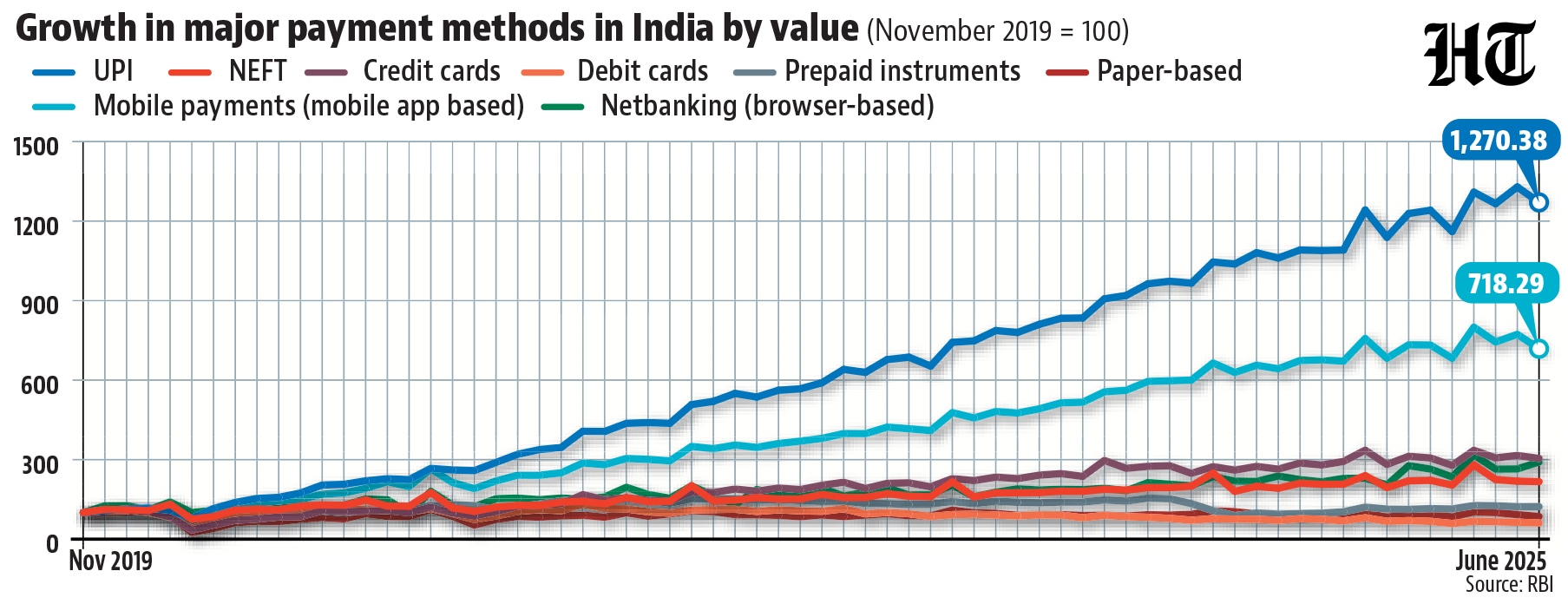
- Has UPI grown at the cost of other payment methods?Since November 2019, RBI’s payment system data has not been directly comparable with earlier figures due to revised definitions. Still, given UPI’s rapid rise during the Covid-19 pandemic, it is possible to examine whether its growth has displaced other payment methods. Between November 2019 and June 2025, UPI volumes surged from under 8.6 million to over 20 million transactions a month — a more than 23-fold increase — while transaction values rose around 14-fold, from ₹2.36 lakh crore to ₹24 lakh crore. In contrast, retail interbank transfer systems such as IMPS and NEFT also expanded, but at a steadier pace. Credit card usage has climbed strongly in both value and volume, aided by bank incentives. Debit card payments, however, have steadily declined, likely reflecting the shift of everyday retail spending and cash withdrawals to UPI, which offers the same direct-from-bank function with greater convenience and no per-transaction fees. And the decline in paper-based instruments is par for the course in an economy where digital penetration has surged, and settlement times have shortened. In short, UPI’s rapid growth has mainly come through bringing in more people into the digital payment ecosystem. While it has absorbed interpersonal and small-merchant payments that once relied on cash or cheques, higher-value transfer systems such as NEFT continue to grow in their own respective domains. While the rise and rise of UPI is a remarkable achievement of India’s payment ecosystem and overall economy, it ought not to distract us from other valid macroeconomic concerns.


Unlock a world of Benefits with HT! From insightful newsletters to real-time news alerts and a personalized news feed – it's all here, just a click away! -Login Now!


