E-Paper



How good are major states in raising taxes? | Number Theory
HT has analysed the revenue mobilisation performance of India’s major states using a recently released report by the CAG.

 Prefer HTon Google


Two states-- Kerala and Tamil Nadu -- that elected new governments in the latest election cycle have presented White Papers on their fiscal health, or lack thereof. State finances have increasingly emerged as a critical nerve of India’s overall fiscal health. States have lost some fiscal autonomy after the roll-out of the Goods and Services Tax (GST) and they are also rolling out more and more populist schemes to win elections. This has made states’ ability to mobilise revenue more important than ever. HT analysed the revenue mobilisation performance of India’s major states using a recently released report by the Comptroller and Auditor General (CAG), which provides fiscal data from 2015-16 to 2024-25. Here are three key takeaways from the analysis.
 Two in three states have seen their tax-GSDP ratio fall between 2015-16 and 2024-25This is the most interesting and damning finding from the CAG report. Twelve out of 18 large states saw their State Own Tax Revenue (SOTR) to Gross State Domestic Product (GSDP) ratio decline between 2015-16 and 2024-25. Bihar recorded the steepest fall, followed by Tamil Nadu. Bihar’s deterioration is largely self-inflicted because it imposed prohibition in 2016, which wiped out excise revenues. This means that the recent Tamil Nadu White Paper has a point in criticising its predecessor for allowing the SOTR-GSDP ratio to fall under its watch.
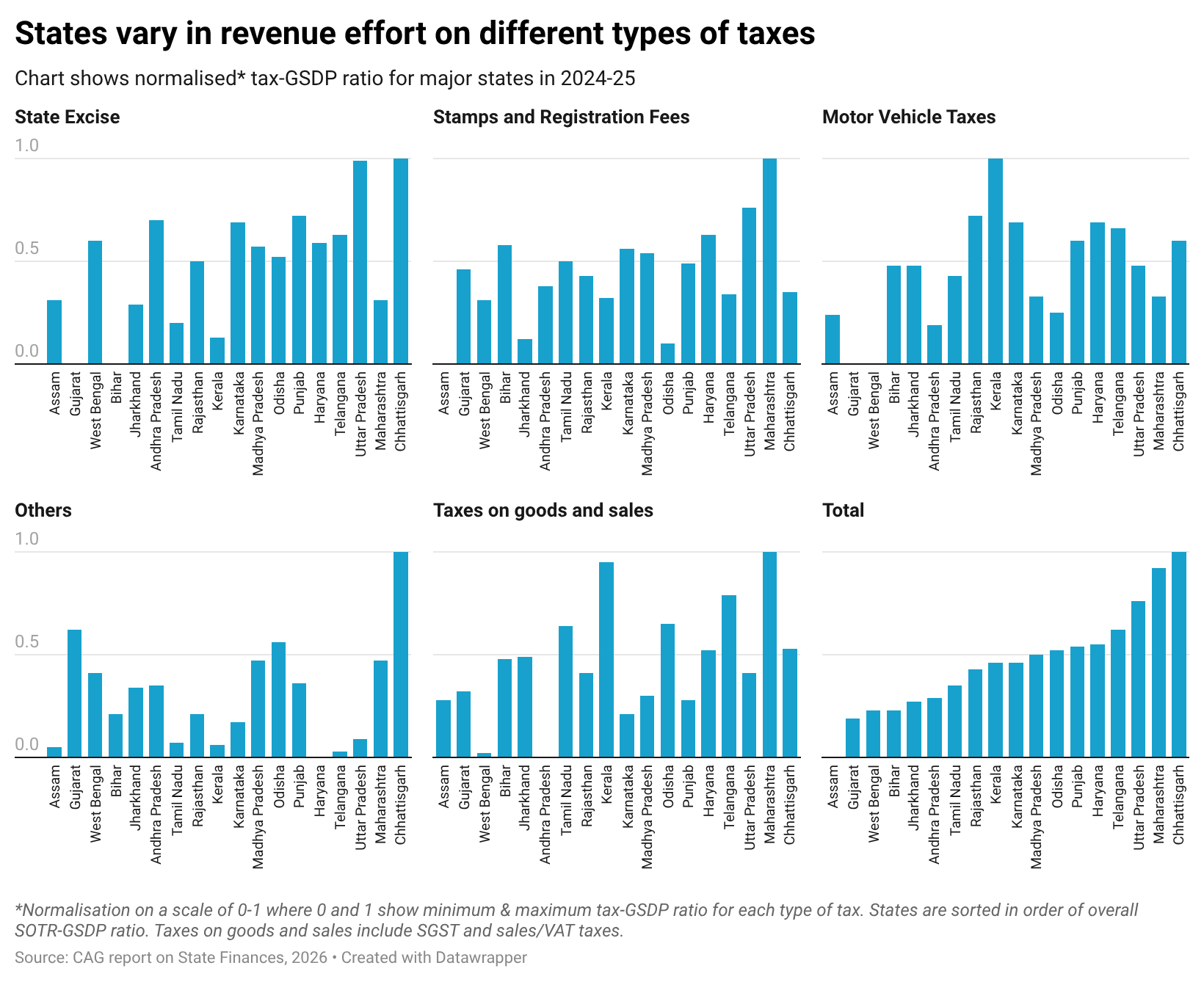
- Revenue raising capacity varies across taxes for statesThe tax powers available to states differ significantly from those of the Union government, which taxes income, corporate profits, imports and collects GST before sharing proceeds. While GST and VAT on petroleum products account for a large share of state revenues, states also raise money stamp duty, motor vehicle taxes and excise duties on alcohol. Outside GST, states retain greater policy autonomy. This makes it interesting to look at ratio of GSDP with individual taxes. Once again, the results are interesting. For example, Chhattisgarh and Uttar Pradesh are among the strongest performers in excise revenue mobilisation. Kerala, counter-intuitively, records the lowest excise-to-GSDP ratio excluding prohibition states and is followed closely by Tamil Nadu. Maharashtra, Kerala, and Telangana report an exceptional taxes on goods and sales to GSDP ratio while West Bengal and Andhra Pradesh performs poorly on this front—taxes on goods and sales here include state GST and sales/VAT taxes. One way to measure this variation is the coefficient of variation (CV), which is calculated as the standard deviation divided by the mean and shows how much each tax head’s tax-to-GSDP ratio varies across states. By this measure, taxes on goods and sales is the most uniform tax head, with a CV of 0.12, while the residual ‘others’ category is most uneven, with a CV of 0.81. But among comparable named tax heads, stamp duty is the most uneven with a CV of 0.46 if excise, which is skewed by states with prohibition, is set aside.
- Can GST be an alibi for poor tax effort?GST has rightly constrained states’ autonomy to raise taxes. But like the analysis so far shows, it is not the only way in which states raise taxes. State GST accounts for just 43.4% for states’ own tax revenue as a whole as of 2024-25. HT has used the CAG’s audited accounts report to compare the change in SOTR-GSDP ratio between 2015-16 and 2024-25 to disaggregate the role of taxes on goods and sales and every other tax head. The exercise generates four kinds of states. The best performers have seen an increase in SOTR-GSDP ratio under both types of taxes while the worst have seen both heads fall. In the middle are states which have seen one fall and another increase. Just one state, Chhattisgarh, qualifies for the best category quadrant, while four out of 18 are in the worst category quadrant. This includes Tamil Nadu, the second worst performer in overall SOTR-GSDP ratio. Bihar, the worst overall performer, has actually done well on the taxes on sales and goods side and its larger predicament is a reflection of prohibition related excise losses.
- InferenceThe findings make a strong case for a nuanced look at performance of individual taxes and related policies such as in excise in addition to claims about the larger environment generating headwinds or tailwinds for revenue of states.