E-Paper



How Warren Buffett transformed a textile firm into a $1 trillion investment powerhouse | Number Theory
.

 Prefer HTon Google


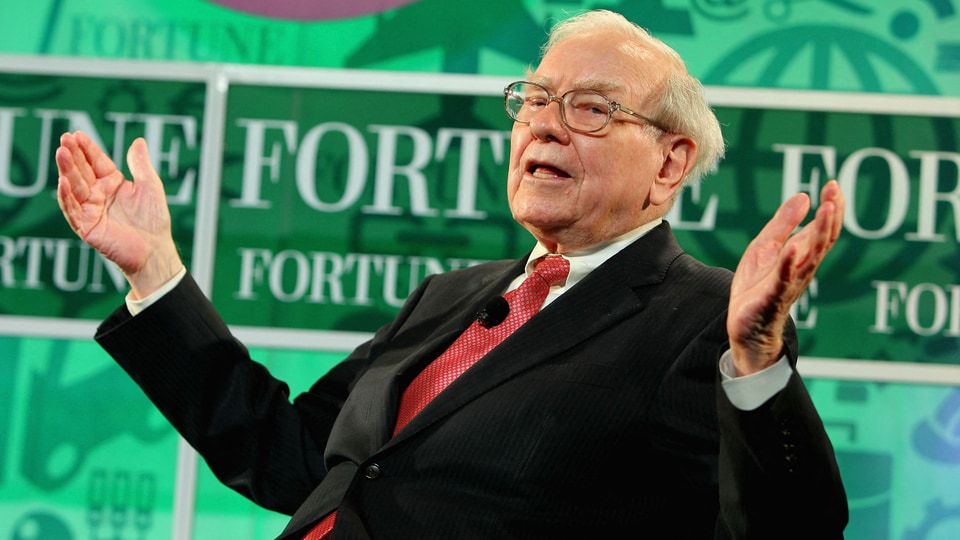
At Berkshire Hathaway’s annual meeting last month, Warren Buffett confirmed he will step down as chief executive at year-end and hand the reins to vice chairman Greg Abel. "I think the time has arrived where Greg should become the chief executive officer of the company at year-end. And I want to spring that on the directors, effectively, and give that as my recommendation," he said. A month later, markets have largely absorbed the announcement. What remains compelling is how a once-struggling textile company evolved into a investment powerhouse valued at more than $1 trillion, and how Buffett’s returns have stacked up against broader market benchmarks. Equally intriguing is what makes his investment approach uniquely successful. The charts below explore what has made Buffett the ‘Oracle of Omaha’.
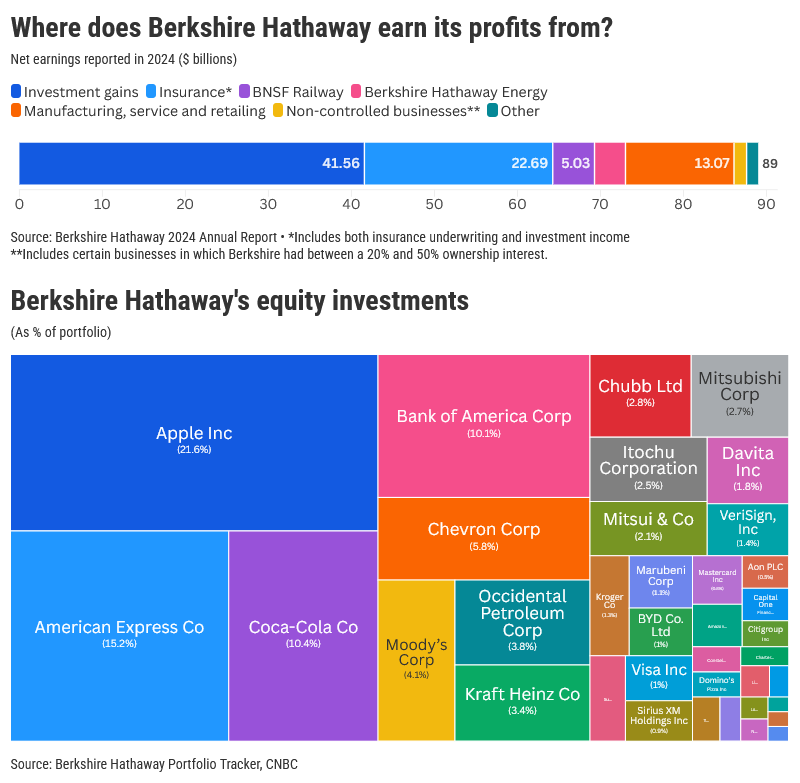
 From where does Berkshire Hathaway make its profits?Having launched his first investment partnership in 1956, Buffett took control of Berkshire Hathaway, a struggling textile business, in 1965 and transformed it into the vehicle for his expanding portfolio. Berkshire made around $89 billion in net income in 2024. And not surprisingly, the biggest chunk of it—$41.6 billion or 46.7%—came from its investment gains. The rest of its earnings come from its businesses in insurance, railways, energy, and manufacturing, among others. Its insurance businesses, including earnings from underwriting operations and investing the insurance float, raked in around $22.7 billion in profits in 2024. But Buffett and his firm has made most of their money over the years by investing in the stocks of 'wonderful companies at a fair price'. For instance, Buffett started investing in Apple, which now accounts for 21.6% of Berkshire's investment portfolio in early 2016. Its share price remains around 700% higher today. "When we own portions of outstanding businesses with outstanding managements, our favorite holding period is forever," said Buffett in his 1988 letter to shareholders, after investing for the first time in Coca-Cola, another company in which Berkshire has a sizeable stake.
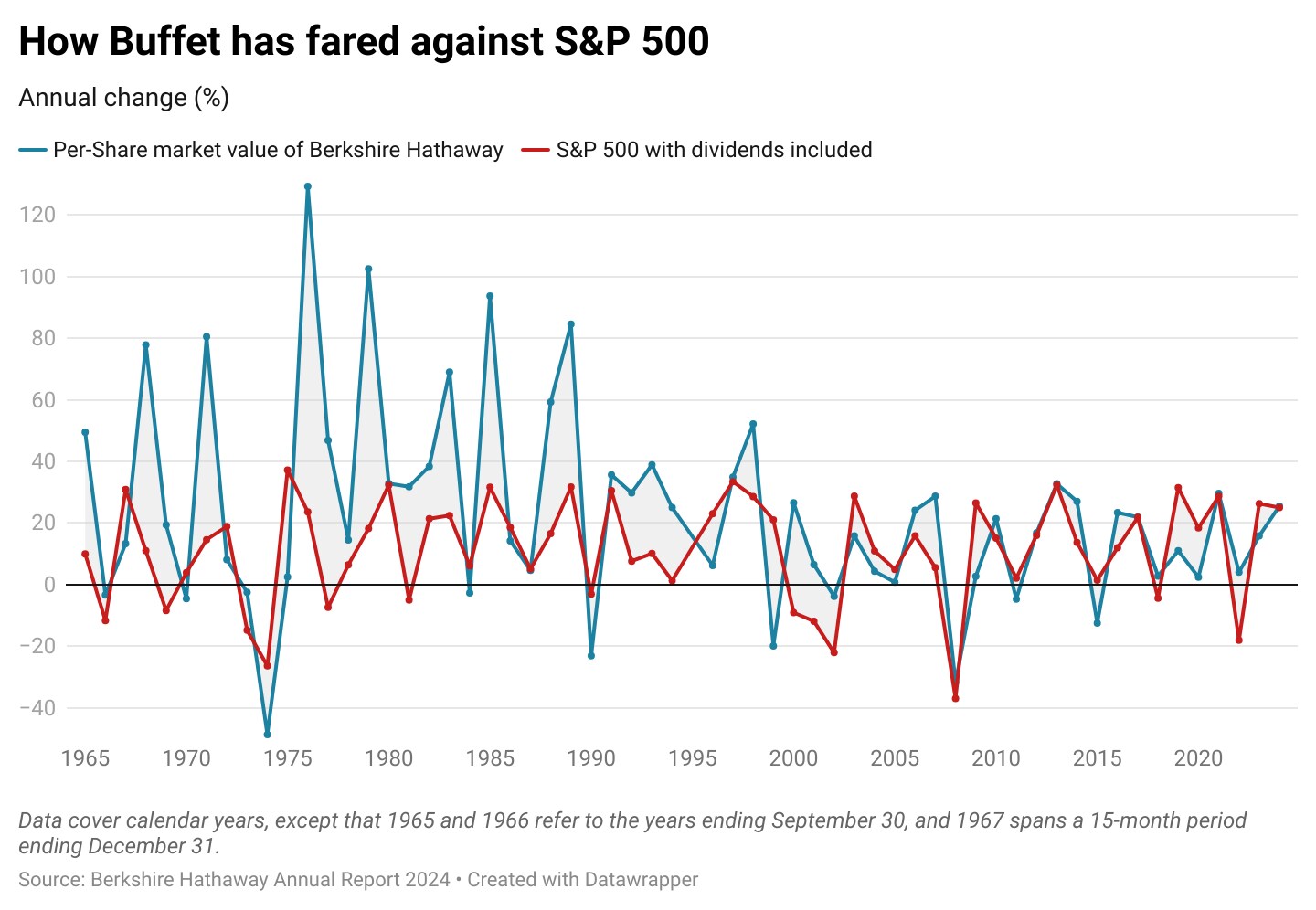
- How has Buffett fared in comparison to wider markets?Buffett measures his returns against the S&P 500 Total Return Index (TRI), which includes dividends. After taking control of Berkshire Hathaway at 35 in 1965, its per-share market value rose 5,502,284% by December 2024, versus a 39,054% gain for the TRI—compounded annual returns of 19.9% against 10.4%. By the end of 2024, a $10 investment in Berkshire Hathaway made in 1965 (although it was publicly listed in 1980) would have grown to roughly $550,238, whereas the same $10 placed in the S&P 500 (with dividends reinvested) would have amounted to about $3,915. His largest outperformance came in the late 1960s and 1970s. In more recent years, while Berkshire still delivers substantial returns on a much larger capital base, its percentage gains in comparison to S&P 500 has narrowed. However, this is par for the course in the world of investing, as studies show that most fund managers and funds perform their best in their early years. But what sets Buffet apart is his reputation. "Buffett’s investors have absolute trust in him, and do not put meaningful pressure on him — by selling or otherwise rebelling — even when his performance is average or worse. His image as the wise old man of finance, and of Berkshire as the shining example of American shareholder capitalism, brings stability to the company and the stock that has a huge value," said an opinion piece published by the Financial Times after Buffett announced that he is stepping down. What remains to be seen is whether Abel, his successor, will be able to emulate this level of trust from the shareholders once Buffett steps down.
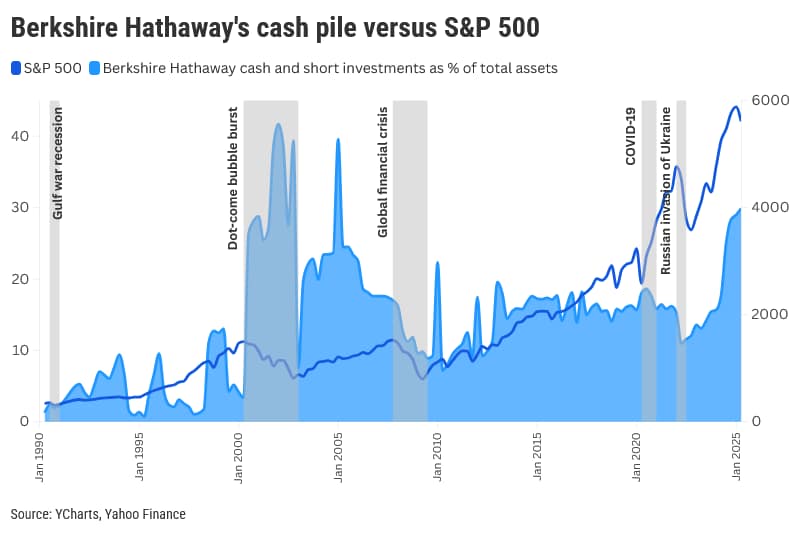
- Contrarian cash managementBuffett distinguishes himself by bucking the herd—building cash reserves when valuations are stretched and deploying them when opportunities arise. By March 2025, Berkshire’s cash hoard hit a record $347.7 billion, or 29.9 percent of its assets—a cushion that swells in bull markets and shrinks in crises. During the Global Financial Crisis (mid-2007 to early 2009), for instance, Berkshire’s cash pile dropped from 17.6% of its assets at the start of 2007 to just 9.6% by the end of 2008, as Buffett used it to snap up “wonderful companies at fair prices” while panic gripped the markets. Similar, though less dramatic, drawdowns occurred during the COVID-19 crash and in the wake of Russia’s 2022 invasion of Ukraine. Conversely, as markets rallied from mid-2024 into early 2025, Berkshire’s cash pile surged again—evidence that Buffett remains patient even amid frothy conditions. It’s a quality he says hasn’t faded with age. "I don’t have any trouble making decisions about something that I was making decisions on 20 years ago or 40 years ago or 60 years," he said in an interview last month with the Wall Street Journal. "I will be useful here if there’s a panic in the market because I don't get fearful when things go down in price or everybody else gets scared. And that really isn’t a function of age," he added, and remarked that Abel will have ideas about where the Berkshire's mounting cash reserves should be invested.