
 E-Paper



India's equity market story could have been worse | Number Theory
The Iran war has deepened the pressure on Indian markets, but foreign selling had begun much earlier.
Published on: May 19, 2026, 08:03:16 IST

 Prefer HTon Google
Share via


Copy link

India’s benchmark equity market index, BSE Sensex is down nearly 12% on a year-to-date basis. The bearish sentiment is not just a reflection of the ongoing geo-economic turbulence because of the ongoing war in West Asia. And an HT analysis shows that things would have much worse if not for the domestic savings being channelised into the markets as Foreign Institutional Investors (FIIs) continue to sell.

India's equity market story could have been worse
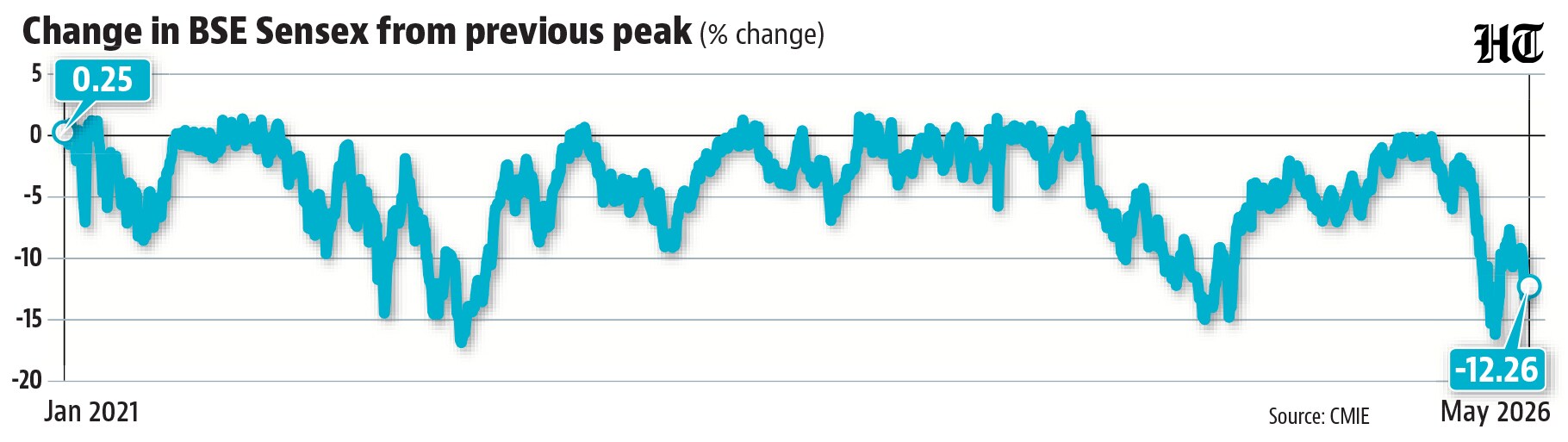
 How bad is the current correction in markets?A 12% year-to-date fall looks pretty bad. But this is not the first bear run on the Senex. How bad is this compared to past troughs in the market.? HT has compared BSE Sensex daily values in relation to its previous peaks to put this in perspective. The data shows that while this is not the worst downward rally in the markets, it is not insignificant either. On May 18, the Sensex was down 12.26% compared to the previous peak of 85,836 on September 26, 2024. This is ranked the 4,580th lowest among the 10,232 (bottom half) days on which the index was down compared to a previous peak since 1979; but 840th lowest of 3,768 (bottom 25%) such days since the global financial crisis (post-2009); and 68th lowest of 1,207 (bottom 6%) such days since the pandemic (after 2020).
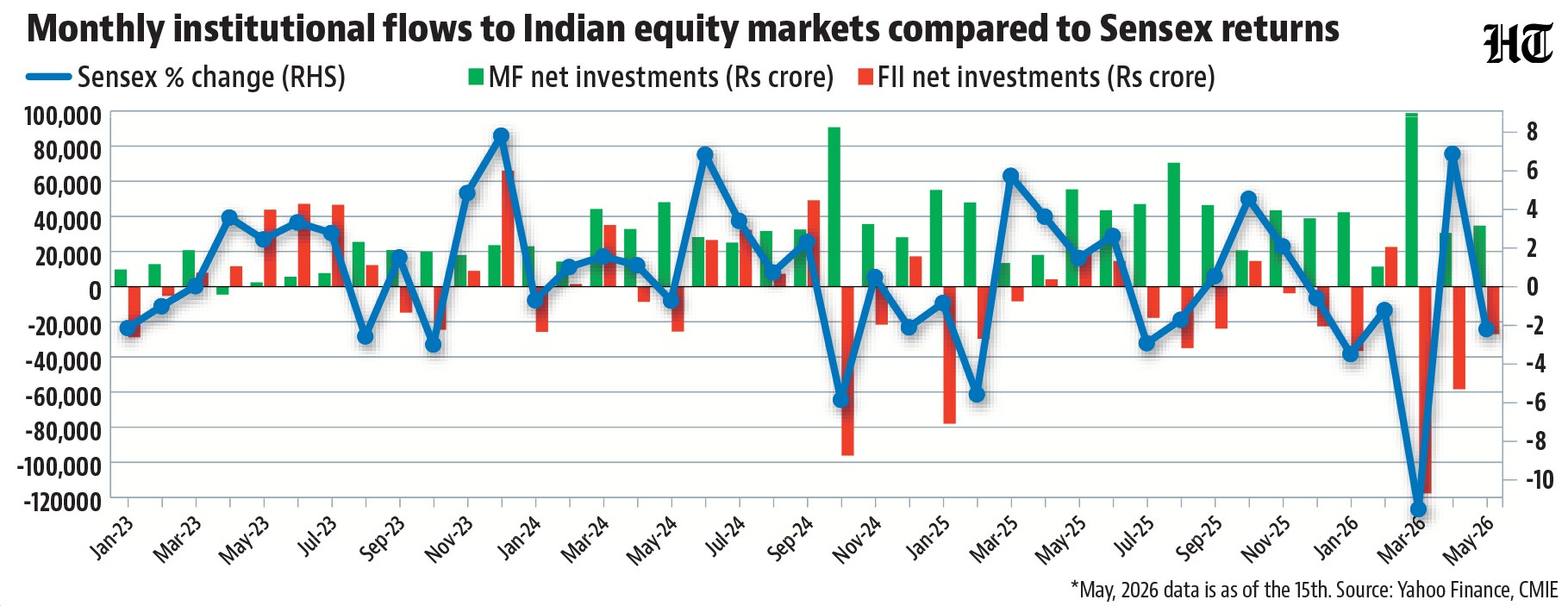
- FII selling has been becoming deeperThe Iran war has deepened the pressure on Indian markets, but foreign selling had begun much earlier. Monthly flow data shows that FIIs have been net sellers in 13 out of the past 20 months. This number was just 7 for the same period preceding that. What has changed in the FII story is that the selling is becoming deeper and wider. In 2025 FIIs sold a net ₹1.66 lakh crore in equities during the year, but debt still saw net inflows of about ₹94,700 crore. Since the US-Israel war with Iran began at the end of February, FIIs have sold ₹2.03 lakh crore in equities and also pulled out ₹12,512 crore from debt as of Friday, according to depository data. The conflict therefore turned an equity-led withdrawal into a broader foreign capital retreat.
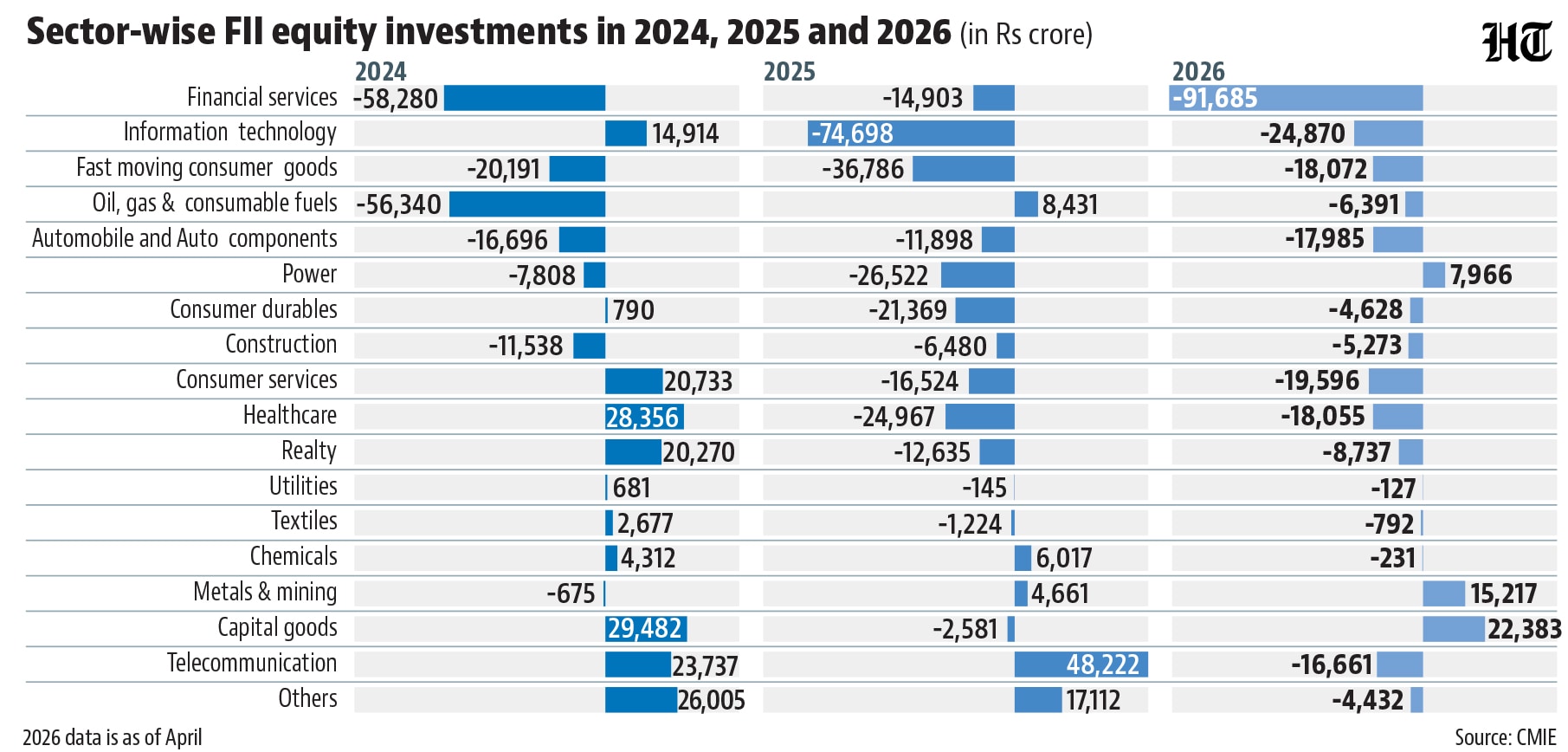
- Selling has moved from rotation to risk aversionThe sectoral picture shows that the foreign exit has not been uniform. In 2024, net FII equity investment was almost flat at ₹426 crore, but this masked large churn. Foreign investors sold financial services, oil and gas, FMCG and automobiles, while adding to capital goods, healthcare, telecom, realty and consumer services. By 2025, the selling became much broader, led by information technology, where FIIs pulled out ₹74,698 crore, followed by FMCG, power, healthcare and consumer durables. Data as of April shows that in 2026, the stress has shifted decisively to financial services. FIIs have sold ₹91,685 crore from the sector so far, nearly half of all FII outflows this year. But pockets of buying in capital goods, metals and power suggest this is not a blanket exit from India, but a sharp de-risking of sectors most exposed to global uncertainty.
- Domestic money has been the market’s shock absorberThe reason FII selling has not translated into a one-way market collapse is the growing weight of domestic institutions. In March , domestic institutional investors (DIIs) held 19.24% of the value of NSE-listed companies, compared with 16.13% for FIIs. This is a major reversal from the earlier structure of the market. In December 2020, FIIs held 21.16% while DIIs held just 13.58%. Since then, foreign ownership has fallen by about five percentage points, while domestic institutional ownership has risen by nearly six percentage points. Retail ownership, in comparison, has hovered around 7%. The rest of the holdings are largely held by promoters, including the Government of India.
- And they have been buying against the trendDomestic investors have not just become bigger players in the market. Monthly flow data shows that mutual funds, which are the core of DII activity, have repeatedly put money into Indian equities during months when FIIs were selling heavily. This buying has helped cushion the Sensex from the full impact of foreign exits. It has not removed the risk altogether, though. March showed that when foreign selling becomes very large, domestic buying may not be enough to prevent a sharp fall. The bigger question now is whether domestic institutions, powered by retail SIP flows, can keep cushioning Indian markets if foreign selling persists.


Unlock a world of Benefits with HT! From insightful newsletters to real-time news alerts and a personalized news feed – it's all here, just a click away! -Login Now!


