
 E-Paper



J&K embodies the evolution in Ranji Trophy, and more | Number Theory
If Jammu & Kashmir cricket team win the Ranji Trophy, it will be a historic feel-good tale—an underdog rising despite strife and limited experience
Updated on: Feb 28, 2026, 07:26:38 IST

 Prefer HTon Google
Share via


Copy link

If Jammu & Kashmir (J&K) win the 2025-26 Ranji Trophy -- the team is well placed to do so -- it will go down as one of the remarkable and feel-good stories in Indian men’s domestic cricket. A team pieced together against the backdrop of strife in the union territory that had never progressed past the quarter-finals in the tournament’s 91-year history and in which half the players have played fewer than 21 first-class matches, against 33 for its fancied opponent, Karnataka.
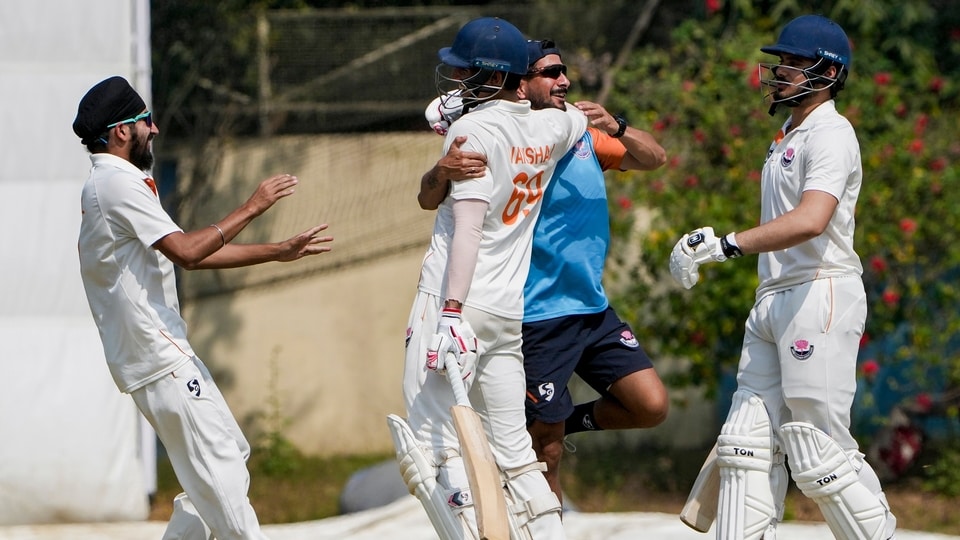
This century has seen several first-time winners of the prized trophy in men’s domestic cricket and while J&K’s showing is a result of similar factors, it represents a whole lot more.
- The field spreads outWhile Indian men’s cricket had been making incremental gains in international prowess and popularity, a breakout moment was the 1987 ODI World Cup that India co-hosted with Pakistan. It was the first big injection of funds into cricket in the sub-continent, and matches were played in 14 venues in India and 7 in Pakistan, and also telecast live. That tournament had several ripple effects. India started playing more international cricket, which would reduce availability of international players for domestic tournaments. A certain Sachin Tendulkar would arrive on the scene a year later. The geography of cricket started spreading beyond Mumbai, Delhi and Karnataka. The impact of that spread shows up in the list of Ranji Trophy winners. In the four-decade period between India’s independence in 1947 and 1987, the Ranji Trophy had only three first-time winners: Madras in 1954-55, Karnataka in 1973-74 and Delhi in 1978-79. The roughly four-decade period since 1987 has seen 10 first-time winners, and J&K look set to become the 11th.Click Here
- The IPL momentMost of these first-time winners of the last four decades are large states (for example, Uttar Pradesh and Rajasthan). Then, there are smaller regions such as Vidarbha and Saurashtra that have come through by investing in cricket and making the Ranji Trophy a priority. After the 1987 World Cup, the second tipping point came in 2008 with the launch of the city franchise-based Indian Premier League (IPL), which caused demand for quality Indian players to explode. Alongside, there were other changes to the Ranji Trophy format such as dismantling the zonal system and allowing teams to recruit up to three players from other states. Since the 2008-09 Ranji Season, 27 different teams have made the knockouts (quarter-finals and above). Jammu & Kashmir, for example, is no stranger at this level, having lost in the quarter-finals thrice before . At the very top, traditional powerhouses Karnataka and Mumbai retain their dominance, and have accounted for 7 of the 14 titles since then. But below them, a second set of teams has emerged, putting themselves in contention on a consistent basis.Click Here
- Strike bowlerThere are several remarkable stories embedded in these victory runs. Of coaches shaping a team authoritatively and indelibly—for example, Chandrakant Pandit leading Mumbai, Madhya Pradesh and Vidarbha to titles within the span of a decade. Of turning the form book—for example, Uttar Pradesh in 2005-06 under Mohammed Kaif, who joined the team mid-season and took over its captaincy, vaulting it from near the bottom of the table to winning the title. In the 2025-26 season, among the many performances of note for Jammu & Kashmir, the pace bowling of 29-year-old Auqib Nabi stands out. In 10 matches, he’s taken 60 wickets—the most this year—at an incredible average of 12.6 runs per wicket, including seven 5-wicket hauls. In the knockout matches, his showing reads 12 wickets against Madhya Pradesh in the quarter-finals and 9 wickets against Bengal in the semi-finals, both player-of-the-match efforts. Even in the finals, his 5 wickets in the first innings broke the Karnataka batting.Click Here
- Batting depthThis year, J&K finished second in its group, after Mumbai, to secure a quarter-finals spot. Some of the more-fancied teams it finished above include Hyderabad, Rajasthan and Delhi. In a group where the results were liberally peppered with draws, its points count in the group stages was the lowest of the eight quarter-finalists. But in the quarter-finals and semi-finals, Nabi’s potent bowling secured J&K victories. The other thing that worked for J&K was a strong batting core. Among the top 150 batsmen in this year’s tournament by runs scored, J&K had seven batsmen—the most, along with Bengal. Between them, they amassed 3,262 runs, which is the third-highest among sides, after Karnataka and Bengal. Abdul Samad was the 10th highest run-getter (716 runs) and captain Praveen Dogra number 16 (621 runs). No wonder J&K has one hand on the trophy.Click Here
(www.howindialives.com is a database and search engine for public data)

Unlock a world of Benefits with HT! From insightful newsletters to real-time news alerts and a personalized news feed – it's all here, just a click away! -Login Now!


